
Preparing a Manuscript Before Using the CLS Submission Checklist
Many authors view a submission checklist as the final hurdle before manuscript submission. In reality, the checklist is designed to confirm that a manuscript is already publication-ready. A well-prepared manuscript not only satisfies technical requirements but also improves readability, strengthens reviewer confidence, and increases the likelihood of a smooth peer-review process.
At Crosslink Studies (CLS), manuscripts submitted to the Ubiquitous Technology Journal (UTJ) undergo an editorial screening before peer review. During this stage, editors assess whether the manuscript aligns with the journal’s scope, formatting requirements, academic standards, and overall quality expectations. Articles that fail to meet these foundational requirements may be returned for revision before entering the review process. Therefore, authors should focus on comprehensive manuscript preparation before consulting the CLS Submission Checklist.
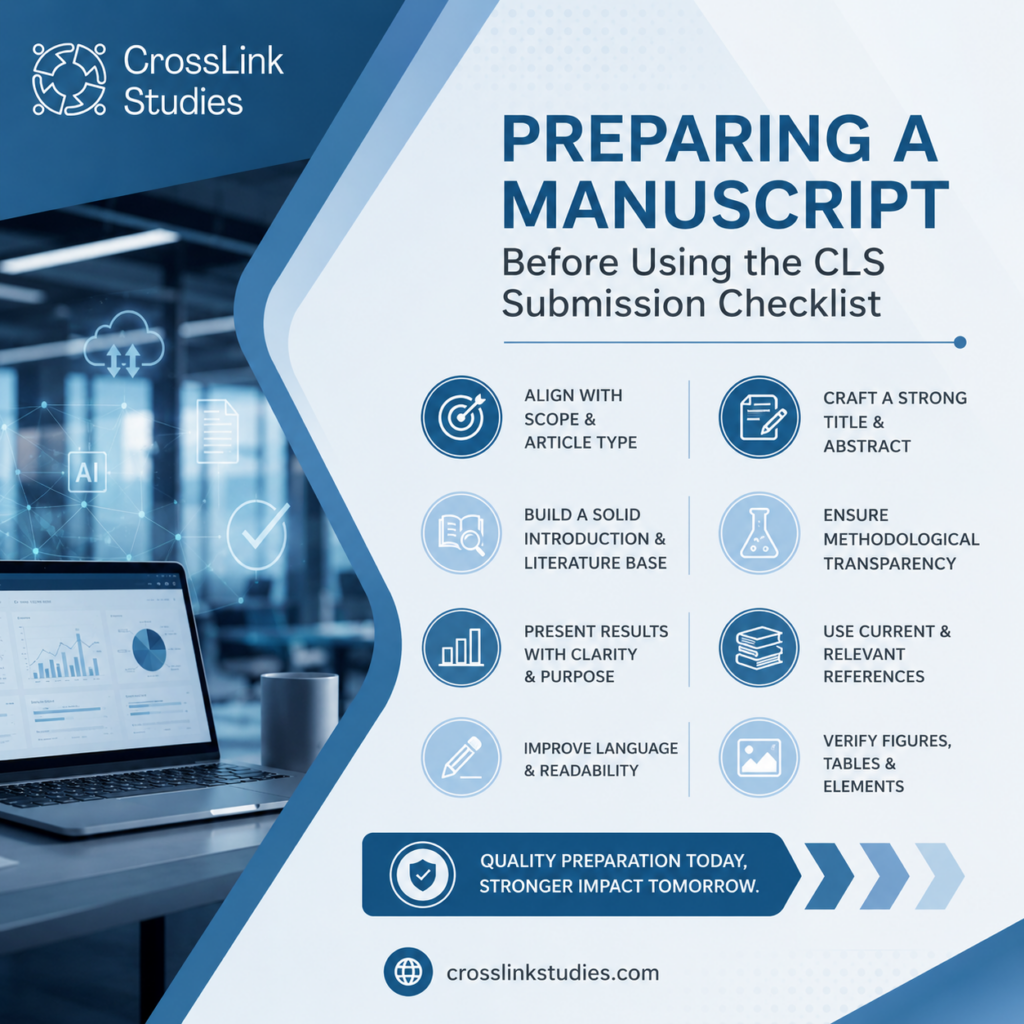
Begin with Journal Scope and Article Type
The first step in manuscript preparation is ensuring that the research fits the journal’s aims and scope. CLS publishes research covering a broad range of computer science and engineering disciplines, including artificial intelligence, Internet of Things (IoT), ubiquitous computing, cybersecurity, cloud computing, edge computing, human-computer interaction, smart systems, distributed computing, and related emerging technologies.
Authors should clearly identify the appropriate article category before writing. Whether submitting a regular research article, review paper, survey, theoretical study, methods paper, perspective article, or applied research contribution, the manuscript structure and presentation should reflect the chosen article type. Selecting the correct category from the outset helps establish appropriate objectives, methodology, and scholarly contribution.
Develop a Strong Research Narrative
High-quality manuscripts tell a coherent research story. Reviewers are not merely evaluating technical correctness; they are assessing the significance and clarity of the contribution. Before drafting, authors should be able to answer several fundamental questions:
- What problem does the study address?
- Why is this problem important?
- What gap exists in current knowledge or practice?
- How does the proposed approach improve upon existing solutions?
- What evidence supports the conclusions?
A manuscript with a clear narrative allows readers to follow the progression from problem identification to methodology, results, discussion, and conclusion without confusion.
Craft an Effective Title and Abstract
The title and abstract are often the first and sometimes only parts of a manuscript that editors, reviewers, and readers examine before deciding whether to continue reading. For UTJ submissions, authors should aim for a concise and informative title that accurately reflects the study’s contribution without unnecessary abbreviations. The abstract should summarize the research problem, methodology, key findings, and conclusions while remaining self-contained and free of citations.
An effective abstract enables reader to understand the research context, the problem being investigated, proposed solution or methodology and primary outcomes.
Strengthen the Introduction Before Submission
One of the most common weaknesses identified during peer review is an underdeveloped introduction section. A strong introduction should establish the research context, explain the problem being addressed, identify limitations in previous studies, and clearly define the manuscript’s contribution. Rather than simply listing prior work, authors should synthesize existing literature and demonstrate how their research advances the field.
For technology-focused studies, particularly those involving AI, IoT, cybersecurity, smart environments, and pervasive computing, authors should ensure that references reflect current developments and emerging trends. Recent and relevant literature strengthens the credibility of the manuscript and demonstrates awareness of ongoing scholarly discussions.
Ensure Methodological Transparency
Reproducibility remains a cornerstone of scientific research. Readers and reviewers should be able to understand precisely how the study was conducted. Authors should provide sufficient detail regarding research design, data collection procedures, experimental setup and algorithms and models
Present Results with Clarity and Purpose
Results should be presented logically and supported by appropriate figures, tables, and quantitative evidence. Rather than overwhelming readers with raw data, authors should focus on communicating the most meaningful findings. Each figure and table should contribute directly to the research objectives and be discussed within the text. When presenting results, consider the following:
- Highlight key observations.
- Explain trends and patterns.
- Compare findings with previous studies.
- Discuss practical implications.
- Address unexpected outcomes where relevant.
The discussion section should move beyond reporting numbers and explain what those numbers mean in the broader context of the field.
Review References Carefully
Reference quality often influences reviewers’ perceptions of manuscript quality. Authors preparing submissions for UTJ should prioritize peer-reviewed journal articles and recent literature relevant to their topic. References should be integrated naturally into the discussion and cited consistently throughout the manuscript. Proper reference management tools can help maintain accuracy and ensure compliance with the required citation style.
A carefully curated reference list demonstrates scholarly engagement and positions the manuscript within the existing body of knowledge.
Improve Language and Readability
Even technically sound research can face challenges during review if the writing is unclear. Before submission, authors should evaluate grammar and sentence structure, logical flow between sections, and consistency in terminology. The objective is not to use complex language but to communicate complex ideas clearly. Well-written manuscripts allow reviewers to focus on the research contribution rather than language issues.
Verify Figures, Tables, and Supporting Elements
Visual elements are critical components of scientific communication. Authors should ensure that every figure and table:
- Is clearly numbered
- Includes an informative caption
- Is referenced within the manuscript
- Supports the research narrative
- Maintains high visual quality
Figures should enhance understanding rather than merely decorate the manuscript. Well-designed visuals often communicate findings more effectively than lengthy textual explanations.
Conduct a Final Quality Review Before the CLS Submission Checklist
The CLS Submission Checklist should be viewed as a verification tool rather than a manuscript development tool. Before consulting the checklist, authors should confirm that their manuscript:
- Aligns with UTJ’s scope and article categories.
- Follows the journal template and formatting requirements.
- Presents a clear and original research contribution.
- Includes a strong introduction and comprehensive literature review.
- Provides reproducible methodology.
- Presents results logically and accurately.
- Uses current and relevant references.
- Meets academic writing standards.
- Contains properly formatted figures, tables, and citations.
Completing these steps beforehand allows the submission checklist to function as intended confirming readiness rather than identifying avoidable deficiencies. For researchers submitting to the Ubiquitous Technology Journal (UTJ), thorough preparation demonstrates professionalism, strengthens scientific communication, and ensures that innovative ideas receive the attention they deserve. By focusing on manuscript quality first and using the CLS Submission Checklist as a final verification step, authors can approach submission with greater confidence and a stronger foundation for success.