
Final Formatting Checks Before Submitting to UTJ
A Comprehensive Pre-Submission Guide for Authors Seeking a Smooth Editorial and Peer-Review Process
For many researchers, manuscript submission represents the culmination of months or even years of investigation, experimentation, analysis, and writing. By the time authors reach the submission stage, significant attention has typically been devoted to research design, data collection, methodological rigor, literature review, and interpretation of findings. Yet one critical phase of scholarly publishing is frequently underestimated: the final formatting review.
For authors submitting to the Ubiquitous Technology Journal (UTJ), ensuring that a manuscript is properly formatted before submission is more than an administrative task. It is an essential component of professional scholarly communication. A well-prepared submission demonstrates attention to detail, respect for editorial processes, and commitment to publication standards.
The final formatting review serves as a quality assurance stage that helps authors identify issues that may affect readability, reviewer perception, editorial assessment, and publication efficiency.
Why Final Formatting Matters
Many researchers assume formatting is merely a cosmetic requirement. In reality, formatting directly influences how editors and reviewers interact with a manuscript. When a submission contains inconsistent headings, incomplete references, poorly labeled figures, missing declarations, or structural irregularities, reviewers may question the overall quality of the work before evaluating its scientific contribution. Proper formatting helps improve manuscript professionalism, facilitate editorial screening, enhance reviewer experience and reduce technical revision requests.
Understanding the Purpose of the Pre-Submission Review
The final review should not focus solely on grammar correction. Instead, authors should evaluate the manuscript from the perspective of an editor encountering the paper for the first time.
Questions to consider include:
- Is the manuscript complete?
- Is the structure logical?
- Are all required sections present?
- Are figures and tables properly integrated?
- Are references accurate and consistent?
- Are ethical requirements fulfilled?
- Does the manuscript follow journal expectations?
A systematic review reduces the likelihood of avoidable corrections after submission.
Verify Compliance with Journal Scope
Before checking formatting details, authors should confirm that their work aligns with the journal’s aims and scope. This step is frequently overlooked. A technically excellent manuscript may still face rejection if it does not clearly fit within the journal’s disciplinary focus. For UTJ, submissions should demonstrate relevance to areas including computer science, artificial intelligence and machine Learning. Authors should ensure that the title, abstract, keywords, introduction, and conclusions clearly communicate the technological significance of the research.
Review the Overall Manuscript Structure
One of the first aspects evaluated during editorial screening is document organization. Authors should verify that all required sections appear in the correct sequence. A typical research article should include: Title, Author Information, Abstract, Keywords, Introduction, Literature Review (if applicable), Materials and Methods / Methodology, Results, Discussion, Conclusion, Funding Information, Conflicts of Interest, Acknowledgments, References. Missing sections can delay processing and create additional correspondence between authors and editors.
Conduct a Comprehensive Title Check
The title is often the first element reviewed by editors, reviewers, and future readers. An effective title should be specific, accurate, concise, informative and technically relevant. Authors should avoid excessively broad titles, unnecessary abbreviations, promotional language and unsupported claims.
Evaluate the Abstract Carefully
The abstract is one of the most frequently read sections of any manuscript. Editors often use it to determine reviewer assignments, while researchers rely on it when deciding whether to read the full article. A final abstract review should confirm that it clearly includes background, objective, methods, results and conclusion.
Verify Keywords for Discoverability
Keywords influence indexing, search visibility, and discoverability. Authors should select keywords that reflect the manuscript content, represent important technical concepts and match terminology commonly used by researchers in the field. Avoid repeating words already present in the title whenever possible. Effective keywords improve the visibility and accessibility of published research.
Examine Headings and Subheadings
Heading consistency significantly improves readability. During the final review confirm consistent formatting, verify hierarchical structure and ensure logical organization.
Review Technical Terminology Consistency
Terminological inconsistency is a common issue in technology-focused manuscripts. Authors frequently alternate between multiple labels for the same concept. For example, artificial intelligence, and intelligent systems. If these terms refer to the same concept, choose one primary term and use it consistently. Consistency improves clarity and reduces reviewer confusion.
Inspect Figures and Visual Elements
Figures play a crucial role in communicating technical information. Before submission, verify that every figure:
- Is clearly labeled.
- Has a descriptive caption.
- Is referenced within the text.
- Uses readable fonts.
- Maintains adequate resolution.
- Supports rather than duplicates the text.
Review Tables Thoroughly
Tables should present information efficiently. Authors should verify that tables include informative titles, use consistent formatting and define abbreviations.
Verify Equations and Mathematical Content
For computational and engineering research, equation accuracy is essential. Authors should review variable definitions, mathematical notation equation numbering and formatting consistency.
Conduct a Citation and Reference Audit
Reference errors remain one of the most common submission problems. Before submission verify citation accuracy, check reference completeness and confirm formatting consistency. All references should follow the required citation style consistently. Reference accuracy reflects scholarly professionalism and supports research credibility.
Review Ethical and Administrative Requirements
Many manuscripts require additional declarations. Authors should verify the inclusion of:
- Conflict of Interest Statements
- Funding Information
- Ethical Approval Statements
- Informed Consent Statements (where applicable)
- Data Availability Statements
- Author Contribution Information
Perform a Language and Readability Review
Even technically strong manuscripts benefit from a final language review. Authors should examine grammar, sentence clarity, technical precision and redundancy. The objective is not to simplify scientific content but to ensure effective communication. Clear writing improves reviewer comprehension and enhances manuscript impact.
Conduct a Reviewer Simulation Exercise
One highly effective strategy involves reading the manuscript from the perspective of a reviewer.
Ask:
- Is the research objective clear?
- Are methods understandable?
- Are results logically presented?
- Does the discussion interpret findings effectively?
- Are conclusions supported by evidence?
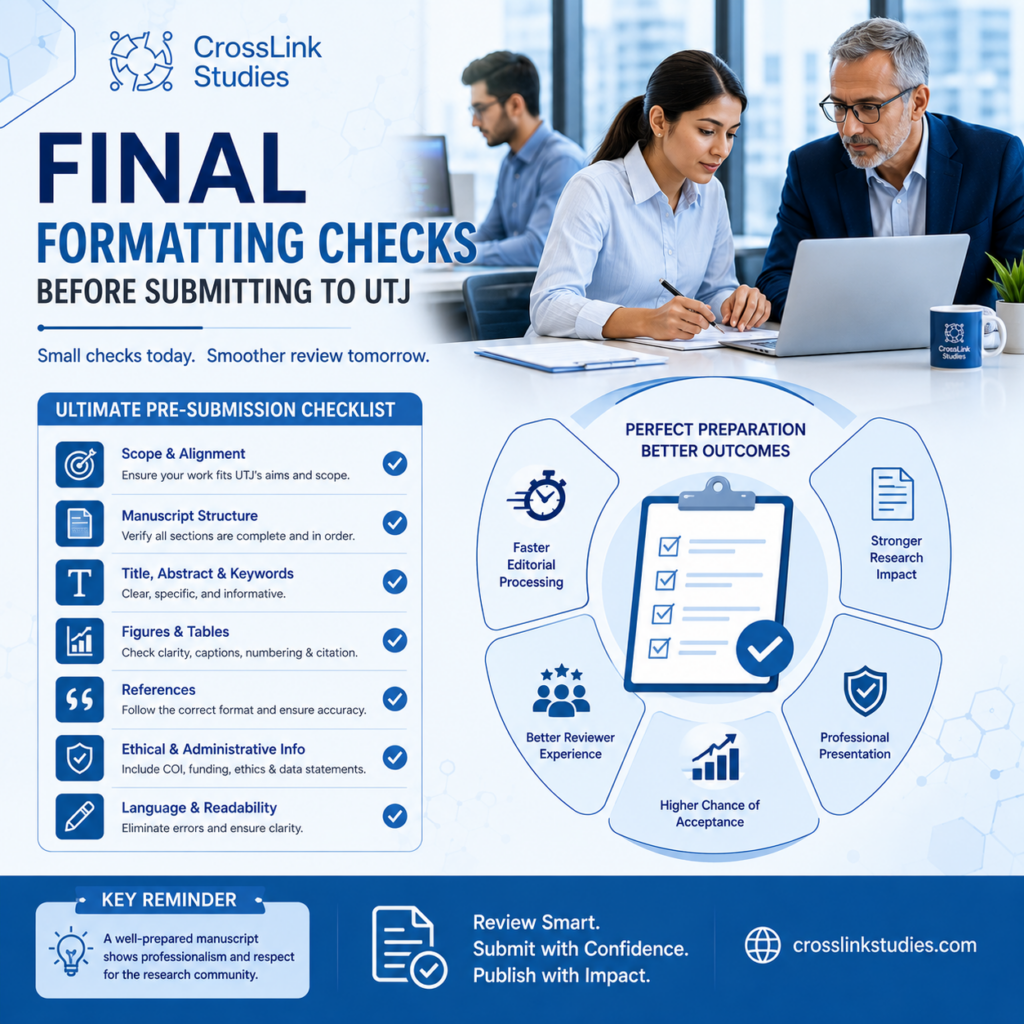
The Ultimate Pre-Submission Checklist
Before clicking the submit button, confirm:
✓ Journal scope alignment
✓ Complete manuscript structure
✓ Accurate title
✓ Comprehensive abstract
✓ Effective keywords
✓ Consistent headings
✓ Terminology consistency
✓ Proper figure formatting
✓ Complete table review
✓ Equation accuracy
✓ Citation verification
✓ Reference consistency
✓ Ethical declarations
For authors submitting to the Ubiquitous Technology Journal, conducting comprehensive formatting checks before submission can help ensure that reviewers focus on the research itself rather than avoidable technical issues. In a competitive publishing environment, attention to detail remains one of the simplest yet most effective ways to strengthen a manuscript and support a successful publication journey.