
How to Use the UTJ Template Correctly from the First Draft?
Why Starting with the Journal Template Can Save Time, Reduce Revisions, and Improve Publication Readiness?
Preparing a research manuscript involves far more than documenting experimental results or presenting computational findings. Successful academic publishing requires authors to communicate their work in a format that is clear, organized, professional, and aligned with journal expectations. While many researchers devote significant attention to methodology, analysis, and writing, one aspect of manuscript preparation is frequently underestimated: the proper use of the journal template.
A common practice among authors is to write the entire manuscript in a personal format and apply the journal template only when the study is ready for submission. Although this approach may appear convenient initially, it often creates substantial challenges during the final stages of manuscript preparation. Formatting inconsistencies, misplaced headings, incorrect reference structures, figure alignment issues, and incomplete metadata frequently emerge when authors attempt to retrofit a completed manuscript into a journal-specific format.
For authors submitting to the Ubiquitous Technology Journal (UTJ), using the journal template correctly from the first draft is one of the most effective ways to improve manuscript organization, maintain consistency, and reduce technical revisions before submission. The template is not simply a formatting document; it is a structural framework designed to guide authors through the preparation of a publication-ready manuscript.
This blog explores why early template adoption matters, how researchers can use the UTJ template effectively throughout the writing process, and the best practices that help transform a first draft into a professionally prepared submission.
The Purpose of a Journal Template
Many authors view templates as formatting tools used primarily to adjust fonts, margins, and heading styles. In reality, a journal template serves a much broader purpose. A properly designed template provides a standardized manuscript structure, consistent presentation across published articles and clear section organization. The template represents the journal’s preferred communication framework. By writing within this structure from the beginning, authors ensure that their manuscript develops in alignment with editorial expectations rather than requiring extensive restructuring later.
Why Authors Encounter Problems When Templates Are Used Late
One of the most common manuscript preparation mistakes occurs when formatting is postponed until submission. Authors often write manuscripts using personal preferences, laboratory formats, institutional templates, or previous journal styles. When submission approaches, they attempt to transfer content into the journal template. This process frequently introduces problems such as structural inconsistencies, formatting error, figure placement issues and citation problems.
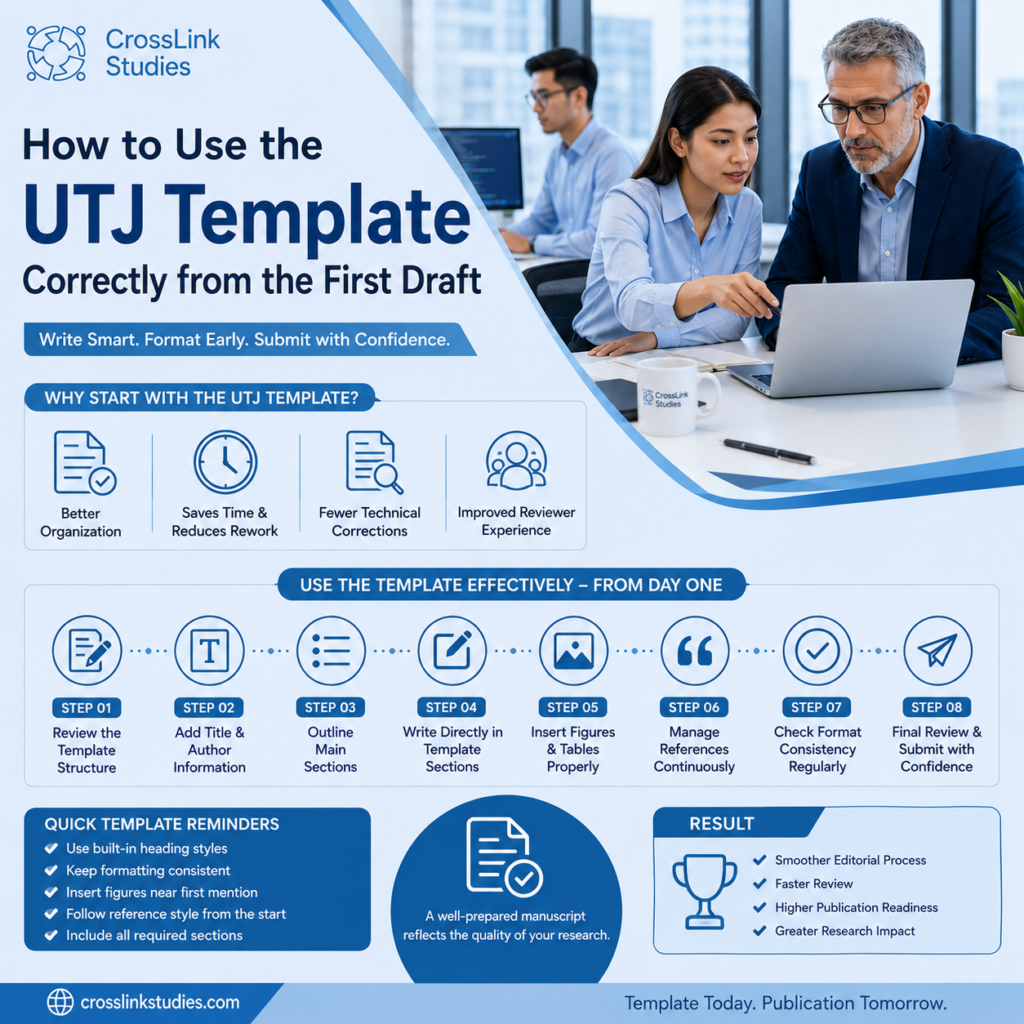
Benefits of Starting with the UTJ Template
Researchers who begin writing within the UTJ template often experience significant advantages.
- Better Manuscript Organization
- Improved Writing Efficiency
- Reduced Technical Corrections
- Enhanced Reviewer Experience
- Faster Submission Preparation
Understanding the Core Components of the Template
Before drafting begins, authors should familiarize themselves with the template structure. Rather than immediately inserting text, spend time reviewing:
- Title format.
- Author information layout.
- Abstract requirements.
- Keyword placement.
- Heading hierarchy.
- Figure formatting rules.
- Table presentation standards.
- Reference style expectations.
- Supplementary sections.
Start with the Title and Metadata Sections
Many authors postpone completing title-page information until submission. However, including these elements from the beginning provides important advantages. The title section helps define research focus, scope of investigation and primary contribution.
Similarly, author information encourages early verification of names, affiliations, institutional details and corresponding author information.
Build the Manuscript Around the Template Structure
The most effective strategy is to treat the template as the manuscript framework rather than as a formatting layer. A typical technology-focused research article should develop according to the following structure as an abstract, keywords, Introduction, literature review, methodology, and results and discussion and conclusion
Apply Heading Styles Correctly
Heading inconsistencies are among the most common formatting issues identified during editorial screening. Authors should avoid manually adjusting font sizes, bold formatting, or spacing. Instead, use the template’s predefined heading styles consistently.
Insert Figures and Tables Properly During Drafting
Many researchers collect figures separately and insert them only during final formatting. This approach often causes numbering conflicts and citation errors. instead insert figures immediately, add captions early and number sequentially.
Manage References Using the Correct Style
Reference management becomes increasingly difficult as manuscripts grow. Authors should avoid creating reference lists manually whenever possible.
Instead:
- Use reference management software.
- Select the appropriate citation format early.
- Verify metadata accuracy.
- Maintain consistency throughout revisions.
Maintain Consistency Throughout the Writing Process
The greatest advantage of template-based writing is consistency. Authors should routinely review terminology, formatting, citation Practices, numbering systems.
Common Template Mistakes to Avoid
Even when authors use templates, several errors frequently occur.
- Modifying Template Styles
- Removing Required Sections
- Ignoring Placeholder Instructions
- Delaying Figure Integration
- Inconsistent Heading Usage
A Practical Workflow for Template-Based Writing
Researchers can maximize efficiency by following a structured workflow:
Step 1
Review the entire template.
Step 2
Complete title and author information.
Step 3
Outline major sections.
Step 4
Draft content directly within designated sections.
Step 5
Insert figures, tables, and equations during writing.
Step 6
Manage references continuously.
Step 7
Conduct periodic formatting reviews.
Step 8
Perform a final compliance check before submission.
This approach keeps the manuscript aligned with journal expectations from start to finish.
Why Editors Appreciate Template-Compliant Submissions
Editors evaluate hundreds of manuscripts each year. Well-formatted submissions immediately demonstrate professionalism, attention to detail and compliance with guidelines. While formatting alone does not determine acceptance, a well-prepared manuscript creates a positive first impression and facilitates efficient processing. A template-compliant submission allows editors and reviewers to focus on scientific quality rather than technical corrections.
The Connection Between Templates and Publication Success
Using the UTJ template correctly from the first draft does not guarantee publication. However, it significantly reduces avoidable technical issues that can slow editorial evaluation and distract from the research contribution. When authors write directly within the journal framework, they create manuscripts that are more organized, more consistent and easier to review.
The strongest manuscripts are not merely well researched they are well prepared. Using the UTJ template correctly from the beginning is one of the simplest and most effective steps authors can take toward publication readiness.