
Why Reviewers Reject Manuscripts They Cannot Understand
Excellent Research Is Not Enough
Many researchers assume that strong results alone guarantee a positive peer-review outcome. In reality, reviewers evaluate two equally important aspects of a manuscript: the quality of the research and the clarity with which it is communicated.
A technically sound study can still receive unfavorable reviews if reviewers struggle to understand its objectives, methodology, findings, or significance. In today’s competitive publishing environment, where reviewers often assess multiple submissions within limited timeframes, clarity is not a luxury, it is a necessity.
For authors submitting to CLS journals like Ubiquitous Technology Journal (UTJ), including fields such as artificial intelligence, ubiquitous computing, cybersecurity, data science, Internet of Things (IoT), and human-computer interaction, the ability to communicate complex ideas clearly can significantly influence publication success.
Understanding the Reviewer’s Perspective
Peer reviewers are not participants in your research project. They do not possess the background knowledge, assumptions, or familiarity that authors develop throughout months or years of investigation. When reviewers encounter a manuscript, they expect to quickly identify the research problem, the knowledge gap and the proposed solution.
The Hidden Cost of Poor Communication
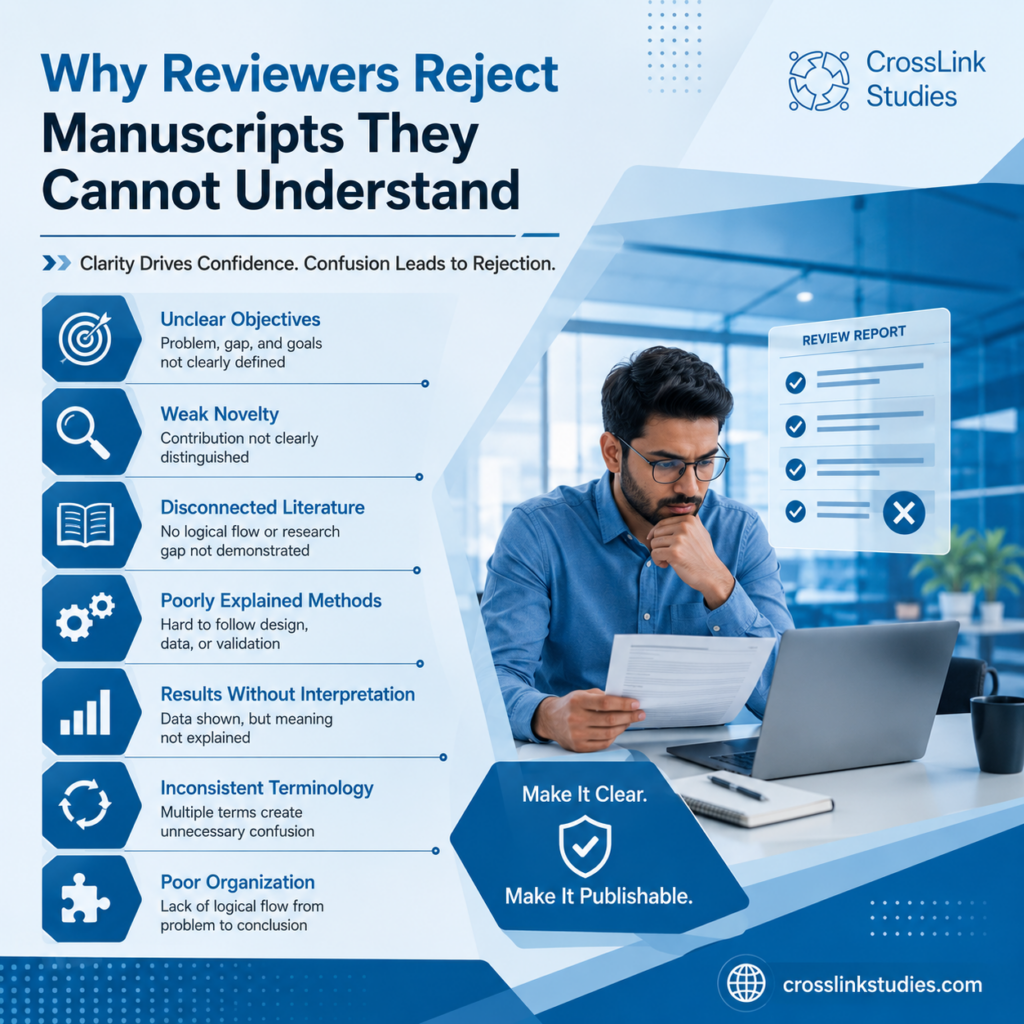
Authors sometimes believe that reviewers will invest extra effort to understand unclear sections. In practice, reviewers are expected to assess manuscripts efficiently and objectively. When a paper contains ambiguous explanations, inconsistent terminology, or poorly organized sections, reviewers may report concerns such as the contribution is unclear, methodology is difficult to follow, novelty is not sufficiently demonstrated and discussion lacks coherence.
Common Reasons Reviewers Struggle to Understand a Manuscript
1. Unclear Research Objectives
The purpose of the study should be evident within the introduction. Reviewers should never have to infer:
- What problem is being solved.
- Why the problem matters.
- What specific question the study addresses.
2. Weak Presentation of Novelty
One of the most frequent reviewer comments is:
“The novelty of the work is not sufficiently demonstrated.”
This often occurs because authors describe what they did without explaining how their work differs from existing research. Novelty should be presented explicitly by answering:
- What limitation exists in prior studies?
- What new solution is proposed?
- Why is the proposed approach superior or different?
Reviewers should not have to search for the contribution of the paper.
3. Disconnected Literature Review
A literature review should not be a collection of article summaries. Instead, it should build a logical argument that leads directly to the research gap. When previous studies are discussed without synthesis or critical analysis, reviewers may struggle to understand why the current research is necessary. An effective review demonstrates what is already known, what remains unresolved, how the present study addresses the gap.
4. Complex Methods Explained Poorly
In technology and engineering research, methods are often sophisticated and multi-layered. However, complexity should never become an excuse for poor explanation. Reviewers expect to understand data sources, experimental design, algorithms or frameworks and evaluation metrics. Flowcharts, framework diagrams, and structured methodological descriptions often improve comprehension and reduce reviewer uncertainty.
5. Results Without Interpretation
Another common problem occurs when authors present large volumes of data without explaining their meaning. Tables and figures alone do not communicate scientific value. Reviewers want answers to questions such as:
- What does this result indicate?
- Why is it important?
- How does it compare with existing research?
- What practical implications emerge?
Without interpretation, even statistically significant findings may appear disconnected from the study’s objectives.
6. Inconsistent Terminology
Using multiple terms for the same concept creates unnecessary confusion. For example, referring to the same system as proposed framework and smart architecture may lead reviewers to believe multiple systems are being discussed. Consistent terminology improves readability and demonstrates professionalism.
7. Poor Manuscript Organization
Even strong research becomes difficult to evaluate when sections lack logical flow. Reviewers should experience a clear progression:
Problem → Gap → Method → Results → Interpretation → Contribution
When this sequence is disrupted, reviewers may struggle to connect evidence with conclusions. Effective organization reduces cognitive effort and allows reviewers to focus on scientific merit.
Why Clarity Influences Reviewer Confidence
Reviewers often make judgments about the reliability of a study based on how effectively it is presented. A clear manuscript suggests careful planning, methodological rigor, transparency and scholarly maturity. Conversely, unclear writing may unintentionally create doubts regarding the validity of the research process itself. Although presentation should not determine scientific quality, it frequently influences reviewer confidence during evaluation.
Practical Strategies to Improve Manuscript Clarity
Before submission, authors should ask the following questions:
Can a reader identify the contribution within the first page?
Does every section support the research objective?
Are methods described in a reproducible manner?
Do figures and tables have clear purposes?
Are results interpreted rather than simply reported?
Is terminology consistent throughout the manuscript?
Does the conclusion reinforce the study’s significance?
The Role of Revision Before Submission
Many rejected manuscripts could have been significantly improved through internal review before submission. Authors should consider obtaining feedback from:
- Co-authors.
- Colleagues outside the project.
- Subject specialists.
- Academic editors.
If a knowledgeable reader struggles to follow the manuscript, reviewers will likely encounter the same difficulties. Pre-submission revision often reveals organizational and communication issues that authors may overlook.
Researchers invest substantial time in designing studies, collecting data, developing models, and validating results. Yet the impact of that effort depends on how effectively the research is communicated. A manuscript that clearly presents its objectives, methodology, findings, and significance allows reviewers to focus on the science rather than the presentation. In many cases, the difference between rejection and acceptance is not the quality of the research itself, it is the clarity with which that quality is conveyed.