
How to Document Hyper parameters in AI Research Manuscripts
In artificial intelligence and machine learning studies, hyper parameters directly influence model performance, training stability, reproducibility and scientific reliability.
Yet many AI manuscripts fail to report hyper parameters completely, making results difficult or impossible to reproduce. Increasingly, reviewers from CLS expect transparent reporting of all training and optimization settings.
Research reproducibility frameworks emphasize that AI studies must clearly disclose model configurations, tuning strategies, optimization procedures, and training parameters. For journals under Crosslink Studies and UTJ, strong hyper parameter documentation demonstrates methodological rigor and strengthens reviewer confidence.
What Are Hyper parameters?
Hyper parameters are predefined settings that control how a machine learning model learns during training. Unlike model parameters, they are selected before or during experimentation. Common examples include Learning rate, Batch size, number of epochs, optimizer type, dropout rate, weight decay, hidden layer size, regularization settings and early stopping criteria.
Why Incomplete Hyper Parameter Reporting Is a Serious Problem
Many AI papers report only final accuracy scores while omitting critical training settings. This creates several problems:
❌ Experiments cannot be replicated
❌ Results become difficult to validate
❌ Reviewer trust decreases
❌ Comparative evaluation becomes unreliable
Recent reproducibility guidance highlights undocumented hyperparameter tuning as one of the most common weaknesses in AI research manuscripts.
Essential Hyperparameters Authors Must Report
1. Optimization Settings
Always specify optimizer used (Adam, SGD, RMSProp, etc.), learning rate, momentum or beta values and learning rate schedules.
✔ Example:
“The model was trained using Adam optimizer with learning rate = 0.001 and β₁ = 0.9.”
2. Training Configuration
Clearly document batch size, number of epochs, gradient clipping, early stopping strategy and warm-up steps. These settings strongly affect convergence and performance reproducibility.
3. Architecture-Related Hyper parameters
For neural network models, report number of layers, hidden units, activation functions, attention heads and embedding dimensions
Avoid vague statements like:
“Default architecture settings were used.”
4.Regularization and Generalization Controls
Include dropout rate, weight decay, data augmentation parameters, label smoothing and regularization coefficients. Such details are critical for understanding generalization performance.
5. Randomness and Initialization
Modern AI reproducibility standards strongly recommend documenting random seed values, initialization strategies, data shuffling procedures and cross-validation randomness. Reproducibility guidance from AI publishing standards specifically identifies random seed reporting as essential for scientific verification.
Documenting Hyper Parameter Tuning Properly
One major issue in AI manuscripts is reporting only the “best” settings without explaining how they were selected.
Authors should clearly describe grid search, random search, bayesian optimization, manual tuning and validation strategy used. Also explain search ranges, selection criteria and computational constraints. Transparent tuning procedures improve scientific credibility substantially.
Best Practices for Hyper Parameter Presentation
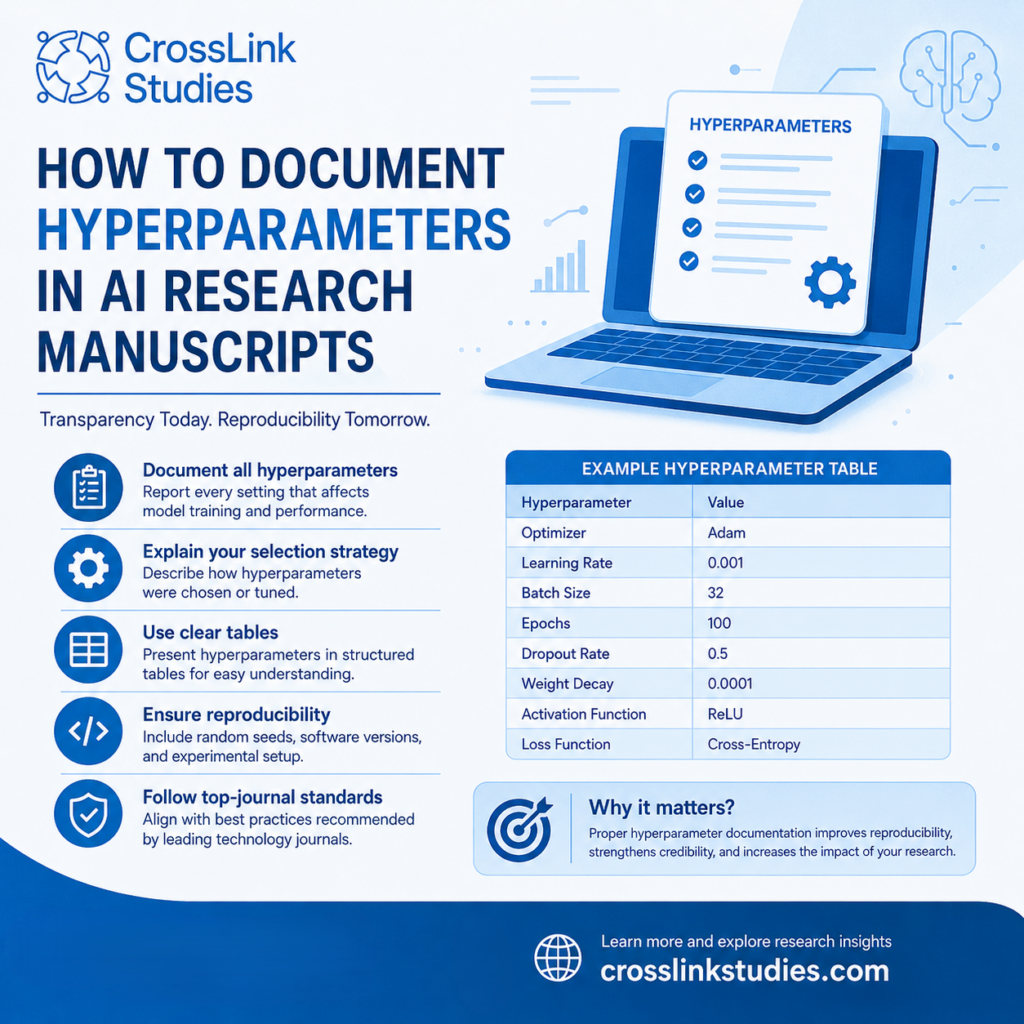
Use Tables Instead of Long Paragraphs
A structured table improves readability significantly.
Recommended columns:
| Hyper parameter | Value | Description |
| Learning Rate | 0.001 | Adam optimizer |
| Batch Size | 32 | Training configuration |
| Epochs | 100 | Early stopping enabled |
Separate Core and Supplementary Settings
Main Manuscript
Include key training settings, important hyper parameters and critical optimization choices.
Supplementary Material
Move full search spaces, extensive tuning logs, additional configurations and ablation parameter tables. This balance improves readability while preserving reproducibility.
Maintain Consistency Across the Paper
Hyper parameter values mentioned in tables, figures, appendices, and experimental sections must remain fully consistent. Inconsistencies reduce reviewer confidence quickly.
Reproducibility and Transparency Expectations
Modern AI reporting standards increasingly emphasize:
- Transparent configuration reporting
- Complete computational environments
- Reproducibility checklists
- Open methodological documentation
For UTJ submissions, this means hyper parameter reporting should be precise, organized, transparent, and reproducible.
Common Mistakes to Avoid
❌ Reporting only final accuracy metrics
❌ Missing learning rate details
❌ Undefined tuning strategies
❌ No random seed documentation
❌ Incomplete optimizer configuration
❌ Using “default settings” without explanation
❌ Hiding experimental details in vague statements
These issues frequently trigger reviewer concerns regarding scientific validity.
Recommended Structure for UTJ AI Manuscripts
For AI-focused submissions to CLS and UTJ, an effective structure is:
- Dataset Description
- Model Architecture
- Hyper parameter Configuration
- Training Procedure
- Tuning Strategy
- Evaluation Metrics
- Reproducibility Statement
This structure aligns closely with modern AI reproducibility expectations and international publishing standards.
Practical Checklist for Authors (CLS-Ready)
Before submission, ensure:
✔ Learning rates are documented
✔ Optimizer settings are specified
✔ Batch size and epochs are reported
✔ Architecture hyper parameters are defined
✔ Random seeds are included
✔ Hyper parameter tuning strategy is explained
✔ Tables improve readability
✔ Experimental configurations are reproducible
✔ Main and supplementary materials remain consistent
In AI research, hyper parameters are not minor implementation details; they are essential components of scientific reproducibility. A model cannot be fully understood if its training configuration remains hidden.
For authors submitting to CLS Crosslink Studies and UTJ, transparent hyper parameter documentation strengthens research credibility, reproducibility, reviewer trust, and long-term scientific impact. Clear reporting transforms AI experiments from isolated results into reproducible scientific contributions.