What a Strong Reviewer Report Looks Like in UTJ
Peer review plays a central role in maintaining the quality, credibility, and usefulness of scientific research. In technology and engineering, where published findings may influence software development, intelligent systems, industrial applications, and future experiments, reviewers help determine whether a study’s claims are supported by reliable evidence. Their assessments also help authors identify weaknesses, improve methodological clarity, and communicate their contributions more effectively.
However, an effective reviewer report involves considerably more than identifying errors or recommending acceptance or rejection. A manuscript may introduce an interesting idea but provide insufficient validation, use inappropriate comparison methods, or omit details needed to reproduce its experiments. A useful review must distinguish between these substantive weaknesses and minor presentation issues, then explain how the research can be assessed or improved.
For the Ubiquitous Technology Journal (UTJ), which covers areas such as artificial intelligence, machine learning, ubiquitous computing, the Internet of Things, cyber-physical systems, embedded computing, cybersecurity, and robotics, rigorous peer review is particularly important. These fields frequently combine complex technical methods with practical claims about reliability, efficiency, safety, and performance.
Understanding the Purpose of a Reviewer Report
A reviewer report is a structured scholarly assessment of a manuscript’s contribution, methods, evidence, interpretation, and suitability for publication. Its purpose is not to demonstrate the reviewer’s expertise through criticism, nor to rewrite the paper according to personal preferences. Instead, it should establish whether the manuscript makes a meaningful contribution and whether its conclusions are justified by the research presented.
A strong report begins by understanding the study on its own terms. The reviewer should identify the research problem, the proposed contribution, the methodology, and the principal findings before evaluating their strengths and weaknesses. This prevents criticism from becoming disconnected from the manuscript’s actual objectives. The central responsibility is to evaluate the evidence fairly, identify limitations that affect the scientific conclusions, and provide reasoning that enables the editor and authors to understand the assessment.
The Essential Components of a Strong Review
A Clear Summary of the Contribution
A reviewer should begin with a concise, accurate account of what the manuscript investigates and what it claims to contribute. This opening demonstrates that the work has been understood and establishes the context for the subsequent assessment.
The summary should not simply repeat the abstract. It should identify the central research question, the principal method, and the most important claimed result. For instance, a review of a cyber-physical systems paper might explain that the study proposes a fault-tolerant controller and evaluates its response under simulated sensor failures.
An Evidence-Based Assessment of Originality
Originality should be evaluated in relation to existing knowledge, not simply the number of techniques combined in a proposed system. A manuscript may use familiar algorithms yet contribute valuable evidence through a new application, a rigorous comparative evaluation, or a demonstration of performance under previously unexamined conditions.
Reviewers should identify the relevant contribution and explain whether the manuscript establishes a meaningful distinction from related work. If novelty is unclear, they should specify what comparison, clarification, or positioning is missing. Statements such as “the paper is not innovative” provide little practical guidance. A stronger assessment identifies the overlap with established approaches and explains which claimed advances remain insufficiently demonstrated.
Evaluating Methodology, Validation, and Reproducibility
Technical credibility depends on whether the methods are appropriate for the research question and whether the evaluation supports the conclusions. Reviewers should examine the full chain of reasoning, from research design and data selection to performance measurement and interpretation.
Examine the Research Design
The reviewer should consider whether the chosen methodology can answer the stated research question. In machine-learning research, this may involve checking dataset suitability, preprocessing procedures, training and test separation, and the possibility of data leakage. In robotics, it may involve examining control assumptions, environmental conditions, and the relationship between simulation and physical testing. For experimental studies, reviewers should assess whether baselines are appropriate, comparisons are fair, and the selected metrics reflect the problem being investigated. A model that achieves higher accuracy but requires substantially more computation may not represent an unqualified improvement over a lightweight alternative.
Assess Whether the Results Are Sufficient
A strong review distinguishes between results that are interesting and results that establish the claimed contribution. Reporting one favourable metric under a single experimental condition may be insufficient to support broad claims about reliability or robustness.
Depending on the study, reviewers may recommend additional baselines, subgroup analysis, repeated trials, uncertainty estimates, sensitivity testing, or evaluation under more realistic operating conditions. Such requests should be proportionate to the manuscript’s objectives and feasible within a revision.
Check Reproducibility and Reporting Transparency
A manuscript should describe its methods in enough detail for readers to understand how the results were obtained and, where feasible, reproduce the work. Relevant details may include software versions, model configurations, hardware specifications, experimental parameters, dataset characteristics, and data-processing procedures.
When these details are missing, the reviewer should identify precisely what prevents independent assessment. A general statement that “more information is required” is less useful than specifying which parameters or experimental conditions must be documented.
Distinguish Major Concerns From Minor Corrections
Not every weakness has the same effect on a manuscript’s scientific quality. An effective reviewer report prioritizes issues according to their impact on validity, originality, interpretation, and clarity.
Major concerns may include an inadequately supported contribution, an inappropriate research design, a flawed comparison, insufficient validation, or conclusions that extend beyond the evidence. These issues may require substantial analysis or additional experiments.
Minor concerns generally involve terminology, figure readability, missing definitions, reference inconsistencies, or explanations that can be improved without changing the central research design.
This distinction helps authors allocate their revision efforts effectively and enables editors to understand which issues are fundamental to the publication decision.
Write Criticism That Helps Authors Improve the Manuscript
The quality of a review depends not only on what it identifies but also on how clearly the concerns are communicated. Critical feedback should be specific, professional, and supported by reasoning. Consider a paper that evaluates a new IoT communication protocol using only average latency. A vague comment might state that the evaluation is weak. A constructive comment would explain that average latency alone may conceal deadline violations or unstable performance and recommend reporting latency distributions or relevant tail percentiles if these measures are appropriate to the application.
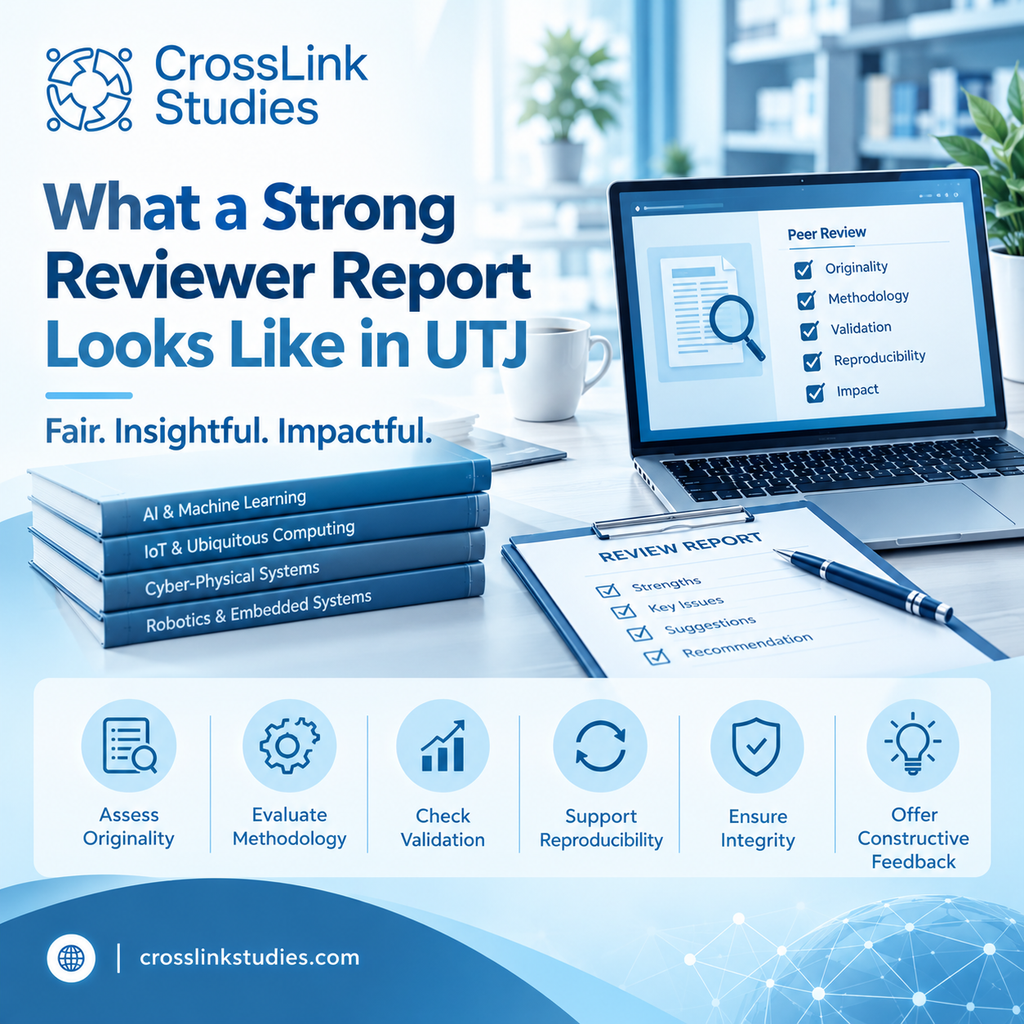
A useful reviewer report generally follows a logical sequence:
- Overall assessment: Summarize the contribution and its principal strengths and weaknesses.
- Major comments: Explain issues that materially affect scientific validity or interpretation.
- Minor comments: Identify specific presentation, terminology, or reporting corrections.
- Editorial recommendation: Provide a reasoned assessment consistent with the review findings and the journal’s criteria.
Common Reviewer Mistakes to Avoid
Even experienced researchers can produce ineffective reviews when they approach manuscripts too narrowly or allow personal preferences to influence their assessment. One common mistake is focusing excessively on grammar while overlooking methodological weaknesses. Clear writing matters, but it cannot compensate for unreliable experiments or unsupported conclusions.
Another is demanding unnecessary citations, experiments, or analyses without explaining their relevance. Reviewers should recommend additional work only when it helps resolve a substantive issue. They should also avoid requiring authors to cite the reviewer’s own publications unless those works are genuinely relevant to the research question.
Reviewers must protect confidentiality and declare potential conflicts of interest in accordance with the journal’s policies. They should not use unpublished findings for personal advantage or share confidential manuscripts without authorization. Any use of AI tools during peer review must comply with the journal’s applicable policies, particularly where manuscript confidentiality is concerned.
What UTJ Reviewers Should Prioritize
For manuscripts submitted to UTJ, the strongest reviews will connect the journal’s technical scope with its expectations for meaningful, verifiable research. The precise criteria will vary across disciplines, but several principles apply broadly. Reviewers should establish whether the research problem is clearly defined, the contribution is distinguishable from existing work, the methodology is appropriate, and the validation supports the conclusions. They should also consider whether the manuscript reports limitations honestly and provides enough information for meaningful technical assessment.
A study of an embedded AI system, for example, should not be evaluated solely on predictive accuracy if its contribution also depends on energy consumption, processing latency, or memory requirements. Likewise, a cybersecurity study should be assessed against a clearly described threat model and relevant evaluation conditions rather than broad claims of security.
Conclusion
A strong reviewer report is a reasoned, evidence-based assessment that helps editors judge a manuscript and enables authors to improve their work. It combines an accurate understanding of the contribution with careful scrutiny of originality, methodology, validation, reproducibility, and interpretation. The most effective reviews identify the issues that matter, explain why they matter, and provide practical guidance without imposing unnecessary demands. They distinguish fundamental weaknesses from minor corrections, recognize legitimate contributions, and maintain professional standards even when recommending substantial revision or rejection.
As research in AI, IoT, robotics, cybersecurity, and connected systems becomes increasingly complex, constructive peer review remains essential to reliable scientific progress. By providing fair, specific, and technically grounded assessments, reviewers contribute to a research environment in which published findings can be critically examined, reproduced where feasible, and developed into stronger future contributions. For the UTJ research community, a strong reviewer report is more than an editorial requirement. It is an opportunity to uphold methodological rigor, protect research integrity, and help ensure that technological innovation is supported by credible evidence.