

Writing Environmental Technology Research for UTJ
Environmental challenges are increasingly being addressed through technological innovation. From Internet of Things (IoT) sensors that monitor air and water quality to artificial intelligence systems that optimize energy consumption, technology is transforming how researchers understand environmental problems and develop practical solutions. However, publishing environmental technology research requires more than demonstrating that a technological system works. Authors must establish a clear research problem, justify their technical approach, validate their findings, and explain how their work contributes to environmental sustainability.
For researchers considering the Ubiquitous Technology Journal (UTJ), these considerations are particularly relevant. Published by Crosslink Studies (CLS), UTJ covers computer science, engineering, ubiquitous computing, artificial intelligence, sensor networks, smart environments, energy-efficient computing, environmental monitoring, and related technological fields. Its scope provides opportunities for research connecting technological development with environmental applications.
The central challenge for authors is to present environmental technology research that is technically rigorous, environmentally meaningful, and relevant to the journal’s readership. A well-prepared manuscript should explain not only what a technology can do, but also why it is needed, how effectively it performs, and under what conditions its benefits can be demonstrated.
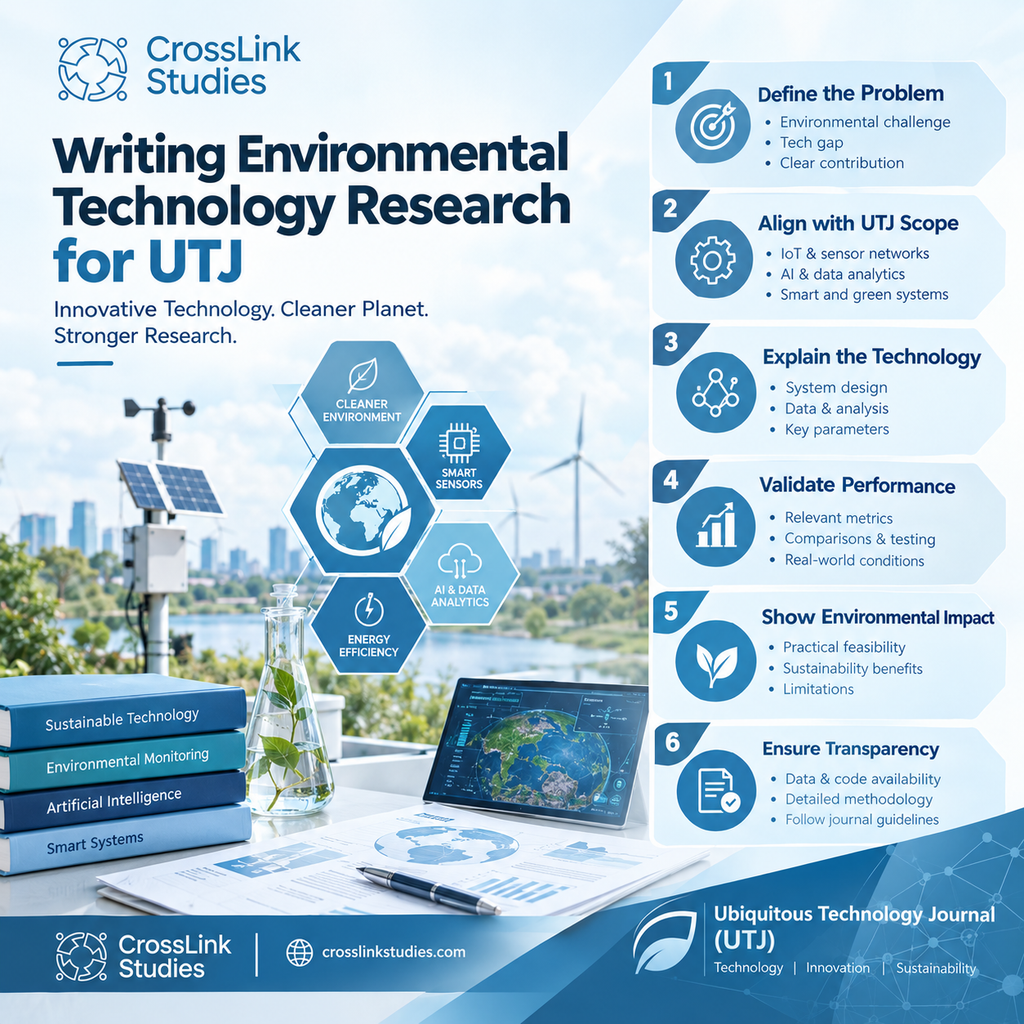
Identify a Clear Environmental and Technological Research Problem
Strong environmental technology research begins with a well-defined problem rather than a technology selected simply because it is innovative. For example, a study investigating IoT-based air-quality monitoring should identify a specific limitation in existing monitoring practices, such as inadequate spatial coverage, high operating costs, delayed measurements, or difficulties integrating data from distributed sensors.
The proposed technology should then address that limitation through a clearly explained research objective. A manuscript becomes less convincing when it introduces artificial intelligence, wireless sensors, or automated systems without explaining why conventional approaches are insufficient or what measurable improvement the proposed solution offers.
Before developing the manuscript, establish three elements:
- Environmental Challenge: Identify the specific problem, its context, and its significance.
- Technological Gap: Explain what existing systems or methods cannot adequately achieve.
- Research Contribution: State how the proposed approach addresses the identified limitation.
Align the study with UTJ’s technological scope
Environmental research can span environmental science, civil engineering, economics, public policy, and numerous other disciplines. However, not every environmental study necessarily constitutes a strong contribution to a technology-focused journal.
For UTJ, authors should make the technological dimension of their research explicit. The journal identifies environmental monitoring, energy-efficient computing, smart environments, sensor networks, and related computing and engineering applications among its areas of interest.
Consider two studies addressing urban air pollution. One might investigate the relationship between pollution and respiratory health using conventional statistical analysis. Another might develop a distributed sensor network that combines real-time pollution measurements with machine-learning models to identify emerging pollution hotspots. Both may have scientific value, but the second has a more direct technological contribution.
Relevant research directions include:
- IoT-Based Environmental Monitoring Systems
- AI-Driven Pollution Detection and Prediction
- Smart Energy Management and Optimization
- Sensor Networks for Water and Air Quality
- Edge Computing for Environmental Applications
- Electronic Waste Monitoring and Sustainable Computing
- Smart Agriculture and Environmental Sensing
Explain the proposed technology with sufficient technical detail
Environmental technology manuscripts often combine hardware, software, data processing, communication protocols, and analytical models. Authors must explain how these components interact without overwhelming readers with unnecessary implementation details. A study developing an IoT-based environmental monitoring system, for example, should describe the sensors used, the variables measured, the data transmission process, the processing architecture, and the method used to interpret the collected information.
A useful way to structure the methodology is to explain the system in stages:
- Data Acquisition: How environmental measurements or other inputs are obtained.
- Data Processing: How observations are cleaned, transformed, transmitted, or analyzed.
- Technological Implementation: How the proposed hardware, software, or model operates.
- Performance Evaluation: How the system is tested against appropriate criteria.
- Environmental Interpretation: What the technical results imply for the original problem.
Validate performance through appropriate experiments
A proposed environmental technology should be supported by evidence demonstrating that it performs as claimed.
Describing a system as efficient, intelligent, reliable, or sustainable is insufficient unless the manuscript defines these properties and explains how they were measured. For example, an air-quality prediction model might be evaluated using appropriate error metrics, comparisons with established forecasting methods, and testing on independent data. A sensor network might be assessed through measurement accuracy, communication reliability, response time, and power consumption.
Authors should consider the following questions:
- Is there a suitable baseline for comparison?
- Are the evaluation metrics appropriate for the intended application?
- Have relevant environmental conditions been considered?
- Are the results reproducible under the reported experimental conditions?
- Do the conclusions remain valid when the system encounters realistic limitations?
Demonstrate environmental relevance and practical feasibility
One of the most important aspects of environmental technology research is establishing whether technical improvements translate into meaningful practical benefits.
A monitoring system may collect data accurately but remain unsuitable for deployment if it requires excessive maintenance, unreliable network connectivity, expensive hardware, or substantial computing resources.
Similarly, an energy-management algorithm may improve simulated performance without demonstrating comparable benefits in a real operating environment. The discussion should therefore examine the conditions under which the proposed technology could be useful.
Depending on the study, relevant considerations may include installation costs, scalability, energy requirements, sensor calibration, maintenance, environmental variability, and the availability of communication infrastructure.
Strengthen reproducibility through transparent reporting
Transparent reporting enables other researchers to examine, reproduce, and extend the findings. It also allows reviewers to assess whether the reported performance follows from the proposed method or depends on undocumented experimental decisions. Authors should report the data sources, equipment specifications, software versions, model parameters, experimental settings, and evaluation procedures relevant to their research.
When appropriate, datasets, source code, configuration files, and supplementary materials should be deposited in suitable repositories. Data availability statements should explain how the materials can be accessed and identify any legitimate restrictions. For experimental systems, documentation should include relevant calibration procedures, measurement conditions, and information about the equipment used. For simulation-based research, authors should describe the assumptions, parameter settings, and computational environment.
Where human participants, sensitive location information, or restricted environmental datasets are involved, ethical and legal requirements must be respected. These practices support the general principles of methodological transparency and reproducibility reflected in established scholarly publishing guidance. Authors preparing submissions to UTJ should also follow the journal’s specific manuscript template, formatting requirements, and submission checklist.
Present findings clearly and follow journal requirements
Even technically strong research can be difficult to evaluate when the manuscript lacks a clear structure. Authors should ensure that the abstract communicates the problem, approach, principal findings, and contribution without excessive background information.
Figures should clarify system architecture, experimental workflows, data flows, or performance comparisons. Tables should present important quantitative results in a form that allows readers to compare methods and evaluate the evidence efficiently. The discussion should interpret the findings rather than repeat the results. It should explain how the study advances existing knowledge, identify its limitations, and suggest specific directions for further research.
Before submission, authors should verify that the manuscript:
- Fits the journal’s aims and scope.
- States its original technological contribution clearly.
- Provides sufficient methodological detail.
- Supports its claims with appropriate evidence.
- Acknowledges limitations and practical constraints.
- Meets the journal’s formatting and ethical requirements.
Conclusion
Writing environmental technology research for UTJ requires a clear connection between environmental challenges, technological innovation, and measurable scientific evidence. A successful manuscript identifies a meaningful problem, explains why the proposed approach is appropriate, validates its performance, and demonstrates the practical relevance of the findings without overstating their implications.
For researchers working on smart environmental monitoring, artificial intelligence, sensor networks, energy-efficient computing, and related applications, these principles provide a useful framework for preparing stronger manuscripts. Ultimately, the value of environmental technology research lies not simply in developing new systems, but in demonstrating how those systems improve understanding, measurement, efficiency, or management of environmental challenges. By combining technical rigor with transparent reporting and clearly articulated environmental relevance, authors can communicate their contributions more effectively to the broader technology research community.