
Assessing Whether a Manuscript Matches Your Expertise
Scientific publishing depends on researchers who can evaluate evidence critically, recognize methodological limitations, and distinguish meaningful contributions from unsupported claims. However, an important question often arises before a researcher begins reviewing a manuscript, collaborating on a study, or submitting work to a journal: does the manuscript genuinely match their expertise?
This question has become increasingly important as research in artificial intelligence, machine learning, ubiquitous computing, cybersecurity, robotics, and other engineering disciplines grows more interdisciplinary. A single manuscript may combine algorithm development, statistical analysis, hardware implementation, experimental validation, and domain-specific applications. Although these elements may contribute to one research question, they require different forms of technical knowledge to evaluate properly. Assessing expertise is not simply a matter of checking whether a manuscript falls within a researcher’s general field. It requires examining the relationship between the manuscript’s central research question, the methods used, the evidence presented, and the researcher’s ability to assess each component reliably. Familiarity with a topic does not automatically establish competence in every technique used to investigate it.
Understanding What Expertise Means in Research
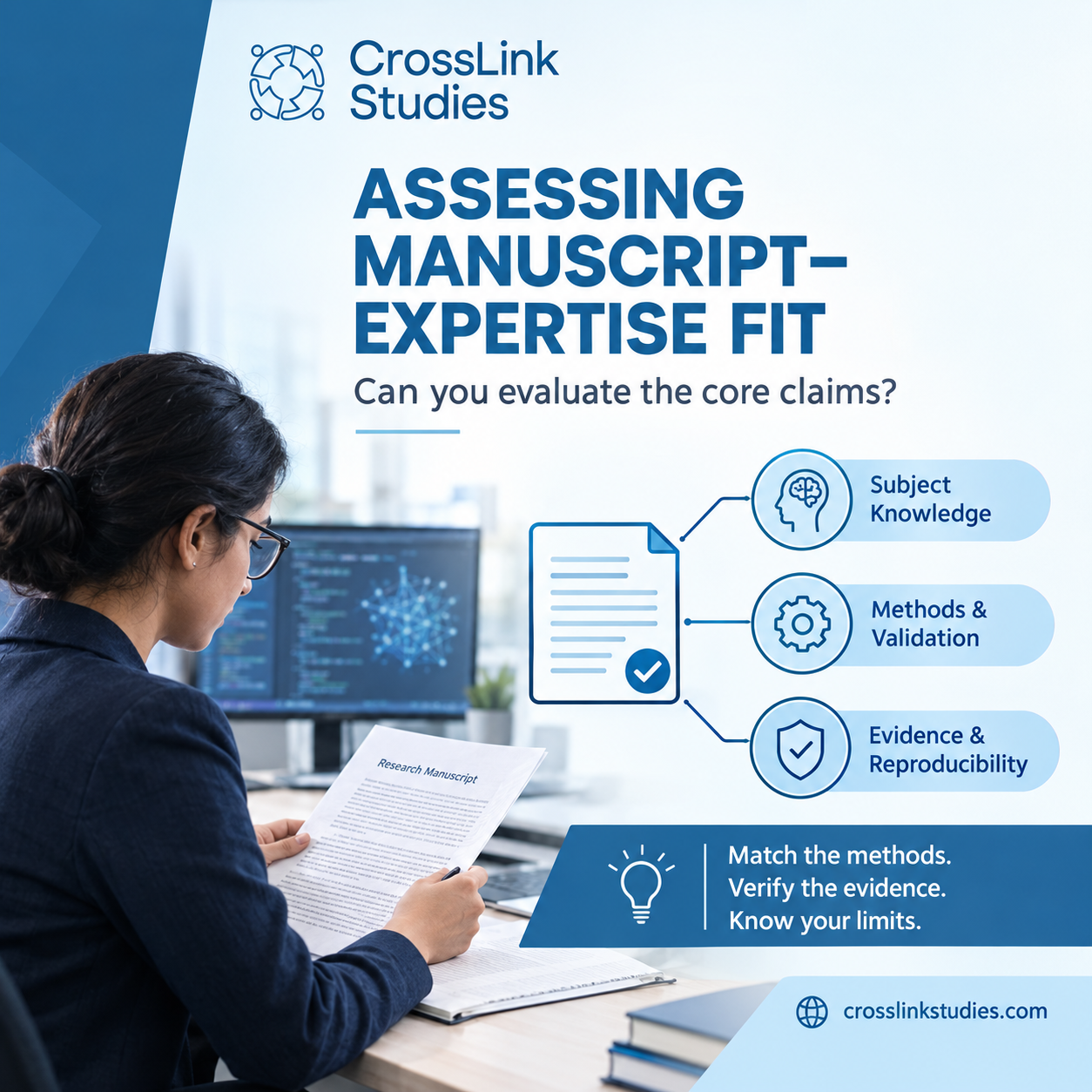
Research expertise is multidimensional. It can arise from sustained work in a particular subject area, practical experience with specific technologies, methodological training, or demonstrated competence in experimental design and analysis. These forms of expertise overlap, but they are not interchangeable. A useful assessment therefore considers three dimensions: subject expertise, methodological expertise, and application expertise. Subject expertise concerns the research problem and its theoretical foundations. Methodological expertise concerns the techniques used to investigate the problem. Application expertise concerns the practical environment in which the proposed solution operates.
Why Accurate Expertise Assessment Matters
Protecting the Quality of Peer Review
Peer review requires more than identifying grammatical problems or deciding whether a topic appears interesting. Reviewers must determine whether the research question is meaningful, the methodology is appropriate, the results support the conclusions, and the reported contribution is sufficiently clear.
When a manuscript falls outside a reviewer’s competence, important weaknesses may remain undetected. An inappropriate baseline may be accepted, a statistical assumption may go unchallenged, or a security claim may be endorsed without examining the threat model.
The opposite problem is equally concerning. Reviewers unfamiliar with a particular technique may incorrectly criticize a valid methodological choice or overlook the significance of an emerging research direction.
Improving Researcher–Manuscript Alignment
Expertise assessment also matters when researchers select manuscripts for collaboration, identify suitable journals, or evaluate opportunities to contribute to an existing project.
A manuscript may share terminology with a researcher’s previous work while addressing a substantially different technical problem. For instance, both papers may discuss artificial intelligence, but one may focus on model interpretability while the other examines adversarial robustness under resource-constrained deployment. Their shared terminology does not establish equivalent expertise.
Supporting Fair and Credible Editorial Decisions
Editors must distinguish between broad subject familiarity and the specific competence required to assess a manuscript. A reviewer with extensive experience in embedded systems may be well suited to assess hardware constraints but less qualified to judge a novel cryptographic protocol. Matching manuscripts with appropriate expertise makes editorial decisions more defensible. It also supports fairer evaluation because authors receive feedback from individuals capable of understanding the research’s technical assumptions, intended contribution, and limitations.
Common Mistakes When Assessing Expertise
One frequent mistake is relying exclusively on keywords. Terms such as deep learning, cybersecurity, or intelligent systems cover diverse research questions and technical approaches. A shared keyword may indicate relevance, but it does not establish the ability to evaluate a study’s methodology.
Another mistake is assuming that experience with a software tool guarantees methodological competence. Using a machine-learning library, simulation environment, or statistical package does not necessarily mean a researcher can assess experimental validity, parameter selection, uncertainty, or reproducibility.
Researchers may also overestimate their competence because a manuscript resembles a previous project. Similarity in application does not guarantee similarity in methodological requirements. A computer-vision study using supervised learning, for example, presents different evaluation challenges from a study using self-supervised learning or testing generalization across unseen environments.
A Practical Framework for Evaluating Manuscript Fit
Start with the Central Research Question
Before examining technical details, identify the problem the manuscript attempts to solve. Determine its intended contribution and distinguish the main research objective from secondary applications or supporting analyses.
Ask whether the manuscript primarily proposes a new algorithm, validates an engineering system, investigates a theoretical relationship, or evaluates an application in a specific environment. This classification helps reveal which knowledge is essential for a meaningful assessment.
Examine the Methods and Validation Requirements
The methodology often provides the clearest indication of whether a manuscript matches your expertise. Identify the techniques that determine the credibility of its main claims, then assess whether you can evaluate their assumptions, implementation, and limitations.
For an AI paper, this may involve understanding dataset construction, train–test separation, baseline selection, hyperparameter tuning, and performance metrics. For a robotics study, it may require evaluating sensor calibration, control strategies, simulation assumptions, and real-world testing. For cybersecurity research, it may involve examining the threat model, attack assumptions, experimental environment, and security evidence. Consider a manuscript claiming that a new intrusion-detection model outperforms existing approaches. A qualified assessment requires more than comparing reported accuracy values. It may require checking class imbalance, data leakage, false-positive rates, dataset representativeness, and whether competing methods received fair evaluation.
Separate What You Can Assess From What Requires Specialist Knowledge
Expertise assessment does not always produce a simple yes-or-no decision. A manuscript may contain components that different specialists can evaluate effectively.
Consider a cyber-physical system combining machine learning, embedded hardware, and secure communication. A researcher may be qualified to assess model architecture and predictive performance but unable to evaluate cryptographic security or hardware timing constraints.
Evaluate the Evidence, Not Just the Presentation
A technically polished manuscript may still contain methodological weaknesses. Clear diagrams, sophisticated equations, and impressive performance figures do not establish that the research is valid. Assess whether the evidence supports the stated contribution. Determine whether experiments answer the research question, comparisons use appropriate baselines, and reported results are consistent with the conclusions. Examine whether implementation details, datasets, evaluation procedures, and relevant limitations are documented sufficiently for independent assessment.
Best Practices for Researchers and Reviewers
A disciplined expertise assessment can be integrated into normal research practice without becoming unnecessarily complicated.
- Review your demonstrated experience. Consider relevant publications, research projects, methodological training, and practical work rather than relying on professional titles alone.
- Map the manuscript’s core requirements. Identify its principal claims, essential methods, validation procedures, and application-specific assumptions.
- Distinguish essential from peripheral knowledge. You do not need to master every technical detail, but you should understand the elements that determine the validity of the central contribution.
- Recognize uncertainty early. Consult appropriate specialists or decline an assignment when a critical component falls outside your competence.
- Maintain methodological awareness. New techniques, datasets, standards, and evaluation practices can change what competent assessment requires.
- Disclose relevant limitations. Transparency about the scope of your expertise helps editors, collaborators, and readers interpret your judgments appropriately.
These practices should be accompanied by a commitment to confidentiality and ethical conduct. Manuscripts received for peer review must not be shared with unauthorized individuals or used to advance personal research interests. Where conflicts of interest exist, they should be disclosed according to the relevant editorial procedures.
The Role of Editorial Standards in Expertise Assessment
A strong editorial process evaluates both the suitability of a manuscript for a journal and the competence required to assess it. These are related but distinct decisions. A manuscript may fit a journal’s scope while requiring reviewers with specialized methodological knowledge.
For research submitted to the Ubiquitous Technology Journal (UTJ), this distinction is particularly relevant to work combining AI, machine learning, IoT, embedded computing, robotics, cybersecurity, and cyber-physical systems. Such manuscripts may cross disciplinary boundaries while making a narrowly defined technical contribution.
Researchers assessing their readiness to contribute to this literature should examine whether they can evaluate the problem definition, methodological choices, validation strategy, fairness of comparisons, reproducibility, and ethical reporting. Authors should apply the same discipline when selecting collaborators and deciding whether their own work is ready for submission.
Conclusion
Assessing whether a manuscript matches your expertise is a fundamental part of responsible scholarly practice. It requires more than recognizing a familiar topic or understanding the terminology used in a paper. Researchers must consider the central research question, the methods supporting its conclusions, the evidence needed for validation, and their own ability to evaluate these elements critically.
As technology research becomes increasingly interdisciplinary, expertise should be understood as a defined and transparent capacity rather than a broad professional label. Recognizing its boundaries helps reviewers provide more reliable feedback, enables researchers to collaborate more effectively, and supports editors in making informed publication decisions.
For authors and reviewers working with CLS and UTJ, the guiding principle is straightforward: evaluate what you can substantiate, acknowledge what you cannot independently verify, and seek the expertise necessary to close the gap. Applying this principle encourages fair assessment, reproducible research, ethical publication, and technical contributions that offer meaningful value to the scientific community.