
How to Turn a Research Grant Project into a Publishable Article
Research grants provide funding, infrastructure, and collaborative opportunities to investigate important scientific and technological problems. Yet completing a funded project does not automatically produce a publishable research article. A project may generate extensive datasets, technical reports, prototypes, experimental results, and stakeholder recommendations, but transforming these outputs into a strong scholarly contribution requires a separate process of research synthesis, methodological evaluation, and scientific writing.
This distinction is particularly important in technology-driven fields, where a funded project may involve several interconnected objectives, multiple research teams, and substantial technical development. An engineering project might produce a working prototype, while an artificial intelligence project might generate several models and evaluation datasets. Although these outputs demonstrate progress, a journal article must establish a clearly defined research problem, explain the methods used to investigate it, and present evidence that supports a meaningful contribution to existing knowledge.
The challenge is not simply to document what a research team accomplished. It is to identify what the project has established that other researchers did not previously know, and to communicate that contribution in a form that can withstand independent scholarly evaluation. Turning a grant-funded project into a publishable article therefore requires deliberate planning, appropriate analytical methods, transparent reporting, and careful alignment between research objectives and the evidence collected. When these elements are addressed systematically, grant outputs can become valuable contributions to the wider research community.
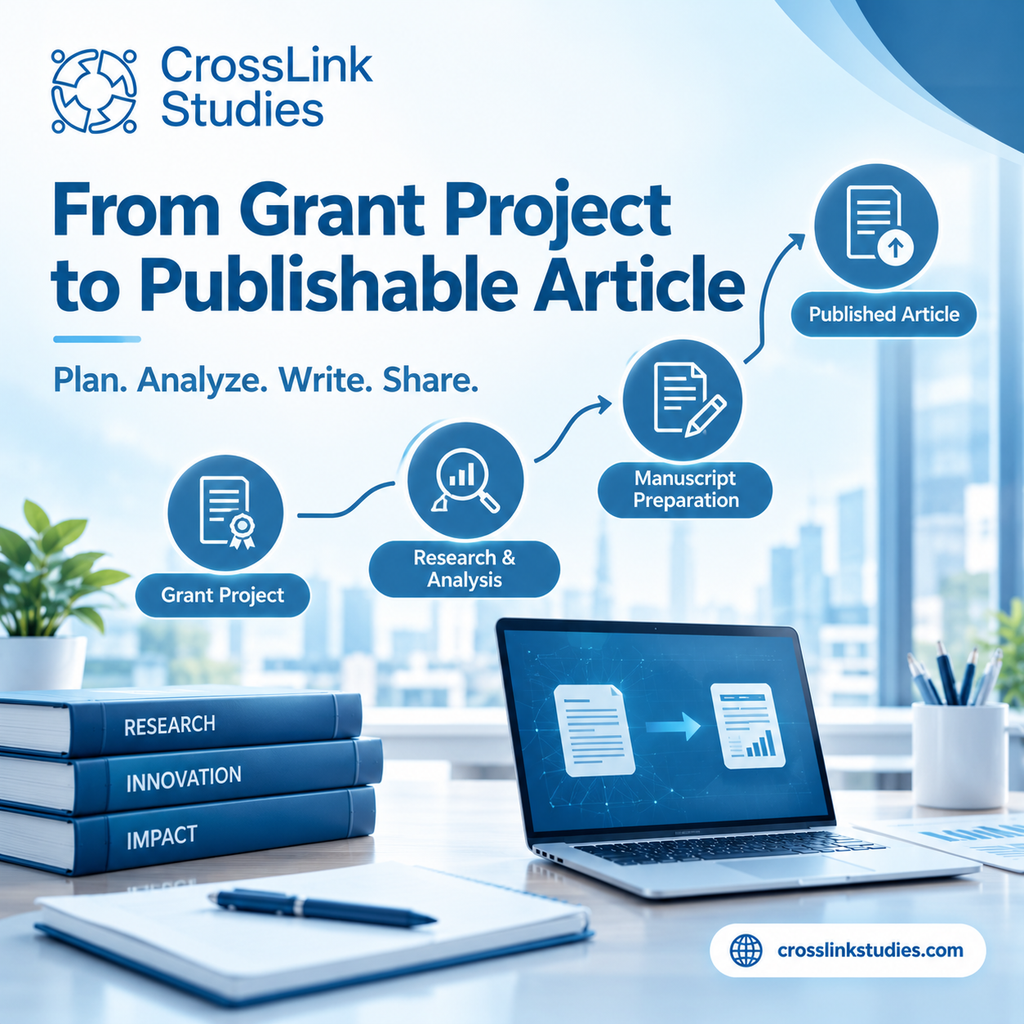
Understanding the Difference Between a Grant Deliverable and a Research Article
A research grant and a journal article serve related but different purposes. Grant proposals generally explain why a project deserves support, what activities will be undertaken, how resources will be used, and which outcomes are expected. Articles, by contrast, must demonstrate what the investigation actually found and why those findings matter.
A project report may satisfy funding requirements by documenting completed activities, expenditure, milestones, and implementation outcomes. A scholarly article requires a stronger analytical focus. It must establish the relationship between the research question, the selected methodology, the results, and the conclusions. For example, a funded project may develop an IoT-based environmental monitoring system. Its project report might describe the sensors installed, the monitoring platform developed, and the locations covered. A publishable article would investigate a more specific question: Does the proposed sensor configuration improve measurement reliability under varying environmental conditions compared with an established alternative?
Identify the Strongest Publishable Contribution
Large research projects frequently address several questions simultaneously. Attempting to include every activity, experiment, and outcome in one manuscript can weaken the argument by creating an unfocused article with too many objectives.
The first task is to identify the project’s most defensible contribution. Researchers should revisit the original objectives, examine the completed work, and determine which findings are sufficiently developed to support a coherent scientific argument.
Distinguish Novelty from Project Completion
Completing a planned activity is not equivalent to making a novel contribution. Researchers should examine how their findings extend, challenge, refine, or validate existing knowledge.
In an AI project, novelty might involve demonstrating improved generalization under distribution shifts rather than simply reporting higher accuracy on a familiar benchmark. In robotics, a contribution might be a control strategy that maintains stability under specified disturbances. In cybersecurity, it could involve a detection method whose effectiveness has been tested against clearly defined attack scenarios.
Decide Whether One Project Can Support Multiple Articles
A multidisciplinary grant may legitimately generate several publications if different research questions require distinct analyses and produce independently meaningful contributions.
For instance, a smart-manufacturing project might support one article on predictive maintenance performance and another on communication latency in an industrial sensor network. Each article would need its own research objective, relevant literature, appropriate methodology, and distinct findings.
However, dividing one limited contribution into several minimally different manuscripts can lead to redundant publication or inappropriate fragmentation. Researchers should ensure that each proposed article offers a substantive and clearly differentiated contribution, with related publications disclosed when required.
Build the Article Around Evidence, Not Activities
Once a contribution has been identified, the next step is to organize the available evidence around the research question. Grant projects often generate more information than an article can accommodate. Researchers must distinguish between material that directly supports the argument and documentation that belongs in supplementary materials or project records.
A useful starting point is to construct an evidence map linking each research objective to its methodology, principal result, and interpretation. This process exposes gaps before the manuscript is drafted.
For experimental studies, researchers should verify that the data support the claims being considered. A model comparison, for example, should use appropriate baselines, clearly described evaluation conditions, and suitable performance measures. Where relevant, researchers should examine uncertainty, variability, robustness, and sensitivity to changes in experimental settings.
For qualitative or mixed-methods projects, the same principle applies. Interviews, observations, and stakeholder feedback should be analyses through a clearly explained procedure rather than presented as isolated quotations or informal impressions.
Address Methodological Gaps Before Writing
Funded projects sometimes prioritize implementation deadlines, stakeholder deliverables, or prototype development over the documentation needed for a rigorous publication. Consequently, a completed project may contain valuable findings but lack sufficient evidence to support every proposed claim.
Researchers should conduct a methodological audit before drafting the article. This should establish whether the research design, data collection, analysis, and validation procedures are appropriate for the intended contribution.
In technology research, this audit may include checking dataset provenance, preprocessing decisions, software versions, hardware specifications, model configurations, test conditions, baseline selection, and the consistency of reported metrics. If experiments were repeated, the manuscript should explain the number of trials and how results were summarized.
Where additional experiments are necessary, researchers should prioritize those that resolve substantive weaknesses. For example, a cybersecurity system evaluated only on one dataset may require testing on an independent dataset to assess generalization. A control algorithm demonstrated only in simulation may require additional validation before claims about physical deployment can be justified.
Write the Manuscript for a Specific Scholarly Audience
A research article should not follow the structure of a grant application or final project report. Instead, its organization should guide readers from the research problem to the evidence and its implications.
The introduction should establish the problem, identify a specific gap in existing knowledge, and explain the article’s contribution. The literature review should critically compare relevant approaches and demonstrate why the investigation is necessary. The methodology should provide sufficient detail for readers to assess the appropriateness of the research design and, where feasible, reproduce the analysis or experiments. The results section should report the findings clearly, using tables and figures where they improve understanding. The discussion should explain what the findings mean, how they relate to previous work, and which practical or theoretical implications can reasonably be drawn.
Manage Collaboration, Funding Disclosure, and Research Integrity
Grant-funded research often involves several investigators, institutions, students, technical staff, and external partners. Turning project outputs into a manuscript therefore requires clear communication about authorship, responsibilities, data ownership, and publication permissions.
Authorship should reflect substantive scholarly contributions and the applicable journal’s authorship criteria. Funding sources and grant identifiers should be disclosed according to the journal’s instructions. Researchers should also identify relevant conflicts of interest and obtain any necessary permissions before using confidential, proprietary, or third-party data.
Ethical requirements deserve particular attention when projects involve human participants, personal information, healthcare applications, or sensitive operational data. Relevant approvals, consent procedures, and privacy protections should be reported accurately. Transparency is also essential when an article draws on an existing project report, dataset, conference paper, or earlier publication. Related outputs should be disclosed where appropriate, and the manuscript must provide a distinct contribution rather than republishing the same findings without adequate differentiation.
Prepare the Manuscript for Submission and Peer Review
Before submission, researchers should evaluate the manuscript from the perspective of an independent reviewer. The central questions are whether the research problem is clear, the contribution is meaningful, the methodology is defensible, and the conclusions follow from the evidence. A final review should confirm that figures and tables are accurate, terminology is consistent, references are complete, and all claims are supported. Authors should also check that limitations are acknowledged and that the manuscript follows the selected journal’s scope and submission requirements. For work involving AI, software engineering, IoT, robotics, embedded systems, cybersecurity, and related technologies, clear validation and reproducible reporting are especially important. Authors should document the experimental setup and provide access to supporting materials where appropriate and ethically permissible.
Peer review may identify weaknesses that were overlooked during project execution. Researchers should respond to substantive comments systematically, revise unsupported claims, and provide clear explanations when a suggested change is not appropriate.