
How to Check Author Names, Affiliations, and ORCID Details
The publication of a scholarly article represents more than the dissemination of research findings it also establishes an official record of authorship, institutional contribution, and academic accountability. While researchers often devote considerable effort to developing methodologies, analyzing data, and responding to peer review comments, one important aspect of the publication process is frequently underestimated: verifying author names, affiliations, and ORCID details before publication.
These elements may appear administrative in nature, but they play a fundamental role in scholarly communication. Accurate author information ensures proper attribution of research, supports institutional reporting, facilitates indexing and discoverability, and enables reliable tracking of academic contributions across databases and citation systems.
In today’s interconnected research ecosystem, where funding agencies, universities, publishers, repositories, and indexing services increasingly rely on digital identifiers and metadata, even minor inaccuracies can create significant complications. A misspelled name, outdated affiliation, incorrect ORCID identifier, or inconsistent author record can affect visibility, citation tracking, collaboration opportunities, and professional recognition.
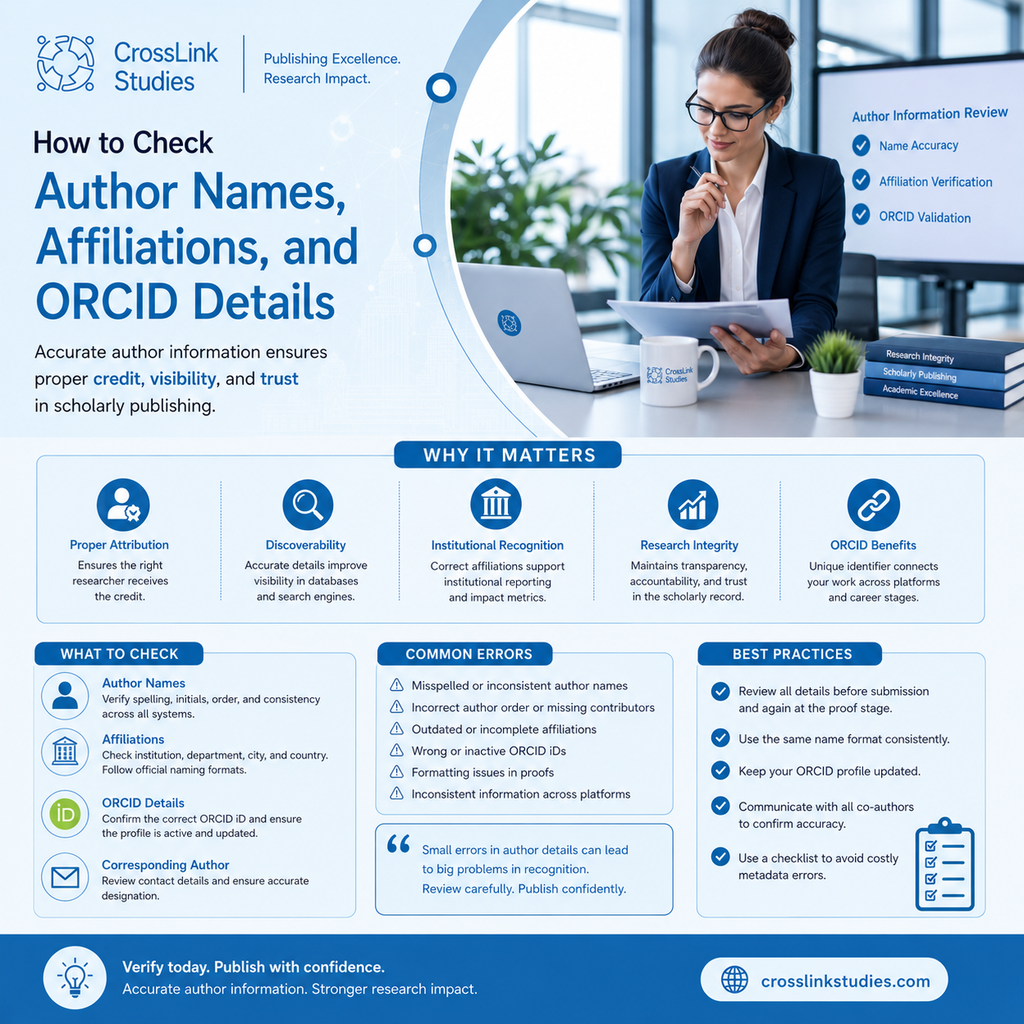
Why Author Information Matters in Scholarly Publishing
Authorship is one of the most important forms of academic recognition. Publications contribute to career advancement, grant applications, promotion decisions, institutional rankings, and professional reputation. Consequently, accurate author information is essential for ensuring that researchers receive proper credit for their contributions.
Modern scholarly communication extends far beyond the printed article. Research outputs are indexed in multiple databases, linked to researcher profiles, integrated into institutional repositories, and tracked through citation metrics and analytics platforms. Author metadata serves as the foundation for these systems. Accurate records help:
- Ensure correct attribution of scholarly work.
- Support citation tracking and impact measurement.
- Facilitate collaboration and networking.
- Improve discoverability in databases and search engines.
- Assist institutions in reporting research outputs.
- Strengthen transparency and accountability.
Understanding the Components of Author Metadata
Before examining verification strategies, it is important to understand the key elements that comprise author metadata.
Author Names
The author’s name is the primary identifier associated with a scholarly publication. It connects research outputs to an individual’s academic record and professional identity.
Institutional Affiliations
Affiliations indicate the organization where the research was conducted or with which the author was associated during the study. They support institutional recognition, funding reporting, and bibliometric analysis.
ORCID Identifiers
ORCID (Open Researcher and Contributor ID) provides a unique digital identifier that distinguishes researchers from others with similar names and creates persistent links between individuals and their scholarly outputs.
Verifying Author Names Before Publication
Check Spelling and Consistency
One of the most common publication errors involves inconsistencies in author names. A single missing letter, incorrect initial, or variation in spelling can affect indexing and citation tracking. Authors should carefully verify:
- Full legal or preferred publishing name.
- Middle initials or middle names.
- Capitalization and punctuation.
- Hyphenated names.
- Diacritical marks and special characters.
Consider International Naming Conventions
Researchers from different cultural and linguistic backgrounds may encounter challenges related to name ordering, transliteration, or formatting. Authors should verify how their names appear in manuscript submissions, proof versions, indexing systems, and ORCID records to ensure consistency across platforms.
Reviewing Author Order and Contribution Accuracy
Author order often carries significant academic meaning. In many disciplines, the sequence of authors reflects the relative contribution of each researcher to the study. Before publication, all contributors should confirm:
- The agreed author sequence.
- Corresponding author designation.
- Contribution statements.
- Acknowledgment sections.
Ensuring Accurate Institutional Affiliations
Verify Current and Publication-Relevant Affiliations
Institutional affiliations should accurately reflect the organization associated with the research at the time it was conducted. Authors should review institution names, faculty or school names, department titles, research centers or laboratories and city and country information. Universities often have official naming conventions that should be followed consistently.
Address Multiple Affiliations Correctly
Many researchers hold appointments at multiple institutions or participate in collaborative projects involving several organizations. In such cases, affiliations should be presented clearly and consistently according to journal guidelines. Authors should ensure that all eligible institutions receive appropriate recognition while avoiding unnecessary complexity.
Check Affiliation Formatting in Proofs
Production workflows occasionally introduce formatting changes that affect affiliation presentation. Authors should carefully review proofs to confirm that affiliation numbering, superscripts, and institutional details remain accurate.
Understanding the Importance of ORCID
What Is ORCID?
ORCID provides a persistent digital identifier that uniquely distinguishes researchers regardless of name similarities, career changes, or institutional movement. Unlike names, which may change over time or vary across cultures, an ORCID identifier remains constant throughout a researcher’s career.
Why ORCID Matters
The adoption of ORCID has increased significantly across the scholarly publishing ecosystem.
Benefits include:
- Improved author identification.
- Enhanced publication discoverability.
- Reduced ambiguity in attribution.
- Better integration with funding systems.
- Simplified manuscript submission processes.
- More accurate citation tracking.
Verifying ORCID Details Before Publication
Confirm the Correct Identifier
A common mistake involves entering an incorrect ORCID identifier during manuscript submission. Authors should verify that:
- The identifier belongs to the correct researcher.
- All digits are accurate.
- The ORCID profile is active.
- The identifier matches institutional records.
Update ORCID Records
Researchers should ensure that their ORCID profiles contain current information before publication. Recommended updates include current affiliations, recent publications, funding information, professional activities and education and employment history. Maintaining an updated ORCID record improves profile completeness and visibility.
Ensure Consistency Across Systems
The name and affiliation displayed in ORCID should align closely with information provided to the journal. Consistency across systems helps reduce confusion and improves metadata accuracy.
Common Metadata Errors Identified During Production
Production teams frequently encounter issues such as:
- Misspelled author names.
- Missing middle initials.
- Incorrect affiliation numbering.
- Outdated institutional information.
- Duplicate author records.
- Invalid ORCID identifiers.
- Inconsistent author ordering.
Creating a Pre-Publication Author Information Checklist
A structured verification process can significantly reduce errors. Before approving proofs, authors should confirm:
Author Names
- Correct spelling.
- Consistent formatting.
- Appropriate initials.
- Accurate sequence.
Affiliations
- Official institutional names.
- Department information.
- City and country details.
- Multiple affiliations correctly assigned.
ORCID Information
- Correct identifier.
- Active profile.
- Updated records.
- Consistent metadata.
Corresponding Author Details
- Current email address.
- Accurate contact information.
- Correct designation.
Using a checklist promotes thorough review and minimizes overlooked issues.
The Relationship Between Metadata Accuracy and Research Visibility
Accurate author metadata directly influences the visibility and impact of scholarly research. Search engines, indexing databases, institutional repositories, funding agencies, and citation tracking systems rely heavily on metadata to identify and classify publications.
Errors can reduce discoverability, fragment citation records, and complicate institutional reporting. Conversely, well-maintained author information strengthens professional visibility, improves attribution, and enhances the accessibility of research outputs.
Conclusion
Verifying author names, affiliations, and ORCID details is one of the most important yet frequently overlooked responsibilities in the publication process. While these elements may appear secondary to the scientific content of a manuscript, they play a crucial role in attribution, discoverability, accountability, and research visibility.
By carefully reviewing author information before publication, researchers can prevent indexing errors, improve citation tracking, strengthen institutional recognition, and ensure that their scholarly contributions are accurately represented within the global research ecosystem.
As scholarly publishing continues to embrace digital identifiers, metadata-driven discovery, and research transparency, attention to author information has become an essential component of publication excellence. Investing time in this final verification step helps protect the integrity of the scholarly record and ensures that researchers receive the recognition they deserve for their work.