
How Editors Use Author-Suggested Reviewers
Understanding the Role of Reviewer Recommendations in Scholarly Publishing
Peer review is at the heart of academic publishing. It serves as a critical quality-control mechanism, helping journals evaluate the originality, significance, technical soundness, and scholarly contribution of submitted research. To support this process, many journals invite authors to suggest potential reviewers during manuscript submission.
For many researchers, particularly early-career authors, there is often uncertainty about how these recommendations are actually used. Some assume that suggested reviewers are automatically invited, while others believe their recommendations have little influence on editorial decisions. In reality, author-suggested reviewers can be a valuable resource for editors, but they represent only one component of a much broader reviewer selection process. Understanding how editors evaluate and use reviewer recommendations can help authors make more effective and ethical submissions.
Why Journals Request Reviewer Suggestions
Modern academic journals receive a large volume of submissions across increasingly specialized fields. Identifying qualified reviewers can be challenging, particularly when manuscripts involve emerging technologies, interdisciplinary research, or niche methodologies.
Reviewer suggestions can help editors:
- Identify subject-matter experts.
- Locate specialists in emerging research areas.
- Expand reviewer databases.
- Accelerate reviewer selection.
- Improve the efficiency of peer review.
For technology-focused journals such as UTJ, where topics may span artificial intelligence, cybersecurity, data science, ubiquitous computing, IoT, software engineering, and related fields, author recommendations can provide useful insight into the appropriate expertise required for manuscript evaluation.
Reviewer Suggestions Are Recommendations, Not Appointments
One of the most common misconceptions among authors is that suggested reviewers will automatically evaluate their manuscript.
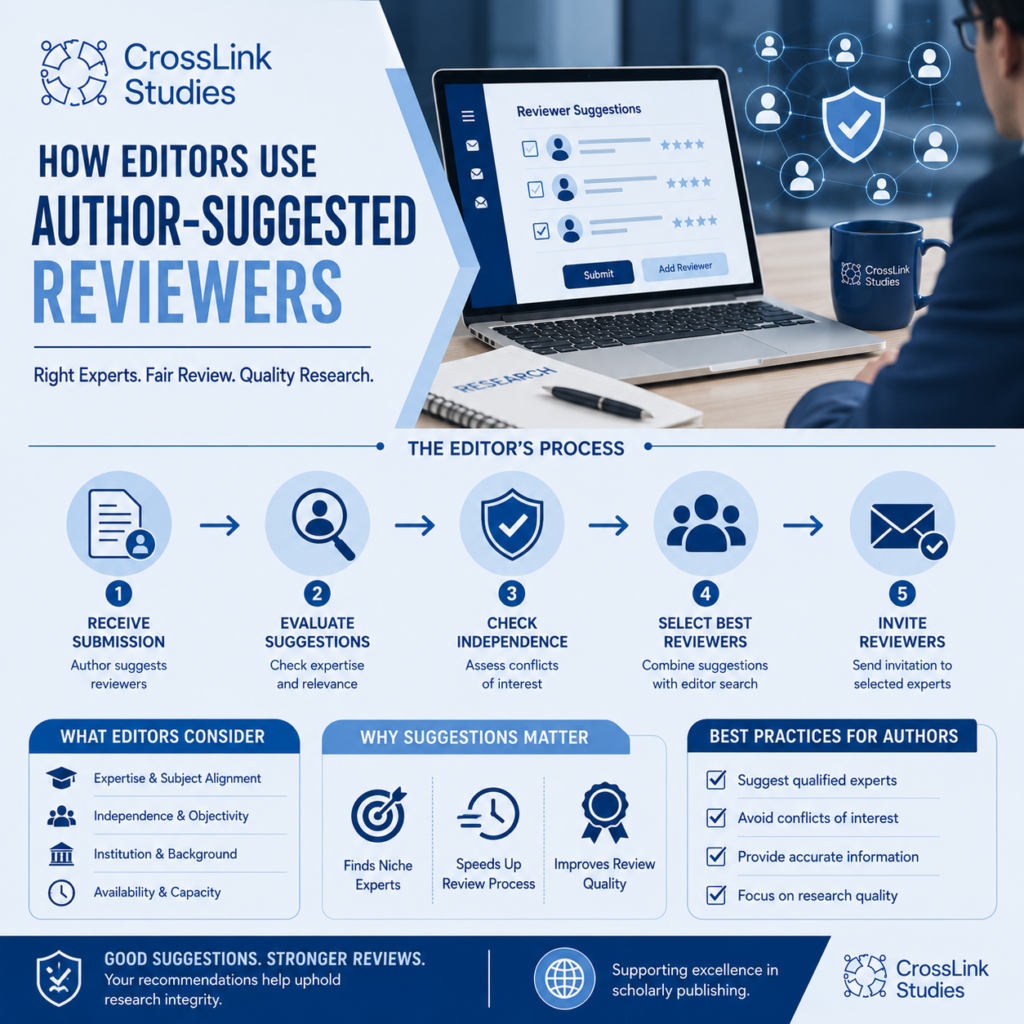
In practice, reviewer recommendations are considered advisory rather than mandatory. Editors retain complete responsibility for reviewer selection, reviewer invitations, conflict-of-interest assessment, peer review management and final editorial decisions. A suggested reviewer may be invited, considered for future reviews, or not used at all depending on the editor’s evaluation and the journal’s policies. The ultimate goal is to ensure an independent, fair, and rigorous review process.
How Editors Evaluate Suggested Reviewers
Before inviting a recommended reviewer, editors typically conduct several checks to determine whether the individual is suitable for the manuscript.
Expertise Assessment
The first consideration is whether the proposed reviewer possesses relevant expertise. Editors often examine research publications, subject specialization, citation records, conference participation and professional achievements. The reviewer’s knowledge should closely align with the manuscript’s topic and methodology.
Independence and Objectivity
Expertise alone is not sufficient. Editors must also determine whether the reviewer can provide an unbiased evaluation.Potential concerns may include:
- Recent co-authorship with the authors.
- Employment at the same institution.
- Ongoing research collaborations.
- Personal relationships.
- Financial interests related to the study.
Reviewers with significant conflicts of interest are generally excluded from consideration.
Reviewer Availability
Even highly qualified reviewers may not be selected if they are unavailable or already handling multiple review assignments.Editors often maintain large reviewer pools to ensure timely evaluations.
How Suggested Reviewers Fit into the Selection Process
Author recommendations are typically evaluated alongside other reviewer identification methods. Editors may identify reviewers through:
- Journal reviewer databases.
- Editorial board recommendations.
- Literature searches.
- Citation networks.
- Previous reviewer performance.
- Professional societies and research communities.
As a result, a manuscript’s reviewer panel often includes a combination of author-suggested reviewers and independently selected experts. This balanced approach helps maintain objectivity while ensuring appropriate technical expertise.
Why Editors Sometimes Do Not Use Suggested Reviewers
Authors occasionally wonder why none of their recommended reviewers were invited. Several reasons may explain this outcome:
Potential Conflicts of Interest
Editors may identify relationships that could compromise reviewer independence.
Limited Subject Alignment
The suggested reviewer may not possess expertise that closely matches the manuscript’s focus.
Reviewer Availability Issues
Qualified reviewers frequently decline invitations because of workload constraints or scheduling commitments.
Journal Policies
CLS journals intentionally limit reliance on author-suggested reviewers to preserve reviewer diversity and independence. Not using a suggested reviewer does not reflect negatively on the manuscript or the recommendation itself.
What Makes a Strong Reviewer Recommendation?
Editors generally value reviewer suggestions that demonstrate both expertise and independence. Effective recommendations typically include:
- Full professional name.
- Current institutional affiliation.
- Professional email address.
- Relevant research expertise.
- No apparent conflicts of interest.
Strong recommendations help editors assess suitability more efficiently and contribute to a smoother peer review process.
Best Practices for Authors
When suggesting reviewers, authors should focus on supporting the integrity of peer review rather than influencing the outcome. Recommended practices include:
Prioritize Expertise
Select reviewers whose research closely aligns with the manuscript.
Ensure Independence
Avoid recommending close collaborators, recent co-authors, or colleagues from the same institution.
Provide Accurate Information
Include complete and current professional details.
Suggest Diverse Experts
Consider reviewers from different institutions, countries, and research communities.
Respect Editorial Judgment
Recognize that reviewer selection remains the editor’s responsibility.
These practices help strengthen trust in the peer review system and promote fair manuscript evaluation.
The Importance of Transparency
Transparency is a cornerstone of ethical scholarly publishing. Author-suggested reviewers can contribute positively to peer review when recommendations are based on expertise, objectivity, and professional integrity.
Editors rely on multiple safeguards to ensure that reviewer selection remains impartial and aligned with journal standards. By understanding this process, authors can provide reviewer recommendations that genuinely support high-quality scholarly assessment.
Author-suggested reviewers play an important but carefully managed role in academic publishing. Their purpose is to assist editors in identifying qualified experts not to influence editorial outcomes. Editors evaluate every recommendation through the lens of expertise, independence, and fairness before deciding whether a reviewer should be invited.
Ultimately, reviewer recommendations work best when authors approach them as a contribution to research quality rather than a strategic advantage. A transparent and ethical reviewer recommendation process strengthens peer review, improves publication quality, and supports the credibility of scientific communication across the global research community.