
Self-Archiving Accepted Manuscripts Responsibly
The modern research ecosystem increasingly emphasizes openness, accessibility, and knowledge sharing. Researchers today are expected not only to publish high-quality work but also to maximize its visibility and impact. As a result, self-archiving has become an important component of scholarly communication, allowing authors to share their research with wider audiences beyond traditional publishing channels.
However, while self-archiving offers significant benefits, it also requires careful consideration of publishing policies, copyright obligations, licensing requirements, and version control. Improper sharing can create confusion about which version of a manuscript is authoritative, potentially undermine the integrity of the scholarly record, and lead to unintended copyright concerns.
For these reasons, responsible self-archiving is essential. At Crosslink Studies (CLS), the principles of open scholarship are closely aligned with the goal of increasing the discoverability, accessibility, and long-term value of research. Understanding how to archive accepted manuscripts appropriately enables authors to broaden the reach of their work while maintaining compliance with journal policies and scholarly publishing standards.
What is Self-Archiving?
Self-archiving refers to the practice of depositing a scholarly manuscript in a repository, institutional archive, personal website, or other approved platform to make research more widely accessible. The purpose of self-archiving is straightforward: to increase the availability of scholarly knowledge while supporting the dissemination of research findings to academic communities, industry professionals, policymakers, educators, and the public. Researchers often encounter different versions of a manuscript during the publication process, including:
Preprint
The original manuscript before peer review.
Accepted Manuscript
The version that has successfully passed peer review and incorporates revisions requested by reviewers and editors but has not yet undergone journal formatting, copyediting, typesetting, or final publication production.
Version of Record
The final published article that appears in the journal and serves as the authoritative scholarly record.
Why Self-Archiving Matters
The visibility of research is increasingly important in a competitive academic environment. Publishing alone does not guarantee that research will reach its intended audience. Self-archiving helps bridge this gap by improving discoverability across search engines, repositories, academic networks, and institutional databases. The benefits are substantial. Researchers who responsibly archive accepted manuscripts may experience:
- Greater global visibility.
- Increased accessibility for readers without subscription access.
- Enhanced opportunities for collaboration.
- Improved knowledge dissemination.
- Broader societal impact.
- Increased engagement from interdisciplinary audiences.
For early-career researchers in particular, self-archiving can play a valuable role in establishing scholarly presence and expanding professional networks. Most importantly, self-archiving contributes to a more open and inclusive research ecosystem where knowledge can be shared beyond institutional and geographical boundaries.
Understanding the Accepted Manuscript
Among the various manuscript versions, the accepted manuscript occupies a unique position. This version represents the culmination of the peer-review process. It contains the scientific content that has been evaluated, revised, and approved for publication. However, it does not yet include the publisher’s final formatting, branding, pagination, copyediting, or production enhancements.
Because the accepted manuscript contains validated scholarly content while remaining distinct from the final published version, many publishers permit its archiving under specific conditions. Authors should recognize that the accepted manuscript is not identical to the published article. The Version of Record remains the definitive citation source and should always be acknowledged when available. Maintaining this distinction protects the integrity of scholarly communication and reduces confusion among readers.
Responsible Self-Archiving Practices
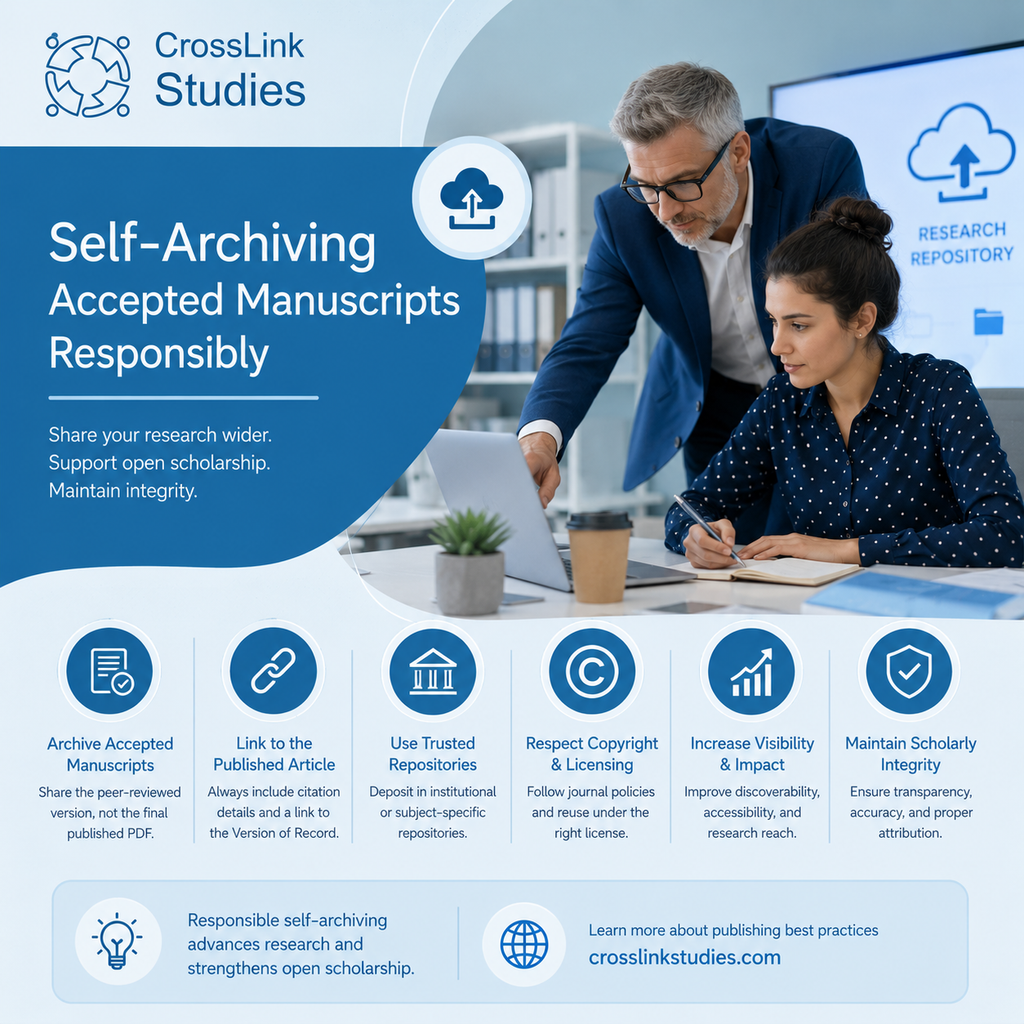
Self-archiving is most effective when it follows established publishing standards. Researchers should consider several best practices before depositing accepted manuscripts.
Clearly Identify the Manuscript Version
One of the most common mistakes in self-archiving is failing to indicate which manuscript version is being shared. Readers should be informed that the deposited file is an accepted manuscript rather than the final published article. A clear statement helps prevent misunderstanding and ensures transparency throughout the research dissemination process.
Include Full Citation Information
Whenever possible, archived manuscripts should include complete bibliographic information for the published article. This information may include:
- Article title
- Author names
- Journal name
- Publication year
- Volume and issue details
- DOI or permanent article link
Link to the Published Article
The final published article serves as the authoritative source of record. Therefore, authors should provide a direct link to the published version whenever available. This practice benefits readers by allowing them to access the most current and professionally produced version of the work while preserving the journal’s role in maintaining the scholarly record.
Use Trusted Repositories
Not all online platforms provide the same level of preservation, discoverability, or credibility. Researchers should prioritize established repositories such as:
- Institutional repositories
- University archives
- Subject-specific repositories
- Research organization repositories
- Recognized open-access repositories
Balancing Accessibility and Scholarly Integrity
The primary purpose of self-archiving is to expand access to research. Yet accessibility should never come at the expense of scholarly integrity. The academic publishing process involves extensive editorial oversight, peer review, production quality control, and permanent archiving. These elements contribute to the reliability and credibility of published research.
Responsible self-archiving acknowledges this contribution by ensuring that readers can distinguish between manuscript versions and locate the official Version of Record. Rather than competing with formal publication, self-archiving should complement it. When implemented properly, both mechanisms work together to strengthen research dissemination and scholarly communication.
Copyright and Licensing Considerations
Copyright and licensing remain central to self-archiving decisions. Before depositing an accepted manuscript, authors should understand the rights they retain and the permissions granted through the publication process. Open-access publishing models increasingly support author rights while facilitating broad dissemination. Nevertheless, authors must still ensure that sharing practices align with applicable licensing terms and journal policies. Key questions researchers should consider include:
- Which manuscript version may be archived?
- Are there specific repository requirements?
- What licensing conditions apply?
- How should the published article be cited?
- Are there restrictions on commercial reuse?
Common Self-Archiving Mistakes to Avoid
Even experienced researchers occasionally make avoidable mistakes when sharing accepted manuscripts. Some of the most common include:
Uploading the Wrong Version
Sharing the publisher-formatted Version of Record when permissions apply only to accepted manuscripts can create compliance concerns.
Omitting Citation Details
Failure to provide complete publication information reduces discoverability and may create citation inconsistencies.
Ignoring Repository Standards
Depositing manuscripts on platforms that lack long-term preservation or reliable metadata may limit visibility and future access.
Failing to Update Records
Once an article is formally published, repository entries should be updated with publication details and links to the final version.
Avoiding these mistakes strengthens both compliance and research impact.
How Responsible Self-Archiving Benefits Researchers
When approached thoughtfully, self-archiving creates advantages that extend beyond accessibility. Researchers benefit from:
- Increased visibility across global audiences.
- Improved discoverability through repository indexing.
- Greater opportunities for collaboration.
- Enhanced academic reputation.
- Broader dissemination of research findings.
- Support for open science initiatives.
- Increased public engagement with scholarly knowledge.
Supporting Open Scholarship Through Responsible Sharing
Open scholarship is not simply about making research available, it is about sharing research in ways that are transparent, ethical, sustainable, and beneficial to the scholarly community. Responsible self-archiving reflects these principles by balancing openness with accountability. It respects copyright, preserves the scholarly record, acknowledges the value of peer review, and promotes the discoverability of research across diverse audiences. For authors publishing with CLS, self-archiving represents an opportunity to extend the reach of their work while contributing to a more connected and accessible global research ecosystem.
The value of research is measured not only by its quality but also by its ability to reach those who can build upon it. Self-archiving accepted manuscripts provides researchers with a powerful mechanism for expanding visibility, increasing accessibility, and strengthening scholarly impact. However, effective self-archiving requires more than simply uploading a file. It demands careful attention to manuscript versions, citation practices, repository selection, copyright considerations, and scholarly integrity. By archiving accepted manuscripts responsibly, researchers can maximize the reach of their work while preserving the reliability and credibility of the academic record. As open scholarship continues to evolve, responsible self-archiving will remain an essential practice for researchers committed to advancing knowledge and fostering global research collaboration.