

What to Do When One Reviewer Accepts and Another Rejects
Few moments in academic publishing create more uncertainty than receiving mixed peer-review reports. One reviewer may recommend acceptance or minor revisions, praising the novelty and significance of the research, while another may recommend rejection, citing substantial concerns about methodology, analysis, interpretation, or presentation.
For many authors, such conflicting feedback can be frustrating and confusing. Questions immediately arise: Which reviewer is correct? Should the manuscript be revised extensively? Is rejection inevitable? How should the response be structured?
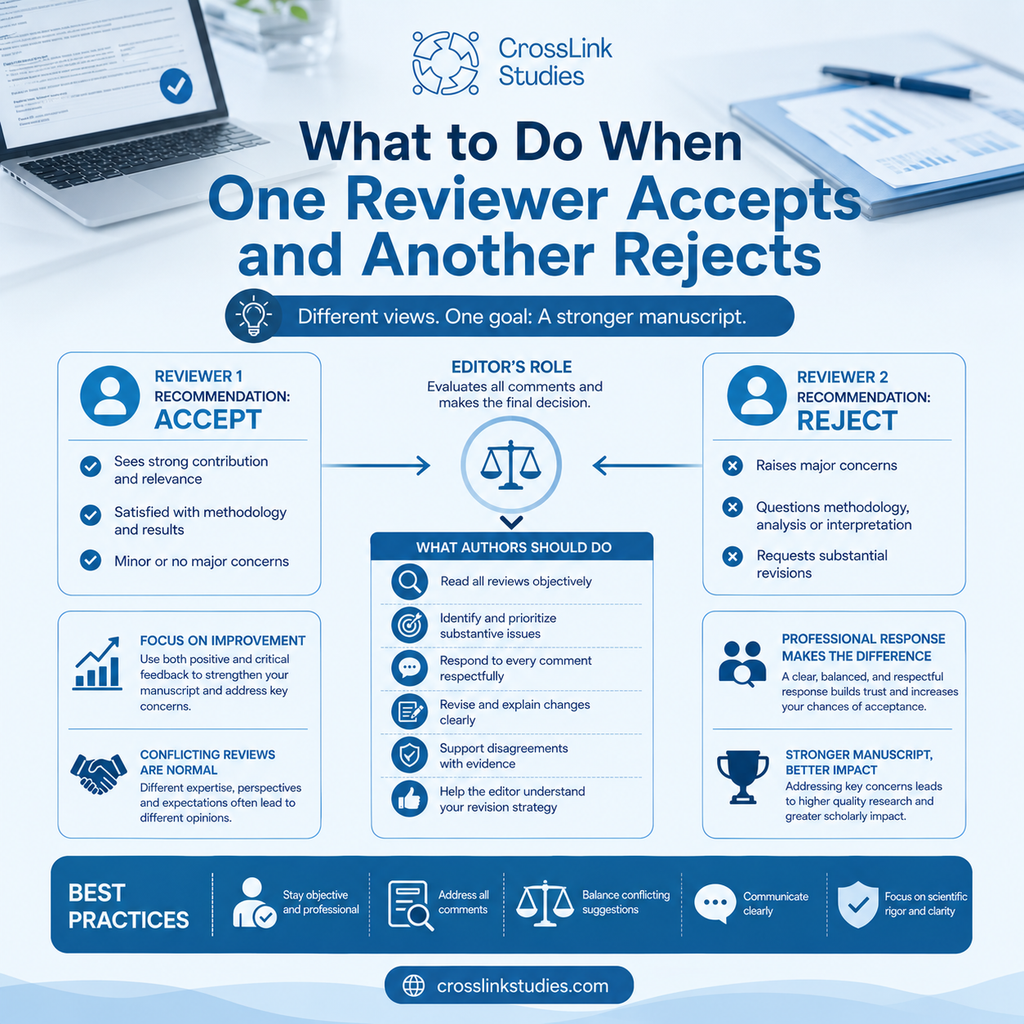
The reality is that conflicting reviews are a normal part of scholarly publishing. Different reviewers bring different expertise, perspectives, expectations, and research experiences to the evaluation process. Editors understand this and are accustomed to making decisions when reviewer opinions differ.
The key for authors is not to focus on which reviewer was “right” or “wrong,” but rather on understanding the concerns raised and responding strategically, professionally, and objectively.
Why Reviewer Recommendations Often Differ
Different Expertise Leads to Different Perspectives
Peer reviewers are selected because of their expertise, but expertise itself can vary significantly. One reviewer may focus primarily on methodology, while another evaluates theoretical contribution, practical implications, or technical innovation.
As a result, reviewers often assess the same manuscript through different lenses.
For example:
- A technical reviewer may appreciate methodological rigor.
- A domain specialist may question practical relevance.
- A statistical reviewer may focus on analytical approaches.
- A theoretical reviewer may seek stronger conceptual framing.
Reviewers Have Different Expectations
Academic disciplines, research traditions, and publication experiences influence reviewer expectations. One reviewer may consider the study sufficiently comprehensive, while another may expect additional experiments, broader validation, or deeper discussion.
Editors recognize these differences and evaluate reviewer comments based on their relevance, validity, and impact on the manuscript’s overall quality.
Understanding the Editor’s Role
The Editor Makes the Final Decision
Authors sometimes assume that reviewer recommendations directly determine publication outcomes. In reality, reviewers provide expert advice, but the final decision rests with the editor.
Editors evaluate:
- Reviewer comments.
- Reviewer recommendations.
- Manuscript quality.
- Journal scope and objectives.
- Scientific contribution.
- Feasibility of revisions.
A manuscript may ultimately be accepted despite a reviewer recommending rejection if the editor believes the concerns can be addressed through revision. Similarly, a manuscript may be rejected even when one reviewer recommends acceptance if significant unresolved issues remain. Therefore, authors should focus on addressing substantive concerns rather than counting positive and negative recommendations.
Step One: Read All Reviews Objectively
Avoid Emotional Reactions
Receiving a rejection recommendation can be discouraging, especially when another reviewer has responded positively. However, immediate emotional reactions often prevent authors from recognizing valuable feedback.
Before preparing revisions read all comments carefully, separate criticism of the manuscript from criticism of the researcher and identify recurring concerns.
Step Two: Identify the Core Issues
Look Beyond the Recommendation
A rejection recommendation is often less important than the reasons behind it.
Consider whether the reviewer is raising concerns about:
Methodology
Are there weaknesses in study design, data collection, sampling, or analysis?
Interpretation
Do conclusions extend beyond the evidence presented?
Literature Coverage
Are important studies missing?
Presentation
Are explanations unclear or insufficiently detailed?
Scope and Relevance
Does the reviewer question the manuscript’s fit within the journal?
By identifying the root causes of concern, authors can develop a focused revision strategy.
Step Three: Prioritize Substantive Concerns
Address Major Issues First
When reviews conflict, authors should give particular attention to comments that affect scientific validity.
Examples include experimental design, statistical methods, data reliability, reproducibility and research limitations. Addressing these concerns thoroughly demonstrates commitment to scientific rigor and often reassures both reviewers and editors. Minor stylistic disagreements should receive less attention than issues affecting the study’s credibility.
Step Four: Respond to Every Reviewer Respectfully
Treat All Comments Seriously
A common mistake is focusing only on the negative review while largely ignoring the positive one.
Instead:
- Respond to every comment.
- Acknowledge constructive feedback.
- Explain all revisions clearly.
- Provide evidence when necessary.
A balanced response letter demonstrates professionalism and respect for the peer-review process.
When Reviewer Comments Conflict
Handling Contradictory Suggestions
Occasionally, reviewers may provide directly opposing recommendations.
For example:
Reviewer A:
“The methodology section is too detailed and should be shortened.”
Reviewer B:
“The methodology section requires additional detail.”
Example Response
We thank both reviewers for their valuable observations. To balance readability and methodological transparency, we streamlined repetitive descriptions while adding targeted clarification regarding data collection and analytical procedures. These revisions are presented in Section 3.
Communicating with the Editor
Use the Response Letter Strategically
When reviews conflict substantially, the response letter becomes particularly important. Authors should:
- Explain revisions clearly.
- Address critical concerns directly.
- Highlight major improvements.
- Clarify areas where reviewer recommendations differed.
The response letter helps editors understand how conflicting feedback was evaluated and incorporated into the revision process.
What If You Disagree with the Negative Reviewer?
Respond with Evidence, Not Emotion
There may be instances where a rejection recommendation is based on a misunderstanding, incorrect assumption, or suggestion that does not align with the study’s objectives. In these cases, authors may respectfully disagree.
Example
Reviewer Comment:
“The study requires an entirely different experimental framework.”
Professional Response:
We appreciate the reviewer’s perspective. However, the proposed framework would address a different research question than the one investigated in this study. The current methodology was selected to align with the stated objectives and follows approaches commonly adopted in related literature. To improve clarity, we have expanded the methodological justification in Section 3.
Turning Conflicting Reviews into an Advantage
Mixed Reviews Often Lead to Stronger Manuscripts
While conflicting reviews may initially seem problematic, they often provide a broader assessment of the manuscript. Positive reviewers identify strengths. Critical reviewers identify weaknesses. Many highly cited articles underwent substantial revision after receiving conflicting peer-review reports.
Common Mistakes to Avoid
Focusing Only on Reviewer Recommendations
The recommendation itself is less important than the underlying concerns.
Ignoring Critical Feedback
Even if one reviewer supports acceptance, serious concerns should never be dismissed.
Becoming Defensive
Professional communication remains essential throughout the revision process.
Assuming the Negative Reviewer Is Wrong
Critical feedback often reveals opportunities for improvement.
Failing to Explain Revisions
Editors and reviewers should be able to easily identify how concerns were addressed.
Best Practices for Authors
When one reviewer recommends acceptance and another recommends rejection:
- Stay objective and professional.
- Analyze comments carefully.
- Identify substantive concerns.
- Prioritize scientific rigor.
- Address all reviewer comments.
- Resolve conflicting suggestions thoughtfully.
- Communicate revisions clearly.
- Support disagreements with evidence.
- Help editors understand your revision strategy.
Conclusion
Conflicting peer-review reports are a common feature of academic publishing and should not be viewed as a sign that a manuscript is destined for rejection. Differences in reviewer recommendations often reflect varying expertise, expectations, and perspectives rather than fundamental flaws in the research.
The most successful authors approach mixed reviews strategically. Rather than focusing on the contrast between acceptance and rejection recommendations, they concentrate on understanding reviewer concerns, improving the manuscript, and communicating revisions effectively.
By responding thoughtfully, addressing substantive issues, and maintaining a professional tone, authors can transform conflicting reviews into an opportunity to strengthen their work and improve its chances of successful publication. In scholarly publishing, the ability to navigate disagreement constructively is often as important as the research itself.