
How to Connect Findings Back to the Original Research Question?
In high-quality academic publishing, presenting results is only one part of effective scientific communication. The true strength of a research paper lies in the author’s ability to explain how the findings answer the original research question. Many manuscripts contain technically sound data, advanced methodologies, and statistically significant results, yet fail to clearly demonstrate how those findings address the central objective of the study. As a result, research may appear fragmented, descriptive, or incomplete despite its scientific value.
For authors submitting to the Ubiquitous Technology Journal (UTJ) by CLS Crosslink Studies, this aspect is particularly important. Because the journal focuses on technology-oriented and applied research fields such as ubiquitous computing, engineering systems, artificial intelligence, cybersecurity, information systems, networking, and digital innovation, reviewers expect authors to move beyond reporting numerical outputs or system performance metrics and clearly explain what those findings mean in relation to the research objective.
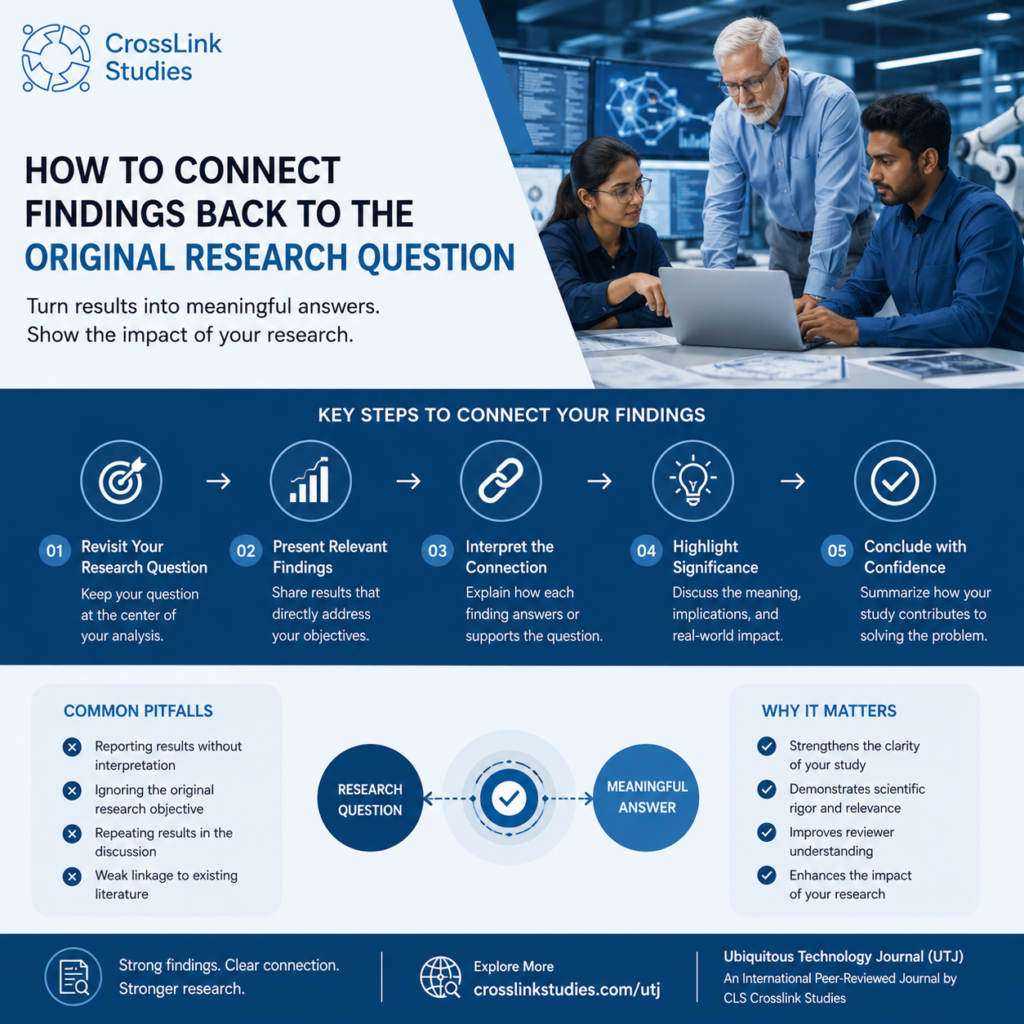
The Research Question as the Foundation of the Study
A research question serves as the intellectual foundation of any scientific investigation. It defines the problem being explored and guides the methodology, data analysis, interpretation, and conclusions. Every major section of a research paper should contribute toward answering that question.
However, one of the most common weaknesses in engineering and information systems manuscripts is the presentation of isolated findings without sufficient analytical linkage to the study’s purpose. Authors often present extensive results but provide limited explanation of how those results resolve the original problem identified in the introduction.
Moving Beyond Data Reporting
For example, a manuscript may report that a proposed machine learning model achieved a classification accuracy of 97%. While this result may appear impressive, reviewers still expect the author to explain how that performance addresses the original research problem.
Important questions remain:
- Does the model overcome limitations identified in previous studies?
- Does it improve efficiency, scalability, security, or reliability?
- Does it support the study’s hypothesis or research objective?
- Does it offer practical value in real-world applications?
Without such interpretation, the finding remains disconnected from the broader scientific contribution of the research.
Maintaining Alignment Throughout the Manuscript
Connecting findings back to the research question begins with maintaining alignment throughout the manuscript. The concepts, terminology, and objectives introduced in the introduction should remain visible throughout the results, discussion, and conclusion sections.
Consistency in language helps readers recognize how the evidence supports the original purpose of the study. When authors use terminology that reflects their research objectives, the logical progression from problem statement to conclusion becomes clearer and more persuasive.
Explicitly Linking Findings to Research Objectives
One of the most effective strategies is to directly reference the research objective while interpreting findings.
Instead of writing:
“The proposed framework reduced network latency by 21%.”
A stronger scholarly interpretation would be:
“The reduction in network latency directly addresses the study’s objective of improving real-time communication efficiency in IoT-based smart healthcare systems.”
Explaining the Significance of Findings
A common weakness in technical manuscripts is an excessive focus on performance metrics without adequate discussion of their significance. While quantitative results are important, journals increasingly prioritize analytical depth over descriptive reporting.
Readers want to understand why the findings matter and how they contribute to advancing knowledge or improving practice.
For example:
- In cybersecurity research, improved intrusion detection accuracy should be connected to enhanced system resilience, reduced security risks, or fewer false positives.
- In artificial intelligence research, increased model accuracy should be linked to improved decision-making reliability, computational efficiency, or scalability.
- In networking research, performance improvements should be related to communication effectiveness, resource optimization, or system stability.
By explaining the broader implications of findings, authors strengthen the impact and relevance of their work.
Positioning Findings Within Existing Literature
Professional academic writing requires authors to discuss whether their findings support, extend, or challenge existing research. Comparative interpretation helps position the study within ongoing scholarly conversations and demonstrates awareness of current developments in the field.
For instance, an author may explain:
“The observed improvement in prediction accuracy aligns with recent deep learning optimization studies while outperforming earlier CNN-based architectures reported in previous IoT security research.”
Interpreting Tables, Figures, and Performance Comparisons
In engineering and information systems research, findings are frequently presented through tables, figures, simulations, benchmark evaluations, and comparative performance analyses. While these visual elements provide technical evidence, they do not interpret themselves.
Authors should avoid assuming that readers will automatically understand the implications of the presented data. The discussion section should clearly explain how the evidence answers the research question and supports the study’s objectives.
Avoiding Repetition in the Discussion Section
One of the most common manuscript preparation mistakes is turning the discussion section into a repetition of the results section.
Simply restating numerical values adds little scholarly value. Instead, the discussion should focus on interpretation of findings, practical implications, theoretical contributions, comparisons with previous studies, limitations of the research and future research directions. A strong discussion section explains what the results mean rather than merely restating what the results are.
Structuring Discussions Around Research Questions
Another effective approach is to organize the discussion according to the study’s research questions or hypotheses. This structure improves clarity and helps reviewers follow the logical progression of the analysis.
A typical framework may include:
Research Question 1
Related Findings → Interpretation → Implications
Research Question 2
Related Findings → Comparative Analysis → Contribution to Knowledge
Research Question 3
Related Findings → Practical Applications → Future Opportunities
Acknowledging Research Limitations
When connecting findings to the research question, authors should also acknowledge limitations. No study completely resolves every aspect of a complex scientific problem. Discussing limitations demonstrates intellectual honesty and helps contextualize conclusions appropriately.
Strengthening the Conclusion
A strong conclusion should directly revisit the original research question. Many manuscripts end with a generic summary of results rather than clearly explaining how the study addressed the problem that motivated the research.
An effective conclusion reinforces the contribution of the findings and highlights their broader significance.
For example:
“This study successfully addressed the challenge of secure data transmission in IoT environments by proposing an optimized encryption framework that demonstrated improved computational efficiency and reduced energy consumption compared with existing methods.”
This statement clearly reconnects the findings to the original purpose of the study while emphasizing the practical value of the research.
Relevance for UTJ Authors
For authors submitting to the Ubiquitous Technology Journal (UTJ), the ability to connect findings back to the research question is essential for demonstrating scientific rigor, analytical maturity, and publication readiness. Because UTJ emphasizes technological innovation and applied research impact, manuscripts should clearly show how experimental results contribute to solving meaningful engineering and information systems challenges.
Authors who successfully establish this connection strengthen the coherence of their papers, improve reviewer confidence, and enhance the overall scholarly value of their research.
When authors successfully connect results to the study’s objectives, their manuscripts become more persuasive, coherent, and impactful. This analytical linkage transforms data into knowledge, strengthens scientific contributions, and increases the likelihood of successful publication in reputable scholarly journals.