Understanding Technical Pre-Check and Editorial Pre-Check
Every Successful Submission Begins Before Peer Review
Many researchers believe that peer review is the first significant evaluation of a manuscript. In reality, the publication process begins much earlier. Before a manuscript reaches expert reviewers, it must successfully pass two essential screening stages: The Technical Pre-Check and the Editorial Pre-Check.
These initial assessments are not administrative formalities, they are critical quality assurance steps that help ensure manuscripts entering peer review are complete, relevant, ethically compliant, and scientifically suitable for the journal. Authors who understand these stages can significantly reduce unnecessary delays, avoid early rejection, and improve the efficiency of the editorial process.
At Crosslink Studies (CLS), every submission undergoes a structured editorial workflow designed to uphold academic integrity, maintain publishing quality, and provide a fair and transparent evaluation process. Technical and editorial pre-checks form the foundation of this workflow by identifying issues that can be resolved before valuable reviewer time is invested.
Why Pre-Checks Matter in Scholarly Publishing
The number of manuscript submissions received by scholarly journals continues to grow each year. Editors must therefore ensure that only manuscripts meeting fundamental publication requirements proceed to external review.
Without these preliminary evaluations, reviewers could spend considerable time examining manuscripts that contain formatting problems, incomplete documentation, ethical concerns, or content that falls outside the journal’s scope. This not only delays editorial decisions but also reduces the overall efficiency of the peer-review process.
Pre-checks serve several important purposes:
- Improve editorial efficiency.
- Ensure compliance with journal requirements.
- Protect research integrity.
- Verify that manuscripts are appropriate for the journal.
- Create a smoother experience for authors and reviewers alike.
Rather than acting as obstacles, these assessments help authors present their research in the strongest possible form before scientific evaluation begins.
Stage One: Technical Pre-Check
Ensuring Your Submission Is Complete and Ready for Editorial Assessment
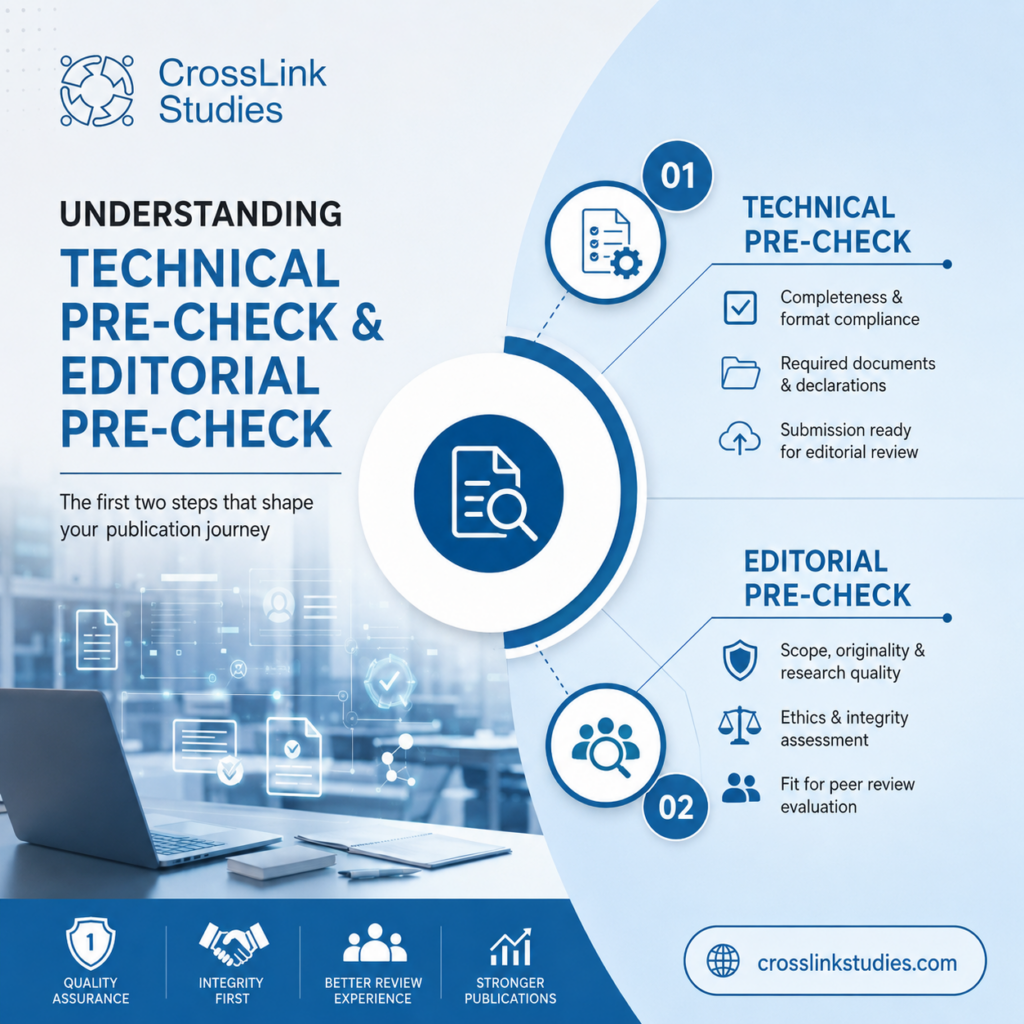
The Technical Pre-Check is the first evaluation performed after manuscript submission. At this stage, editorial staff verify whether the submission satisfies the journal’s technical and administrative requirements.
Importantly, the scientific quality of the research is not evaluated during this stage. Instead, the focus is on determining whether the manuscript is complete, properly prepared, and suitable to enter the editorial workflow. CLS describes this step as assessing the manuscript’s overall suitability for the journal, section, or collection before further evaluation.
What Is Typically Checked?
A technical assessment commonly includes verification of:
- Compliance with the journal’s formatting and manuscript preparation guidelines.
- Correct manuscript structure (title, abstract, keywords, main text, references, figures, and tables).
- Completeness of author information and affiliations.
- Inclusion of required declarations, such as conflicts of interest, funding, and ethical approvals where applicable.
- Appropriate file formats and figure quality.
- Reference consistency and completeness.
- Submission of all required supplementary materials.
- Alignment with the journal’s aims, scope, or selected section.
Even small technical omissions such as missing figure files, incomplete metadata, or incorrectly formatted references can delay editorial processing and require authors to revise their submission before it moves forward.
Stage Two: Editorial Pre-Check
Evaluating Research Quality Before External Peer Review
Once the technical requirements have been satisfied, the manuscript proceeds to the Editorial Pre-Check.
Unlike the technical assessment, this stage focuses on the scholarly and ethical suitability of the research. Editors perform an initial evaluation to determine whether the manuscript meets the journal’s publishing standards and whether it should proceed to independent peer review. This evaluation is not intended to replace peer review. Instead, it serves as an initial quality assessment that helps identify manuscripts unlikely to meet publication standards before reviewers are invited.
At CLS, this stage specifically examines whether the manuscript adheres to high-quality research and ethical standards before external review begins.
Editors Commonly Consider
During the Editorial Pre-Check, editors may evaluate:
- Whether the research fits the journal’s aims and scope.
- The originality and novelty of the contribution.
- Scientific relevance and potential impact.
- Clarity of the research question and objectives.
- Soundness of the study design and methodology.
- Overall quality of writing and presentation.
- Compliance with publication ethics and research integrity requirements.
- Potential ethical concerns, including plagiarism, duplicate submission, inappropriate authorship, or missing approvals.
If substantial concerns are identified at this stage, authors may receive requests for clarification or revision, or the manuscript may be declined before peer review.
Technical Pre-Check Vs Editorial Pre-Check
Although these stages occur consecutively, they evaluate different aspects of a manuscript.
Technical Pre-Check answers the question:
“Is the submission complete, correctly prepared, and ready for editorial evaluation?”
Editorial Pre-Check answers a different question:
“Does this research appear suitable, scientifically credible, ethically compliant, and appropriate for peer review?”
Passing the technical assessment does not guarantee progression beyond the editorial assessment, just as a technically perfect manuscript may still require improvements in originality, clarity, or scientific contribution before reviewers are invited.
Together, these evaluations establish a robust quality-control framework that benefits authors, editors, reviewers, and ultimately the scholarly community.
Common Reasons Manuscripts Do Not Pass Pre-Checks
Many early editorial decisions result from issues that authors could have addressed before submission.
Frequent examples include:
- Submitting research outside the journal’s scope.
- Ignoring manuscript formatting requirements.
- Missing ethical approval statements where required.
- Incomplete author information or declarations.
- Poor-quality English that obscures scientific meaning.
- Low-resolution or improperly labelled figures.
- Potential ethical concerns, including plagiarism or duplicate submission.
Careful preparation before submission can prevent many of these issues and contribute to a more efficient editorial process.
How Authors Can Successfully Navigate Both Stages
Authors can substantially improve their chances of passing both pre-checks by adopting a systematic approach before submission.
Consider the following best practices:
- Carefully read the journal’s Instructions for Authors before preparing the manuscript.
- Confirm that your research clearly aligns with the journal’s aims and scope.
- Follow the recommended manuscript template and formatting requirements.
- Ensure all required sections and declarations are included.
- Verify that references are accurate and complete.
- Review figures, tables, and supplementary files for quality and consistency.
- Check grammar, clarity, and academic writing style.
- Confirm that all authors approve the final version before submission.
- Ensure ethical approvals, informed consent statements, and conflict-of-interest disclosures are provided where applicable.
- Perform a final submission readiness review before uploading your files.
Preparation should be viewed as an integral component of responsible scholarly communication rather than simply an administrative requirement.
Building a Strong Foundation for Peer Review
Peer review remains the cornerstone of scholarly publishing, but its effectiveness depends on the quality of the manuscripts entering the review process. Technical Pre-Checks and Editorial Pre-Checks help establish that foundation by ensuring submissions meet essential technical, scientific, and ethical expectations before external evaluation begins.
For authors, these stages represent an opportunity not a barrier to strengthen their work, improve presentation, and demonstrate professionalism from the very beginning of the publication journey.
At Crosslink Studies, this structured editorial workflow reflects a commitment to research quality, transparency, and integrity. By understanding how these preliminary assessments operate and preparing manuscripts accordingly, researchers can streamline the submission process, facilitate constructive peer review, and increase the likelihood that their research reaches the global scholarly community efficiently and responsibly.