A Submission Readiness Checklist for First-Time Authors
Submitting your first manuscript to an academic journal is a major milestone but it can also be overwhelming. Many first-time authors face desk rejection not because of weak research, but due to avoidable submission issues.
Ubiquitous Technology Journal (UTJ), emphasize that a well-prepared submission reflects professionalism, clarity, and adherence to journal standards. For UTJ a structured submission checklist can significantly improve your chances of successful peer review and publication.
Why a Submission Checklist Matters
A submission readiness checklist helps authors avoid technical and formatting errors, ensure compliance with journal guidelines, present research clearly and professionally, reduce delays during editorial screening. Preparation is not just administrative it is part of research quality assurance.
Manuscript Structure and Clarity
Before submission, ensure your manuscript includes clear and informative title, structured abstract (objective, methods, results, conclusion), logical section flow (Introduction, Methods, Results, Discussion), concise and coherent writing. Editors often make initial decisions based on clarity and organization.
Alignment with Journal Scope
Ask yourself:
- Does the manuscript fit the focus of UTJ (AI, computing, interdisciplinary research)?
- Does it contribute to current scholarly discussions?
Submissions outside the journal’s scope are commonly desk rejected.
Originality and Contribution
Confirm that your work offers a novel contribution, clearly identifies the research gap, avoids plagiarism and redundant publication. Use plagiarism detection tools if necessary to ensure academic integrity.
Methodology and Data Transparency
Ensure that methods are clearly described and reproducible, data sources are properly cited, Data Availability Statement is included (if required). Transparency strengthens both review quality and reader trust.
Figures, Tables, and Visual Quality
Check that figures are high resolution and properly labeled, tables are clear and not redundant, all visuals are referenced in the text. Poor-quality visuals can negatively impact reviewer perception.
References and Citations
Verify that references follow the journal’s citation style, recent and relevant literature is included all in-text citations match the reference list. Accurate referencing reflects scholarly rigor.
Ethical and Compliance Requirements
Before submission, confirm the manuscript is not under review elsewhere, all authors approve the submission, conflicts of interest are disclosed, ethical approvals (if applicable) are included. Failure in this area can lead to immediate rejection.
Cover Letter Preparation
Prepare a concise cover letter that highlights the novelty of your research, explains relevance to the journal, confirms originality and ethical compliance. A strong cover letter supports a positive first editorial impression.
Language and Presentation Quality
Ensure that grammar and language are clear and professional, technical terminology is used correctly, the manuscript is proofread or professionally edited. Clarity enhances both readability and reviewer engagement.
Final Technical Checks
Before clicking “submit,” verify all required files are uploaded (manuscript, figures, supplementary data), file formats meet journal requirements, metadata (author details, keywords) are correctly entered. These small details can prevent submission delays.
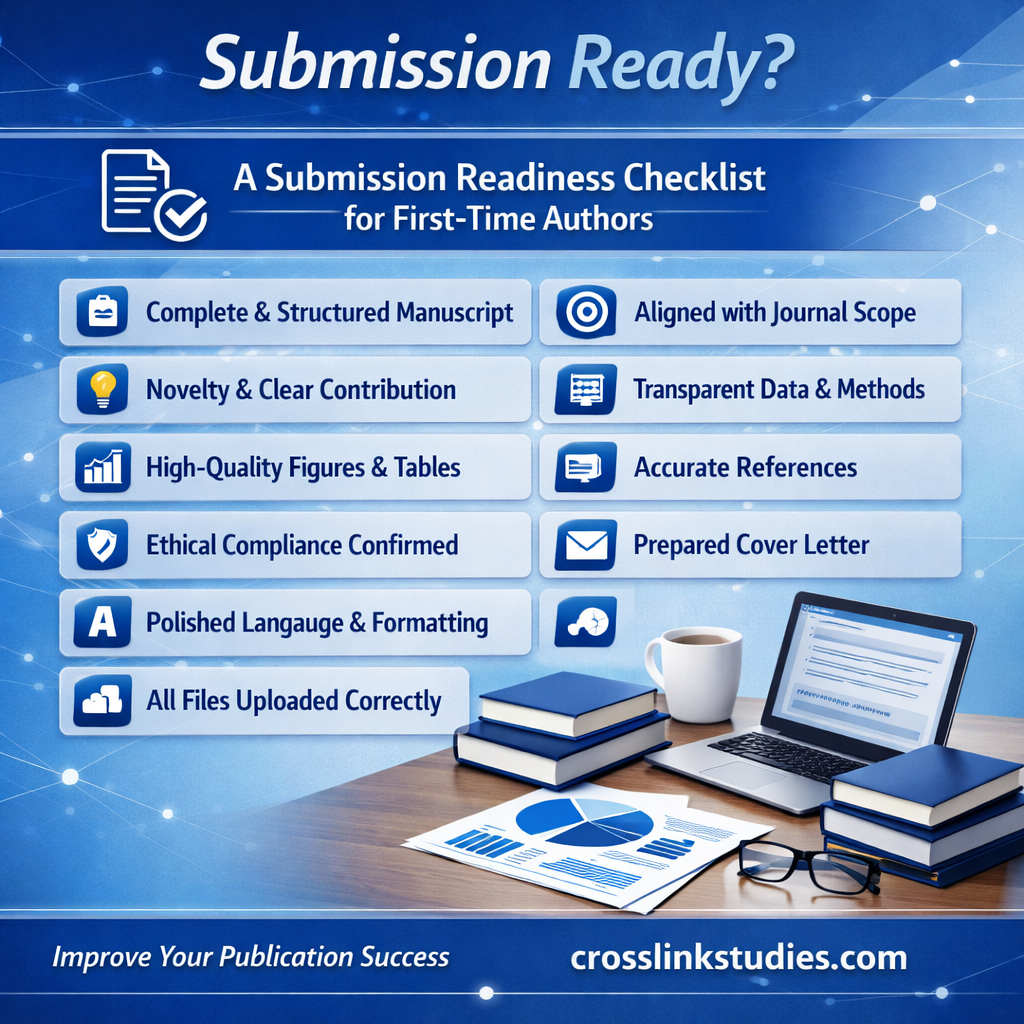
Quick Submission Checklist
- Manuscript is complete and well-structured
- Research aligns with journal scope
- Novelty and contribution are clearly stated
- Data and methods are transparent
- Figures and tables are clear
- References are accurate
- Ethical requirements are fulfilled
- Cover letter is prepared
- Language is polished
- All files and details are correctly uploaded
At UTJ we encourage first-time authors to approach submission with careful preparation and attention to detail. A well-prepared manuscript reflects research quality, facilitates smoother peer review, increases the likelihood of publication success. We view submission readiness as a key step in responsible scholarly communication. By following a structured checklist, first-time authors can avoid common pitfalls and confidently navigate the publication process.