
Responsible Use of AI in Manuscript Preparation: What to Disclose
Artificial Intelligence (AI) is rapidly transforming how researchers write, edit, and refine manuscripts. From language polishing to idea generation, AI tools offer efficiency but they also raise serious questions about transparency, accountability, and research integrity.
Leading publishers now agree on one principle: AI can assist but it cannot replace human responsibility. For CLS journals like Ubiquitous Technology Journal (UTJ) understanding how to use AI responsibly and what to disclose is essential for ethical and high-quality publication.
The Growing Role of AI in Academic Writing
AI tools are increasingly used for language editing and grammar improvement, summarization and paraphrasing, structuring manuscripts, generating initial drafts or outlines. These uses can enhance productivity but must remain under human oversight and control. Authors are ultimately fully responsible for all content, including any AI-assisted material.
Core Principle: AI Is a Tool Not an Author
Across major publishers, there is a clear consensus as AI tools cannot be listed as authors, authorship requires accountability, which AI cannot provide. This means only humans can take credit, only humans bear responsibility for accuracy, originality, and ethics.
When Is AI Use Acceptable?
✔ Acceptable Uses (with caution)
- Language editing and readability improvement
- Grammar correction and formatting
- Idea structuring or brainstorming
These uses are generally allowed, provided authors critically review and revise all outputs.
⚠ Conditional Uses (must be disclosed)
- Generating or rewriting sections of text
- Producing figures, tables, or code
- Assisting in data interpretation or analysis
Such uses go beyond simple editing and require full transparency and disclosure.
✖ Unacceptable or High-Risk Uses
- Submitting AI-generated content without human verification
- Using AI to fabricate data, references, or results
- Allowing AI to replace intellectual contribution
AI outputs may appear convincing but can be incorrect, biased, or fabricated (“hallucinated”), making human validation essential.
What Must Be Disclosed?
Crosslink Studies consistently require clear and transparent disclosure of AI use.
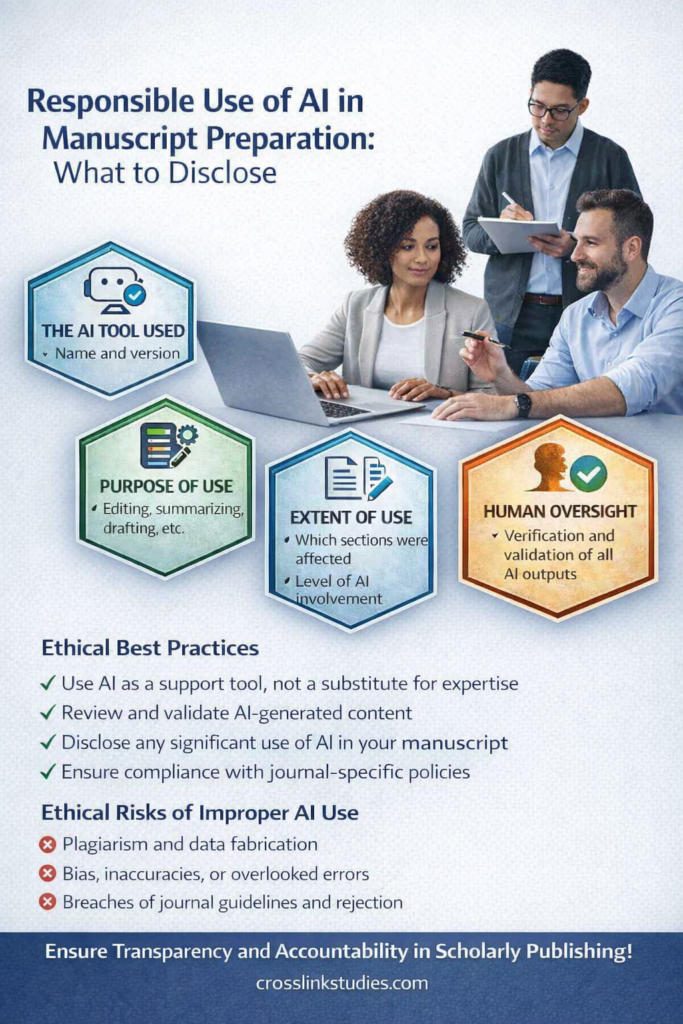
The AI Tool Used
- Name of the tool (e.g., ChatGPT, Gemini)
- Version (if applicable)
Purpose of Use
- Editing, summarizing, drafting, etc.
Extent of Use
- Which sections were affected
- Level of AI involvement
Human Oversight
- Confirmation that authors reviewed and validated all outputs
Disclosure typically appears in:
- Methods section
- Acknowledgements
- Dedicated AI declaration statement
What Does NOT Always Require Disclosure?
CLS indicate that basic language editing using AI may not require formal disclosure, as long as no new content is generated, the intellectual contribution remains fully human. However, when in doubt disclose. Transparency strengthens trust.
Ethical Risks of Improper AI Use
Failure to use or disclose AI responsibly can lead to plagiarism concerns, misleading or inaccurate research, breach of journal policies, manuscript rejection or retraction. Undisclosed AI use has already raised concerns about threats to scientific integrity in publishing.
Best Practices for Authors
To align with global publishing standards:
- Use AI as a support tool, not a substitute for expertise
- Always verify facts, references, and data
- Maintain original intellectual contribution
- Clearly document and disclose AI use
- Ensure compliance with journal-specific AI policies
At Crosslink Studies (CLS), we support the responsible and transparent use of AI, particularly in AI-driven and technology-focused research. We emphasize human accountability at every stage, transparent disclosure of AI involvement, ethical and reproducible research practices. AI should enhance research quality does not compromise integrity.
By clearly disclosing AI use and maintaining human oversight, authors can ensure their work remains credible, trustworthy, and aligned with global publishing standards.