
Writing Results That Separate Evidence from Interpretation
In scholarly publishing, one of the clearest signs of a strong research paper is the author’s ability to distinguish what the data shows from what the data means. Many manuscripts are rejected not because the research lacks value, but because the Results and Discussion sections become blurred together. Editors and reviewers from leading publishers such as Springer Nature, IEEE, MDPI, and Wiley consistently emphasize structured scientific reporting, where evidence is presented objectively before interpretation begins.
For Ubiquitous Technology Journal (UTJ), published by Crosslink Studies this distinction is equally important because the journal values methodological rigor, clarity, originality, and high-quality scholarly communication.
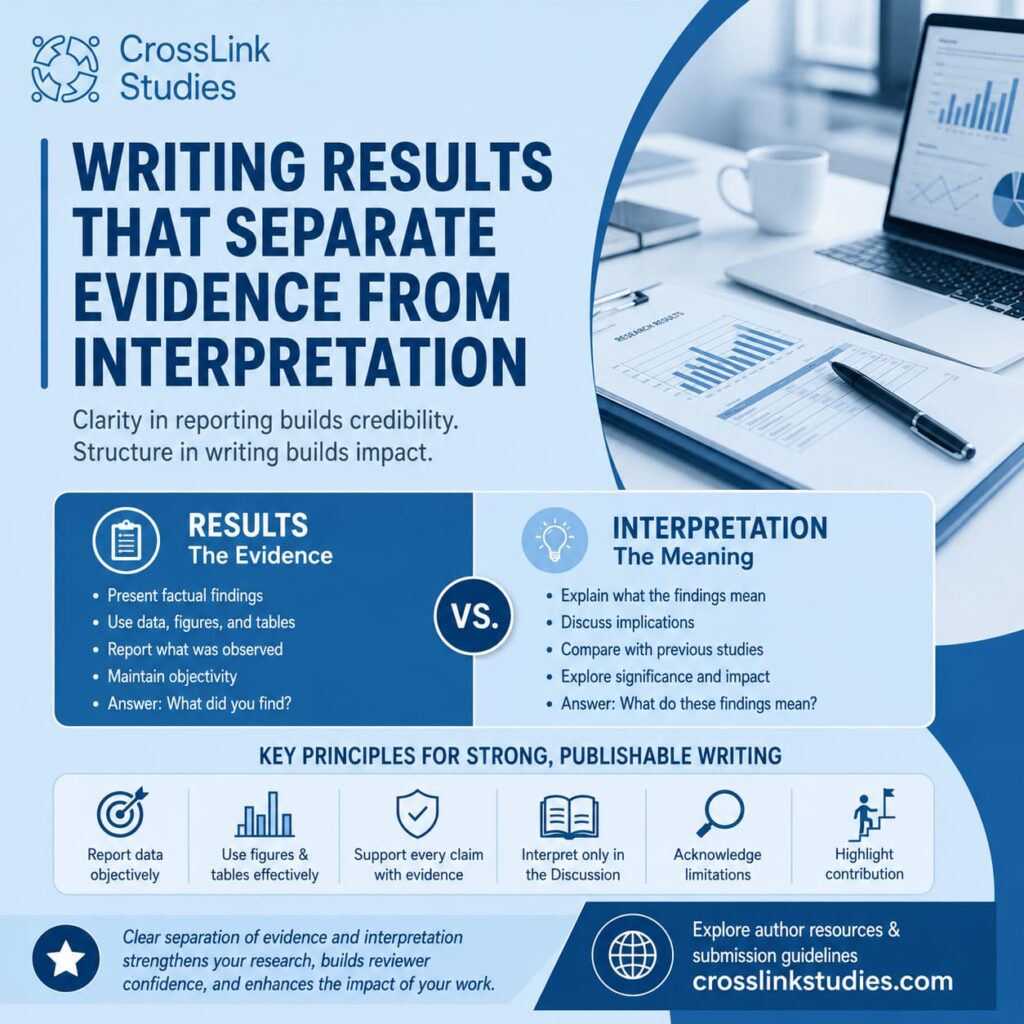
Why Separating Evidence from Interpretation Matters
The Results section is the scientific core of a manuscript. It provides measurable findings obtained through experiments, simulations, surveys, models, or analytical methods. Interpretation, however, belongs primarily to the Discussion section, where the author explains implications, significance, comparisons, and theoretical meaning.
When authors combine both sections carelessly, several problems emerge readers struggle to identify the actual findings, claims may appear exaggerated or unsupported and reviewer confidence decreases.
What Belongs in the Results Section?
The Results section should focus on factual outcomes only. Authors should present observations without inserting assumptions or personal conclusions.
A strong Results section typically includes statistical finding, experimental outputs, simulation performance, comparative measurements, tables and figures and accuracy metrics. For example:
“The proposed IoT monitoring model reduced energy consumption by 18.4% compared to the baseline system.” This sentence reports evidence.
However, the following sentence shifts into interpretation:
“This demonstrates the superiority of the proposed architecture for sustainable smart environments.” That statement belongs in the Discussion section because it explains significance rather than reporting data.
What Belongs in the Discussion Section?
The Discussion section answers the question:
“What do these findings mean?”
This is where authors interpret patterns, compare results with previous studies, discuss theoretical implications, identify limitations, and explain the broader contribution of the work.
An effective Discussion section may include interpretation of trends, comparison with prior literature, practical implications and theoretical significance.
For Ubiquitous Technology Journal, discussion sections often connect findings with emerging fields such as IoT, edge computing, cybersecurity, AI systems, smart environments, and human-computer interaction.
Common Mistakes Authors Make
1. Over explaining Simple Findings
Many authors interpret every sentence immediately after presenting a result. This creates repetition and weakens readability.
Weak approach: “The algorithm achieved 94% accuracy, which proves it is highly efficient and reliable.”
Better approach: “The algorithm achieved 94% accuracy.” The interpretation can later appear in Discussion.
2. Making Claims Beyond the Data
Evidence should support every conclusion. Reviewers often reject papers that overstate findings.
For example: “The framework completely eliminates cybersecurity risks.”
Unless comprehensive evidence exists, such wording appears scientifically unsound.
Instead: “The framework significantly reduced detected vulnerabilities under the tested conditions.”
3. Mixing Literature Review with Results
Results should focus on the current study rather than repeatedly citing previous authors. Comparisons with prior work are more suitable for Discussion.
4. Ignoring Negative or Neutral Findings
Selective reporting weakens transparency. Strong journals appreciate balanced reporting, including unexpected outcomes or limitations. Structural Pattern Used in UTJ.
1. Introduction — Defines the research problem.
2. Literature Review — Establishes research gap.
3. Methodology — Explains research procedures.
4. Results — Presents objective findings.
5. Discussion — Interprets findings.
6. Conclusion — Summarizes contribution.
This structure is common across journals indexed in engineering, computer science, and interdisciplinary technology domains.
Strategies for Writing Cleaner Results Sections
Use Data-Centered Language
Prefer:
“The findings indicate…”, “The experiment showed…”, “The analysis revealed…”
Avoid:
Clearly, Obviously, Undoubtedly and Scientific writing values neutrality.
Organize Results Around Research Questions
Instead of listing random outputs, align each subsection with a specific objective or hypothesis.
Example:
4.1 Network Performance
4.2 Security Evaluation
4.3 Energy Consumption Analysis
This structure improves readability and reviewer navigation.
Let Tables and Figures Support the Narrative
Do not repeat every value shown in a table. Summarize only the most important trends.
Maintain Logical Flow
Present findings in the same order as the methodology or research questions. Consistency improves comprehension and professionalism. How Reviewers Evaluate Results and Discussion
Peer reviewers often ask are the findings presented clearly? Is interpretation supported by evidence? Are claims proportional to the data? Does the discussion contribute new insight?
CLS manuscripts are subjected to peer review and editorial quality checks emphasizing originality, ethical standards, and scholarly rigor. For authors preparing manuscripts for UTJ, mastering this distinction can significantly improve the overall quality and professionalism of scholarly communication.