
How to Structure a Results and Discussion Section?
In academic publishing, the Results and Discussion sections represent the intellectual core of a research paper. These sections demonstrate not only what researchers discovered but also how those findings contribute to existing knowledge. One of the most common weaknesses observed in manuscripts submitted to scholarly journals is the poor organization of results and interpretation. Authors frequently present findings without a logical structure or merge interpretation with raw data in a way that reduces clarity and scientific rigor.
For journals published by Crosslink Studies, including the Ubiquitous Technology Journal (UTJ), a properly structured Results and Discussion section is essential for maintaining academic quality, methodological transparency, and professional scientific communication. The journal’s submission standards emphasize originality, clarity, logical presentation, and evidence-based interpretation, all of which are reflected strongly in these sections.
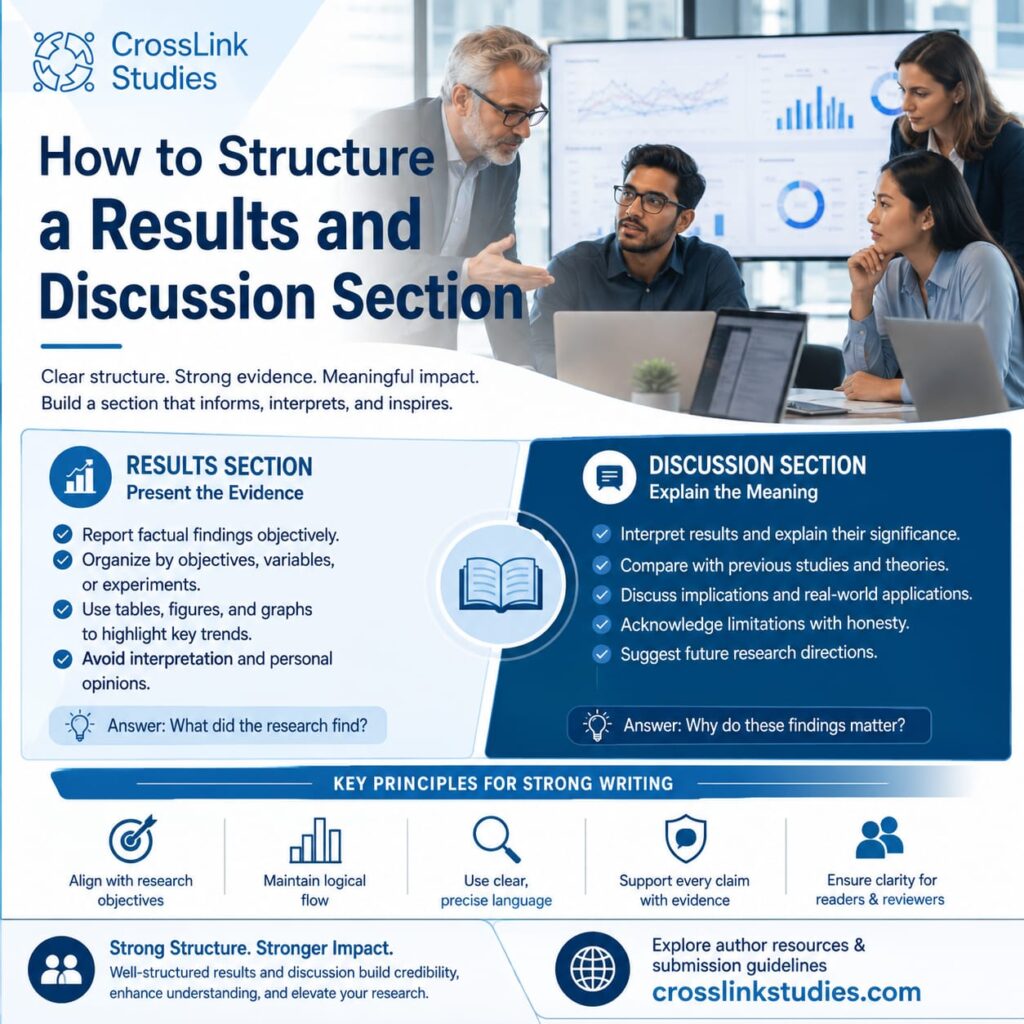
The Purpose of the Results Section
The Results section should focus exclusively on presenting the outcomes of the study in a factual and objective manner. This section answers a fundamental question:
What did the research find?
Authors should avoid personal opinions, exaggerated claims, or extensive interpretation while presenting findings. Instead, emphasis should remain on observed data, measured performance, statistical analyses, survey outcomes, simulations, comparisons, and other analytical results. A professionally written Results section presents evidence in a systematic sequence that aligns directly with the study objectives, hypotheses, or research questions.
Organizing Results Through Thematic Subsections
One of the most effective approaches used in high-impact journals is organizing findings into thematic subsections. Rather than presenting results randomly, authors should structure the section according to variables, experiments, hypotheses, or analytical dimensions.
Using Tables and Figures Effectively
Tables and figures play a critical role in presenting results professionally. Leading journals encourage visual presentation methods because they simplify complex findings and improve reader comprehension.
However, authors should avoid repeating every numerical value contained in a table or figure. Instead, the accompanying text should summarize the most significant trends, patterns, or observations.For example, rather than rewriting an entire table, an author may state:
“System latency decreased consistently following the implementation of adaptive optimization techniques.”
This concise approach improves readability while allowing visual elements to provide detailed supporting evidence.
Maintaining Scientific Neutrality
An essential characteristic of a strong Results section is scientific neutrality. Findings should be reported exactly as observed without attempting to persuade readers through emotional or exaggerated language. Statements such as:
“The proposed model completely revolutionizes smart computing systems” are generally inappropriate in scholarly writing because they overstate the evidence.Professional journals prefer precise, balanced, and evidence-based language that reflects conclusions supported directly by the data.
The Purpose of the Discussion Section
While the Results section focuses on evidence, the Discussion section focuses on meaning and significance. It answers another important question:
Why do these findings matter?
In this section, authors interpret results, compare findings with existing literature, discuss theoretical and practical implications, acknowledge limitations, and explain how the study contributes to the broader academic field.
For technology-oriented research, discussions often connect findings to practical applications in areas such as artificial intelligence, cybersecurity, ubiquitous computing and Internet of Things (IoT).
Interpreting Key Findings
A strong Discussion section begins by interpreting the most important findings rather than simply repeating the results. Authors should explain:
- How the findings address the original research problem?
- Whether the results support or challenge existing theories.
- What new insights emerge from the study?
Comparing Findings with Previous Research
Comparative analysis is a critical component of scholarly discussion. Reviewers expect authors to position their work within the existing body of knowledge.For example, researchers may discuss how a proposed algorithm achieved higher efficiency than methods reported in previous studies while also acknowledging differences in datasets, environments, or experimental conditions.
Discussing Research Limitations
Professional journals value transparency regarding study limitations. Although some authors hesitate to discuss weaknesses, acknowledging limitations actually strengthens academic credibility by demonstrating critical awareness and research maturity. Common limitations may include limited sample size, data availability constraints, and computational restrictions.
Highlighting Practical and Academic Implications
UTJ increasingly encourage authors to demonstrate the practical relevance of their work. Researchers should explain how their findings may influence future technologies, industry practices, public policy and system design. UTJ demonstrating real-world applicability can significantly increase the value and impact of a study.
Avoiding Common Structural Mistakes
One of the most common mistakes in academic writing is merging Results and Discussion without maintaining clear boundaries between evidence and interpretation. Although some journals permit a combined Results and Discussion section, authors should still ensure that:
- Findings are presented clearly first.
- Interpretations follow logically afterward.
- Raw data and commentary are not mixed excessively.
Ensuring Consistency with the Methodology
To improve coherence, authors should maintain consistency between the Methodology and Results sections. The order in which findings are presented should generally follow the sequence of methods, experiments, or research objectives introduced earlier in the manuscript.
For authors preparing manuscripts for Crosslink Studies journals, mastering the organization of these sections can significantly improve publication readiness. Clear reporting, objective presentation, critical interpretation, and evidence-based discussion collectively create a manuscript that aligns with international scholarly standards and contributes meaningfully to academic knowledge.