
How Many Recent References Does a Strong UTJ Submission Need?
In academic publishing, references are not just citations, they are evidence of relevance, credibility, and scholarly engagement. One of the most common questions authors faces is: How many recent references are enough? While there is no fixed number, top journals consistently expect authors to demonstrate strong engagement with recent literature, particularly within the last 3–5 years.
At Crosslink Studies journals like Ubiquitous Technology Journal (UTJ), a well-balanced reference list is essential to show that your work is current, contextualized, and connected to ongoing research conversations.
Why Recent References Matter
Recent references help editors and reviewers assess:
- Relevance → Is the study aligned with current research trends?
- Novelty → Does it build on or extend recent work?
- Awareness → Is the author familiar with the latest developments?
A manuscript lacking recent references may appear outdated or disconnected, regardless of its quality.
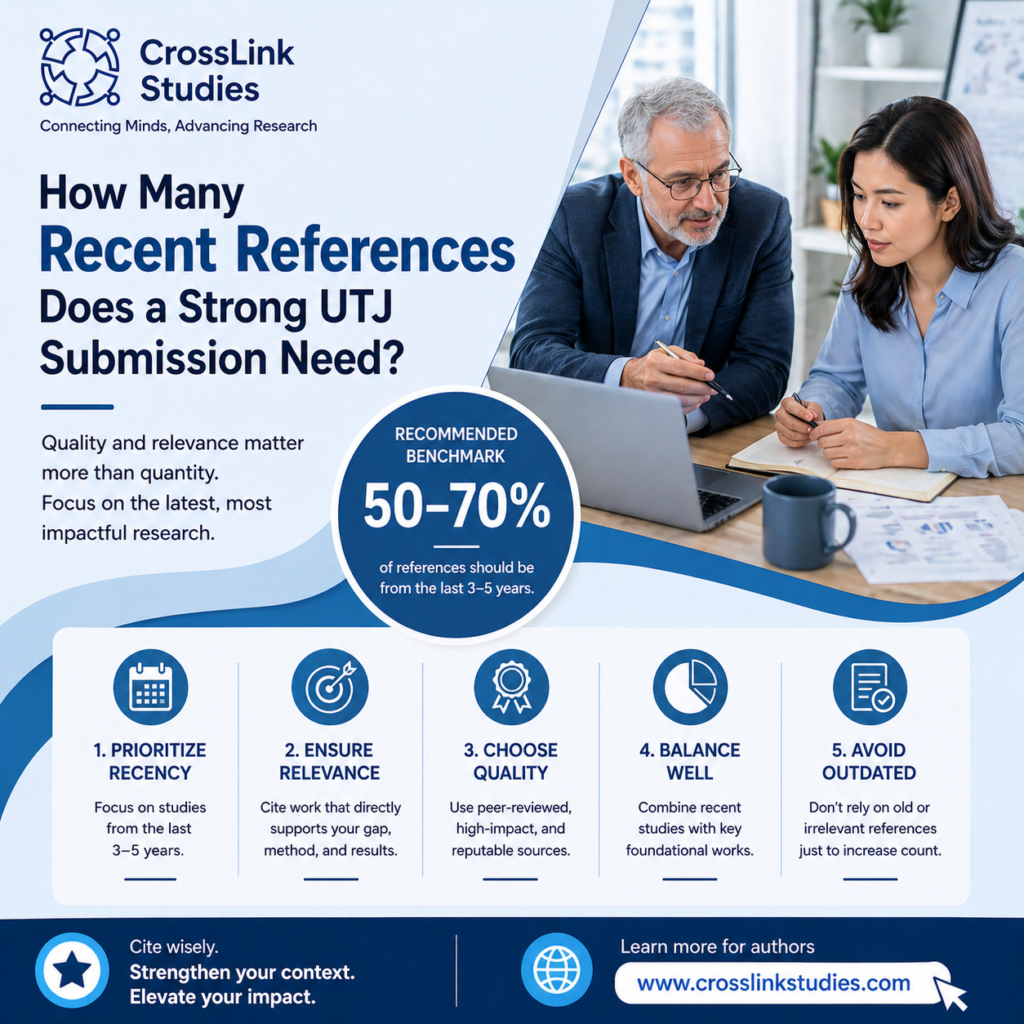
Is There an Ideal Number?
There is no universal rule, but strong submissions typically follow proportional balance, not fixed counts. Quality and relevance matter more than quantity.
General Benchmark (CLS-Aligned Expectation)
- 50–70% of references should be from the last 3–5 years
- The rest can include foundational or classical studies
Factors That Influence Reference Count
Research Field
- Fast-moving fields (AI, energy systems, digital technologies) → More recent references required
- Established fields → Greater reliance on foundational studies
Article Type
- Original Research → Moderate number, focused on recent work
- Review/Survey Papers → Larger reference lists, including historical and recent studies
- Methods Papers → Balanced mix of foundational and latest techniques
3. Scope of Study
- Narrow studies → Fewer but highly relevant references
- Broad/interdisciplinary studies → More diverse and recent references
CLS Strategy for Selecting References
Prioritize Relevance Over Volume
Avoid adding citations just to increase numbers. It includes studies that directly support your research gap, your methodology and your comparison and discussion
Focus on High-Quality Sources
Give preference to peer-reviewed journal articles, high-impact or well-recognized publications and recent conference proceedings (where relevant)
Integrate References Strategically
Do not cluster all references in one section. Distribute them across Introduction (context and gap), Methodology (supporting approach) and Discussion (comparison and validation).
Avoid Outdated or Irrelevant Citations
❌ Excessive reliance on older studies
❌ Citations unrelated to your core topic
These weaken the perceived novelty of your work.
Practical Example
Weak Reference Strategy:
- 25 total references
- Only 5 from the last 5 years
Signals outdated research engagement
Strong CLS-Compliant Strategy:
- 30–40 total references
- 18–25 from the last 3–5 years
- Remaining are key foundational works
Demonstrates both depth and relevance
Common Mistakes to Avoid
❌ Adding unnecessary references to inflate numbers
❌ Ignoring recent high-impact studies
❌ Over-citing outdated literature
❌ Relying heavily on non-peer-reviewed sources
❌ Failing to cite closely related recent work
These issues often lead to reviewer criticism and revision requests.
CLS Reference Checklist
Before submission, confirm:
✔ Majority of references are from the last 3–5 years
✔ All citations are directly relevant to the study
✔ Key recent studies in your field are included
✔ Foundational works are used appropriately
✔ References are well-distributed across sections
A strong reference list is not about quantity; it is about strategic selection and balance. It shows that your research is not isolated but actively engaged with current academic discourse.
At CLS Crosslink Studies and UTJ, we encourage authors to build reference lists that reflect relevance, rigor, and awareness of recent advancements. Cite wisely because your references define your research context.