How Editors Balance Conflicting Reviewer Reports
One of the most challenging aspects of editorial decision-making is handling conflicting reviewer reports. It is common for one reviewer to recommend acceptance while another suggests rejection or major revision.
For authors, such outcomes can feel confusing. For editors, however, this is a normal and expected part of peer review. The role of the editor is not to “average opinions,” but to make a fair, informed, and independent decision.
At Ubiquitous Technology Journal (UTJ), differing expert perspectives are valuable but they must be carefully balanced to ensure quality, fairness, and integrity.
Why Reviewer Reports Often Conflict
Conflicting recommendations arise for several reasons:
- Different expertise areas (e.g., methodology vs. application)
- Varying expectations of novelty or significance
- Subjective interpretation of results
- Differences in reviewing styles (strict vs. lenient)
Diversity in reviewer opinion is not a flaw it reflects the complexity of research evaluation.
The Editor’s Role in Resolving Conflicts
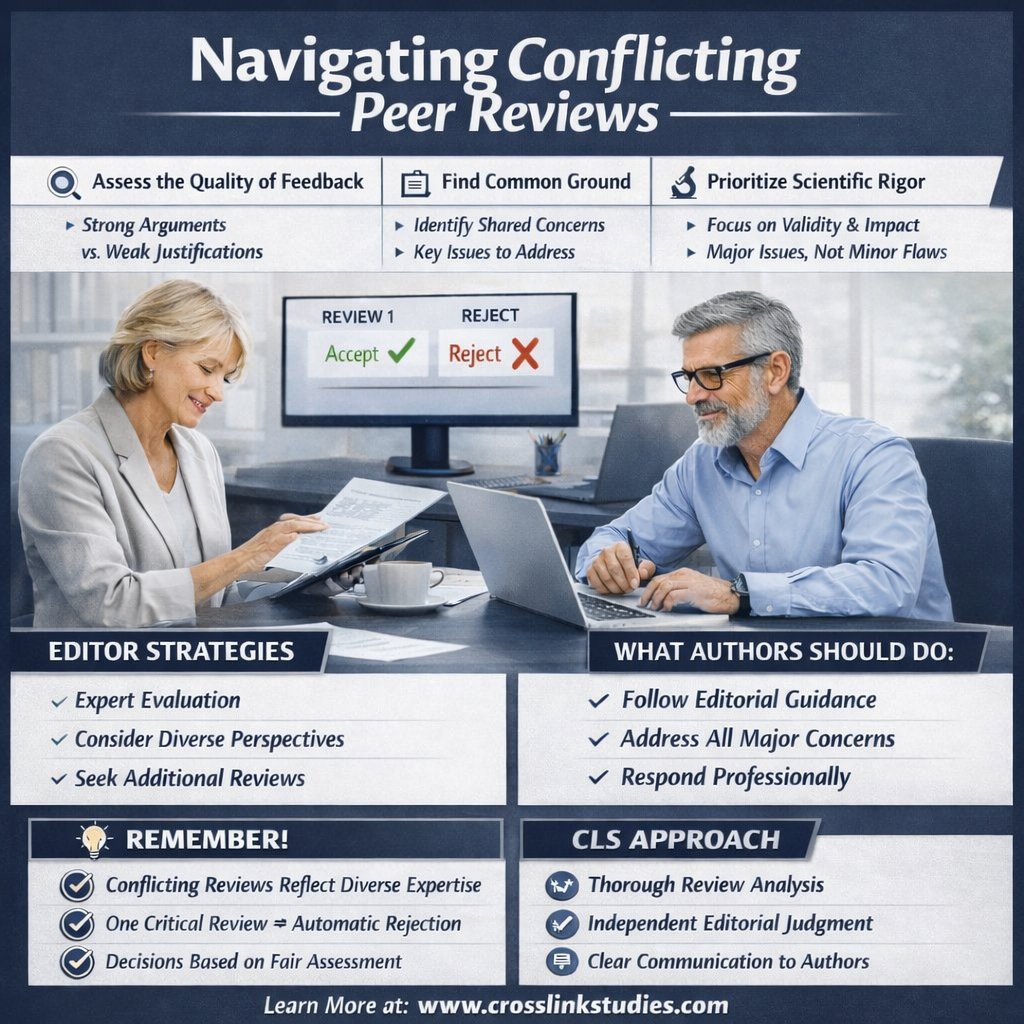
Editors are responsible for interpreting reviewer feedback critically, identifying valid and evidence-based concerns, making a decision aligned with journal standards.
Importantly, editors do not simply count recommendations. Instead, they assess the quality and relevance of each review.
Key Strategies Editors Use
Evaluate the Substance, Not the Recommendation
Editors focus on the content of the review, not just the final verdict.
For example:
- A “reject” recommendation with weak justification may carry less weight
- A “major revision” with detailed, constructive feedback may be more valuable
The strength of reasoning matters more than the label.
Identify Common Ground
Even conflicting reviews often share underlying concerns, such as methodological clarity, data limitations, writing quality. Editors look for overlapping issues to determine what must be addressed.
Prioritize Critical Scientific Issues
Editors distinguish between Major concerns (validity, originality, ethics), Minor issues (language, formatting). Decisions are guided primarily by scientific rigor and contribution, not minor disagreements.
Use Their Own Expertise
Editors apply their own knowledge to interpret technical disagreements assess the manuscript’s overall contribution, determine whether criticisms are justified. Editorial judgment is essential when reviewer opinions diverge.
Seek Additional Reviews (If needed)
When conflicts are significant, editors may invite a third reviewer, consult editorial board members. This helps provide additional perspective and balance.
Communicate a Clear Decision to Authors
Editors synthesize reviewer feedback into a coherent decision letter, which explains key concerns, highlights priority revisions, clarifies the decision (minor/major revision, reject, etc.), good editorial communication reduces confusion for authors.
What This Means for Authors
Receiving conflicting reviews can be challenging, but authors should focus on editorial guidance, not individual reviewer opinions, address all major concerns carefully, provide a structured response to each comment, maintain a professional and objective tone. Editors ultimately guide the revision process their decision is the key reference point.
Common Misconceptions
“Editors just average reviewer scores”
❌ Not true, decisions are based on reasoned evaluation, not numbers.
“One negative review guarantees rejection”
❌ Not necessarily, strong counterarguments or other positive reviews may balance it.
“Conflicting reviews mean unfair evaluation”
❌ Not at all, they reflect diverse expert perspectives.
At Crosslink Studies (CLS), we view conflicting reviewer reports as an opportunity to strengthen manuscripts through diverse insights. Our editorial approach emphasizes careful evaluation of reviewer reasoning, independent editorial judgment, clear and constructive communication with authors.
This ensures that decisions are balanced, transparent, and aligned with high scholarly standards, especially in complex AI and interdisciplinary research. For authors, understanding this process can transform confusion into clarity and ultimately lead to stronger, more impactful research.