
How to Revise a Manuscript Without Breaking Coherence?
Revision is one of the most critical stages in the publication process. While addressing reviewer comments improves a manuscript, poorly managed revisions can disrupt structure, clarity, and logical flow.
Top journals emphasize that effective revision is not just about adding changes it is about integrating them seamlessly. For Ubiquitous Technology Journal (UTJ), maintaining coherence during revision is essential for ensuring clarity, credibility, and readability.
Why Coherence Matters in Revision
A coherent manuscript presents ideas logically, maintains consistency across sections, enhances readability for reviewers and editors. When revisions are inserted without careful alignment, manuscripts may become fragmented, repetitive, difficult to follow. Coherence ensures that improvements strengthen not weaken the manuscript.
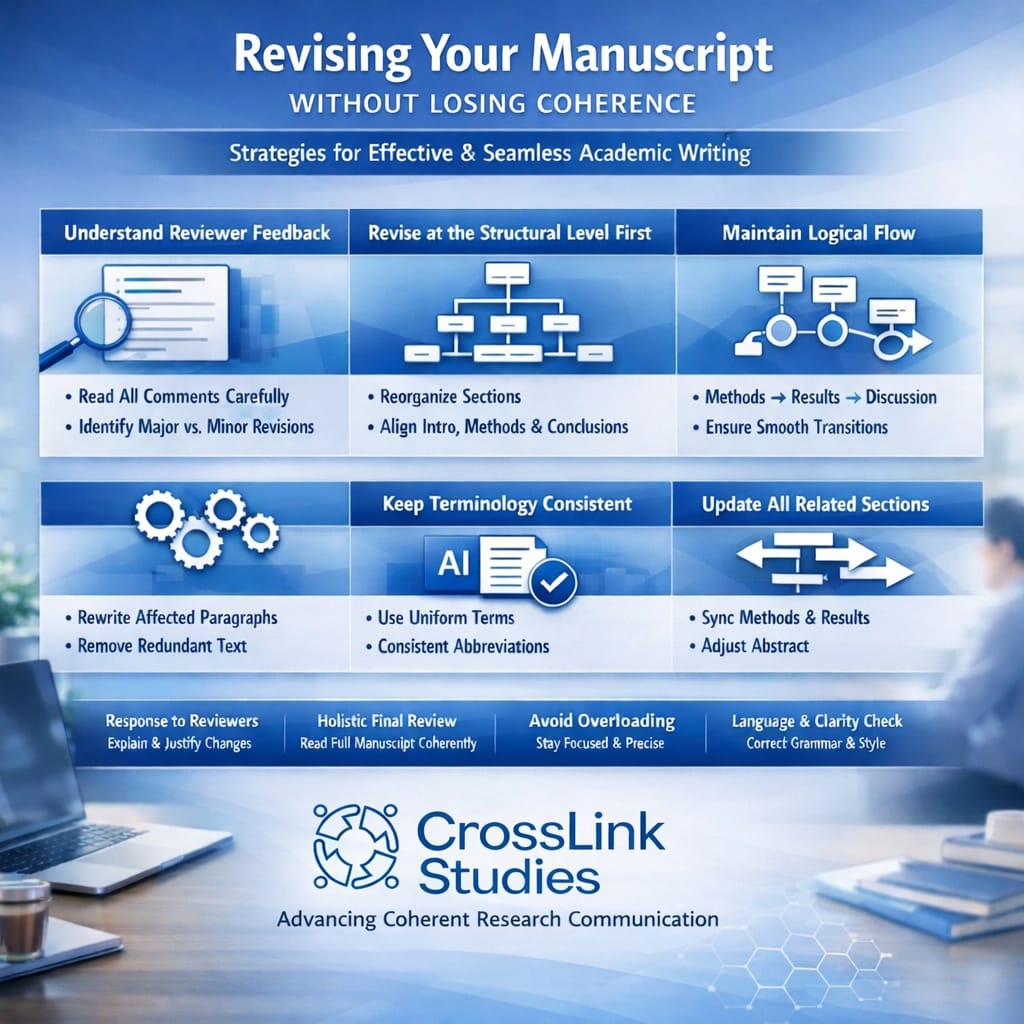
Understand Reviewer Comments Before Revising
Before making any changes read all reviewer comments carefully, group them by theme (methods, results, clarity, etc.), identify major vs. minor revisions. Avoid making isolated edits without understanding the overall direction of feedback.
Revise at the Structural Level First
Start with big-picture changes reorganize sections if needed, clarify research objectives, align introduction, methods, and conclusions. Addressing structure first prevents inconsistencies later.
Maintain Logical Flow Across Sections
Ensure that the introduction leads naturally to the research question, methods clearly support the objectives, results align with methods, discussion reflects findings without contradiction. Every section should connect smoothly, forming a continuous narrative.
Integrate Changes, Don’t Just Insert Them
A common mistake is adding new text without adjusting surrounding content. Instead rewrite affected paragraphs fully, remove redundant or conflicting statements, ensure transitions remain smooth. Think of revision as refining the whole text, not patching parts.
Keep Terminology and Style Consistent
Consistency is essential for coherence use the same key terms throughout, maintain consistent definitions and abbreviations, follow a uniform writing style. In technical fields like AI, inconsistent terminology can confuse readers.
Update All Related Sections
When one section changes, others must be updated accordingly.
For example:
- Changes in methods → update results and discussion
- Revised findings → adjust abstract and conclusion
Failing to align sections leads to internal contradictions.
Use a Response-to-Reviewers Document
Prepare a clear response document address each comment individually, explain what was changed and where, justify decisions respectfully. This helps editors see that revisions are thoughtful and complete.
Review the Manuscript as a Whole
After revisions read the manuscript from start to finish, check for logical continuity, ensure smooth transitions between sections. A final holistic review is essential to confirm overall coherence.
Avoid Overloading the Manuscript
While responding to reviewers, avoid adding excessive detail, overcomplicating explanations, expanding beyond the study’s scope. Clarity is improved through precision, not volume.
Perform Final Language and Clarity Checks
Ensure that grammar and sentence structure are correct, paragraphs are concise and readable, technical explanations remain clear. Professional language enhances the impact of revisions.
Common Pitfalls to Avoid
- Making isolated edits without context
- Ignoring connections between sections
- Introducing contradictions during revision
- Over-expanding the manuscript
- Failing to review the full document
These issues can lead to negative reviewer feedback even after revision.
CLS Crosslink Studies Perspective
At Crosslink Studies (CLS), we encourage authors to treat revision as a strategic and integrated process. A strong revision should address reviewer concerns comprehensively, maintain logical structure and flow, improve clarity without introducing inconsistency. Coherent revision reflects high-quality scholarly communication. Revising a manuscript is not about making scattered changes, it is about refining a unified narrative. In academic writing, the best revisions are those that feel seamless where improvements strengthen the whole, not disrupt it.