
Common Abstract Mistakes That Lead to Editorial Screening Delays
In scholarly publishing, the abstract functions as a gateway to peer review. Before reviewers evaluate your manuscript, editors assess the abstract to determine clarity, relevance, and fit. A poorly constructed abstract does not just weaken your paper; it can delay editorial decisions or lead to immediate rejection.
At Ubiquitous Technology Journal (UTJ), where interdisciplinary clarity and precision are essential, abstracts must communicate value, rigor, and relevance within seconds. This guide highlights the most common mistakes that slow down editorial screening and how to avoid them.
Why Abstract Quality Affects Editorial Speed
Editorial teams use abstracts to quickly answer three critical questions:
- Is the research relevant to the journal?
- Is the contribution clear and meaningful?
- Is the methodology credible?
If these answers are not immediately evident, editors may:
- Request clarification before review
- Return the manuscript for revision
- Reject the paper without external review
A strong abstract accelerates the process; a weak one creates friction.
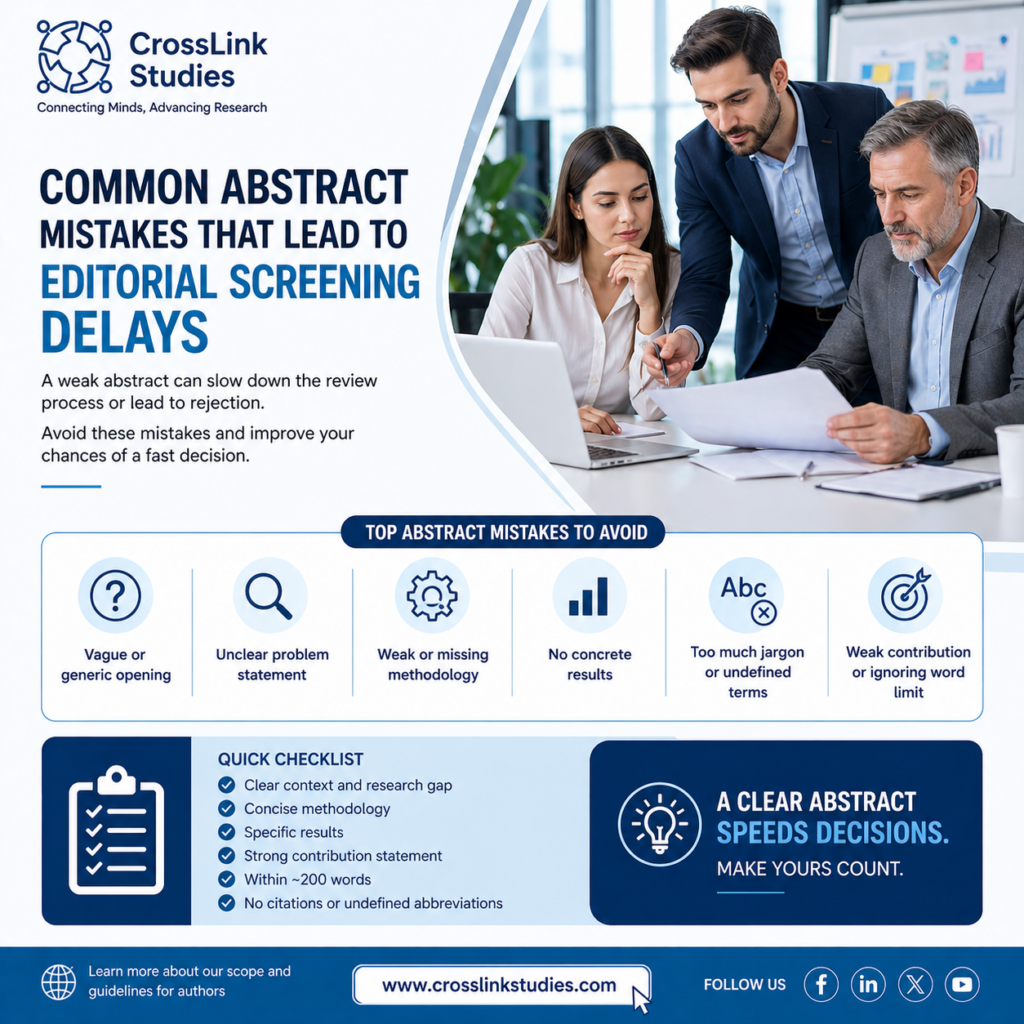
Vague or Generic Opening Statements
The Problem
Abstracts that begin with overly broad or generic claims fail to establish relevance.
❌ “In today’s world, technology is rapidly evolving…”
Why It Delays Screening
Editors cannot quickly identify the specific research context or contribution.
CLS recommends starting with a focused, field-specific context that directly leads to your research problem.
Unclear Problem Statement
The Problem
Many abstracts describe a topic but fail to define a clear research gap.
Why It Delays Screening
Without a defined problem, editors cannot assess novelty or significance.
At UTJ state the problem in one precise sentence. Avoid ambiguity.
Missing or Weak Methodology Description
The Problem
Authors often under-explain how the research was conducted.
Why It Delays Screening
Editors need to quickly evaluate methodological credibility.
CLS Recommendation
Briefly mention approach or model, data source and analytical technique. Keep it concise but informative.
Absence of Concrete Results
The Problem
Some abstracts discuss intentions but omit actual findings.
Why It Delays Screening
Editors cannot judge research value without results.
CLS Recommendation
Include specific outcomes, preferably with measurable or comparative insights.
✔ Example: “Accuracy improved by 18% compared to baseline models.”
Overloading with Technical Jargon
The Problem
Highly technical language reduces readability, especially in interdisciplinary journals.
Why It Delays Screening
Editors may struggle to quickly interpret the contribution.
CLS recommends the balance technical accuracy with clarity and accessibility.
Including Citations or References
The Problem
Some abstracts include citations, which is not standard practice.
Why It Delays Screening
It disrupts readability and signals non-compliance with journal norms.
CLS Recommendation
Abstracts should be self-contained no citations, tables, or figures.
Undefined Abbreviations
The Problem
Using acronyms without explanation confuses readers.
Why It Delays Screening
Editors cannot interpret key concepts efficiently.
CLS Recommendation
Define abbreviations at first use or avoid them entirely in the abstract.
Poor Structure and Flow
The Problem
Abstracts written as disjointed statements lack logical progression.
Why It Delays Screening
Editors must spend extra time interpreting the content.
CLS Recommendation
Follow a clear structure:
Context → Problem → Method → Results → Contribution
Ignoring Word Limits
The Problem
Abstracts that are too long or too short signal lack of discipline.
Why It Delays Screening
Editors may request revision before proceeding.
CLS Recommendation
Adhere to 200 words, ensuring completeness without redundancy.
Weak or Missing Contribution Statement
The Problem
Failing to clearly state “what this study adds.”
Why It Delays Screening
Editors cannot assess impact or originality.
CLS Recommendation
End with a strong statement highlighting theoretical contribution, practical implications and interdisciplinary relevance.
CLS Abstract Quality Checklist
Before submission, confirm:
✔ Clear and specific research context
✔ Defined problem or research gap
✔ Concise methodology description
✔ Concrete and meaningful results
✔ Strong contribution statement
✔ No citations or undefined abbreviations
✔ Logical flow and structure
✔ Within 200 words
Editorial screening is designed to be fast and decisive. Your abstract must therefore do more than summarize; it must communicate clarity, credibility, and contribution instantly. At Ubiquitous Technology Journal (UTJ), we encourage authors to treat the abstract as a precision document one that reflects the rigor and impact of the full manuscript.