How to Write a CLS-Compliant Abstract in 200 Words?
In scholarly publishing, the abstract is not a summary, it is a decision-making tool. Editors use it for initial screening, reviewers use it to understand contribution, and readers rely on it to decide whether to engage with the full paper.
At Ubiquitous Technology Journal (UTJ), where interdisciplinary clarity and impact are central, a well-crafted 200-word abstract can significantly influence both acceptance and visibility.
Why 200 Words Matter
A 200-word limit enforces discipline. It requires authors to prioritize essential information, eliminate redundancy and communicate contribution with precision. In CLS brevity is not a constraint, it is a quality standard.
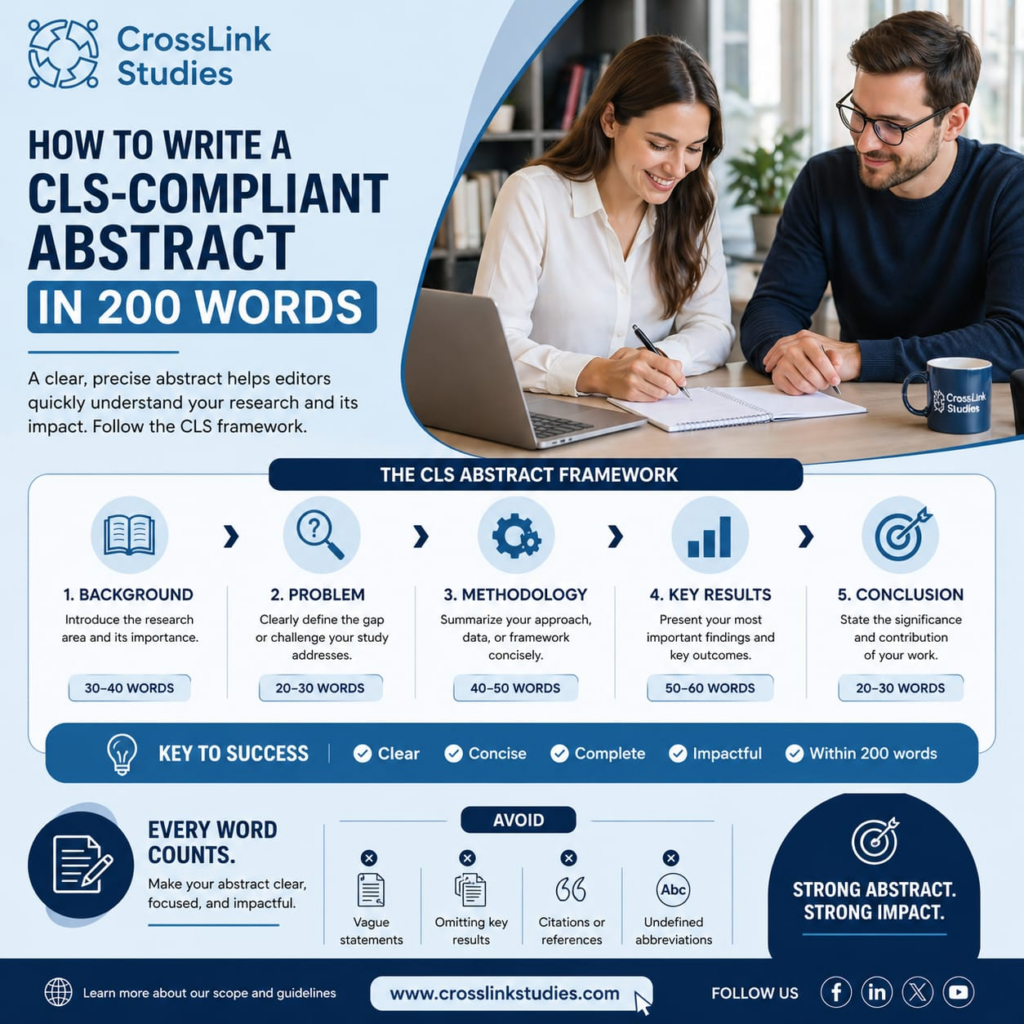
The CLS Abstract Framework (5 Essential Elements)
A high-quality abstract should include the following five components, written as a single coherent paragraph:
1. Background / Context (1–2 sentences)
Briefly introduce the research area and its importance.
✔ Focus on relevance
❌ Avoid broad generalizations
2. Problem Statement (1 sentence)
Clearly define the gap, limitation, or challenge your study addresses.
✔ Be specific and direct
❌ Avoid vague phrases like “little research exists”
3. Methodology (2–3 sentences)
Summarize your approach, data, or framework, mention key methods or models, and keep technical detail concise.
4. Key Results / Findings (2–3 sentences)
Present your most important results. It includes quantitative or specific outcomes when possible, highlight what is new.
5. Conclusion & Contribution (1–2 sentences)
State the significance and implications of your work.
✔ Emphasize impact (theoretical, practical, or interdisciplinary)
✔ Link back to the research problem
Recommended Word Allocation (CLS Standard)
| Section | Suggested Words |
| Background | 30–40 |
| Problem | 20–30 |
| Methodology | 40–50 |
| Results | 50–60 |
| Conclusion | 20–30 |
| Total | ~200 words |
This structure ensures balance, clarity, and completeness.
Writing Style Guidelines (CLS Expectations)
To meet CLS standards, your abstract should be:
✔ Clear and Direct
Use precise language. Avoid unnecessary jargon.
✔ Objective and Evidence-Based
Focus on what was done and found—not opinions.
✔ Concise
Every sentence must add value.
✔ Interdisciplinary-Friendly
Ensure readability for audiences beyond your niche.
Common Mistakes to Avoid
❌ Writing a vague or overly general introduction
❌ Omitting key results
❌ Including citations or references
❌ Using undefined abbreviations
❌ Overloading with technical details
❌ Exceeding or underusing the word limit
These issues often lead to editorial rejection or revision requests.
CLS Abstract Checklist (Before Submission)
✔ Clearly states research context
✔ Defines a specific problem or gap
✔ Summarizes methodology concisely
✔ Presents concrete results
✔ Highlights contribution and impact
✔ Stays within ~200 words
✔ Written as one cohesive paragraph
An effective abstract is not an afterthought; it is a strategic asset. In a competitive academic environment, your abstract must do more than summarize; it must convince, communicate, and position your research. At Crosslink Studies, we encourage authors to treat the abstract as a high-impact micro-publication, one that reflects the clarity, rigor, and interdisciplinary strength of the full paper.