
Structuring a Research Article for Maximum Reviewer Clarity
In academic publishing, clarity of structure is as important as the quality of research itself. Even strong research can be misunderstood, undervalued, or rejected if it is poorly organized. Reviewers who evaluate manuscripts under time constraints rely heavily on logical structure, clear flow, and standardized organization to assess a paper efficiently.
Leading publishers emphasize that a well-structured article improves readability, reproducibility, and review efficiency, ultimately increasing acceptance probability.
For Crosslink Studies (CLS) and Ubiquitous Technology Journal (UTJ), structuring a manuscript effectively is critical for editorial screening, peer review success, and scientific impact, especially in interdisciplinary domains such as AI, software systems, and engineering.
Why Structure Matters in Peer Review
Peer reviewers assess not only the content but also how effectively it is communicated.
A well-structured paper enables reviewers to quickly identify:
- The research problem and objectives
- The methodological approach
- The results and their significance
- The contribution to the field
CLS guidelines highlight that reviewers evaluate manuscripts based on clarity, logical flow, and organization, alongside technical quality.
Poor structure, even with strong results, can lead to misinterpretation of findings, increased revision requests and rejection due to lack of clarity.
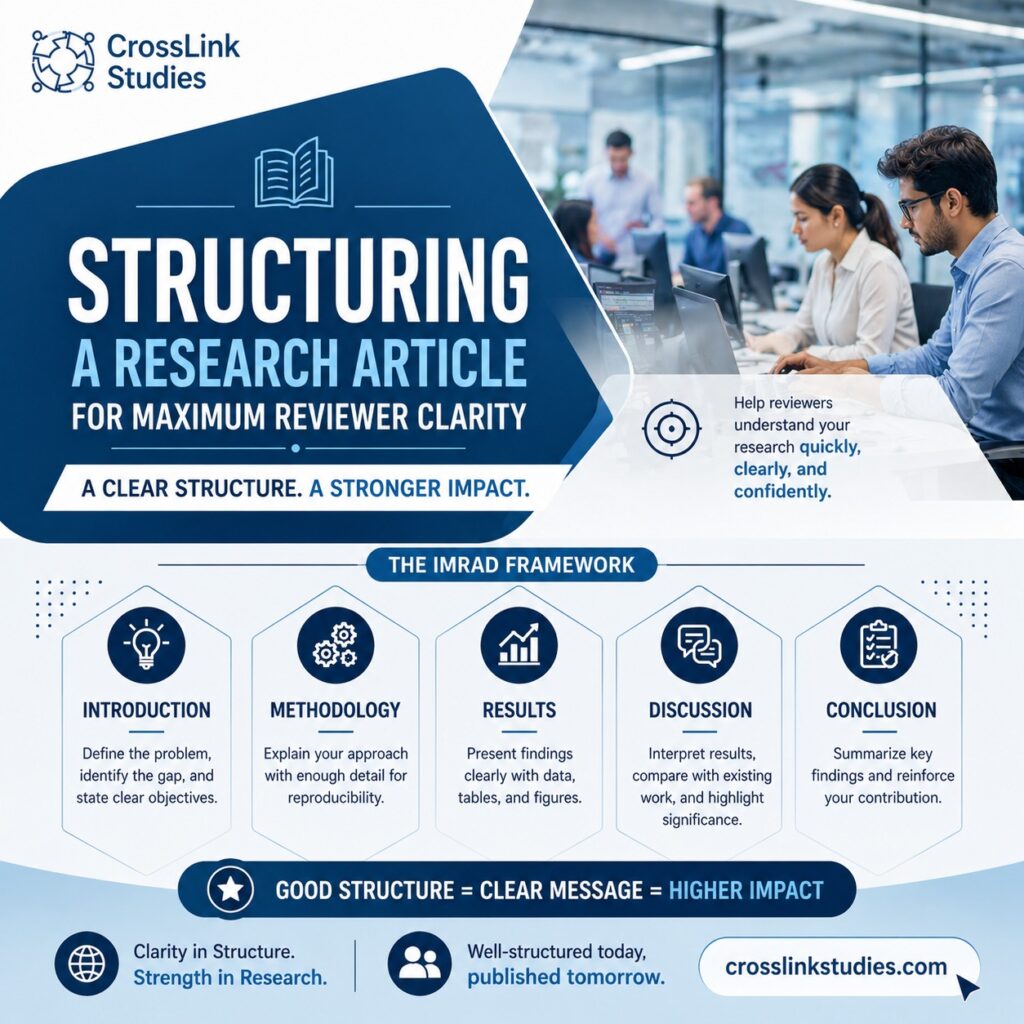
The Standard Structure: IMRaD Framework
UTJ follow the IMRaD structure:
- Introduction – Why the research was conducted
- Methods – How the research was conducted
- Results – What was found
- Discussion – What the findings mean
This format has become the global standard for scientific communication, providing a clear and logical narrative for readers and reviewers.
The IMRaD structure acts as a shared language between authors, reviewers, and editors, enabling faster understanding and evaluation.
Section-by-Section Guide for Maximum Clarity
1. Title
- Must be concise, specific, and descriptive
- Avoid vague or generic words like “novel”
- Clearly reflect the study’s content
A strong title helps reviewers immediately understand the paper’s relevance.
2. Abstract
Provide a self-contained summary, include: objective, method, key results, and implications. Avoid ambiguity and undefined abbreviations. CLS recommends that abstracts clearly highlight what is new and why it matters.
3. Introduction
The introduction must define the problem and research gap, review relevant literature briefly and state clear objectives or hypotheses. A strong introduction ensures reviewers understand:
What problem is being solved and why it is important.
4. Methodology
Describe procedures in a replicable and transparent manner. It includes datasets, tools, parameters, and experimental setup and avoid missing details. Reviewers expect the methodology to be detailed enough for reproducibility, a key acceptance criterion.
5. Results
Present findings clearly and objectively, use tables, figures, and quantitative data and avoid interpretation (leave that for discussion).
6. Discussion
Interpret results in relation to objectives, compare with existing work and highlight significance and limitations. The discussion should answer: Why do these results matter?
7. Conclusion
Summarize key findings, reinforce contributions and avoid introducing new information.
8. References
Use relevant, recent, and credible sources and maintain consistent citation style.
Achieving Logical Flow Across Sections
A well-structured paper must maintain continuity and coherence:
- Introduction → defines the question
- Methodology → answers how
- Results → provides evidence
- Discussion → explains meaning
Misalignment (e.g., results not matching objectives) is a common reviewer criticism.
Practical Strategies to Improve Reviewer Clarity
✔ Use Clear Section Headings
- Guide the reviewer through the paper
✔ Maintain One Idea per Paragraph
- Avoid mixing multiple concepts
✔ Use Transitional Sentences
- Ensure smooth flow between sections
✔ Avoid Redundancy
- Do not repeat the same information across sections
✔ Keep Language Precise
- Avoid vague or overly complex sentences
Common Structural Mistakes to Avoid
❌ Mixing Sections
- Background information in results
- Interpretation in methodology
❌ Poor Flow
- Disconnected paragraphs
- Lack of logical progression
❌ Missing Details
- Incomplete methodology
- Unsupported conclusions
❌ Overloading Sections
- Too much information without clear organization
Reddit academic discussions also highlight that even strong research appears weak when IMRaD structure is not properly followed or sections overlap.
CLS-Oriented Example (AI Research Paper)
Poor Structure
Objectives unclear in introduction, methods incomplete, and results mixed with discussion.
Improved Structure
Introduction:
Defines problem of real-time anomaly detection
Methodology:
Explains deep learning model, dataset, and evaluation metrics
Results:
Presents accuracy improvements with quantitative data
Discussion:
Compares with existing models and explains impact
Aligning with UTJ Submission Expectations
For Crosslink Studies (CLS)and UTJ, manuscripts must demonstrate clear structure aligned with IMRaD, logical consistency across sections, reproducible methodology and evidence-based conclusions. Peer review processes rely on structured presentation to evaluate validity, originality, and clarity effectively. For authors targeting Crosslink Studies and UTJ, mastering article structure is essential to transform high-quality research into clear, impactful, and publishable work.