
How to Move Beyond Summary in Review and Survey Manuscripts
Review and survey manuscripts occupy a unique position in scholarly publishing. Unlike standard research papers that present new experiments or models, review-based manuscripts shape the direction of a field by organizing, interpreting, and critically evaluating existing knowledge. However, many submissions fail because they merely summarize prior studies instead of generating meaningful scholarly insight.
For journals such as Crosslink Studies (CLS) and the Ubiquitous Technology Journal (UTJ), a successful review or survey article must go beyond listing findings. It should synthesize evidence, identify methodological gaps, expose contradictions, evaluate research quality, and propose future research directions aligned with emerging technological challenges.
Why Simple Summaries Are No Longer Enough
A common weakness in review manuscripts is the “paper-by-paper description” approach. Authors often dedicate separate paragraphs to individual studies, explaining what each article did without connecting the findings into a broader analytical narrative. This approach creates several problems:
- The manuscript becomes descriptive rather than analytical.
- Readers cannot identify research trends or unresolved issues.
- The review contributes little intellectual value beyond bibliographic collection.
A strong review manuscript should therefore answer questions such as:
- What patterns emerge across the literature?
- Which methodologies dominate the field?
- Where do studies disagree?
- Which assumptions remain untested?
- What limitations prevent practical deployment?
- Which research directions deserve priority?
The Difference Between Summary and Critical Synthesis
Weak Review Style: Pure Summary
A purely descriptive review often looks like this:
“Study A used machine learning for IoT security. Study B proposed a block chain framework. Study C improved network efficiency using edge computing.”Although informative, this structure lacks interpretation and comparison.
Strong Review Style: Critical Synthesis
An analytical review instead examines relationships among studies:
“Most IoT security frameworks rely on centralized architectures despite claims of decentralization. While block chain-based approaches improve trust management, they frequently introduce scalability and latency limitations that remain insufficiently evaluated in real-time environments.” The second version adds scholarly value because it compares approaches, identifies contradictions, and evaluates limitations.
Key Strategies to Move Beyond Summary
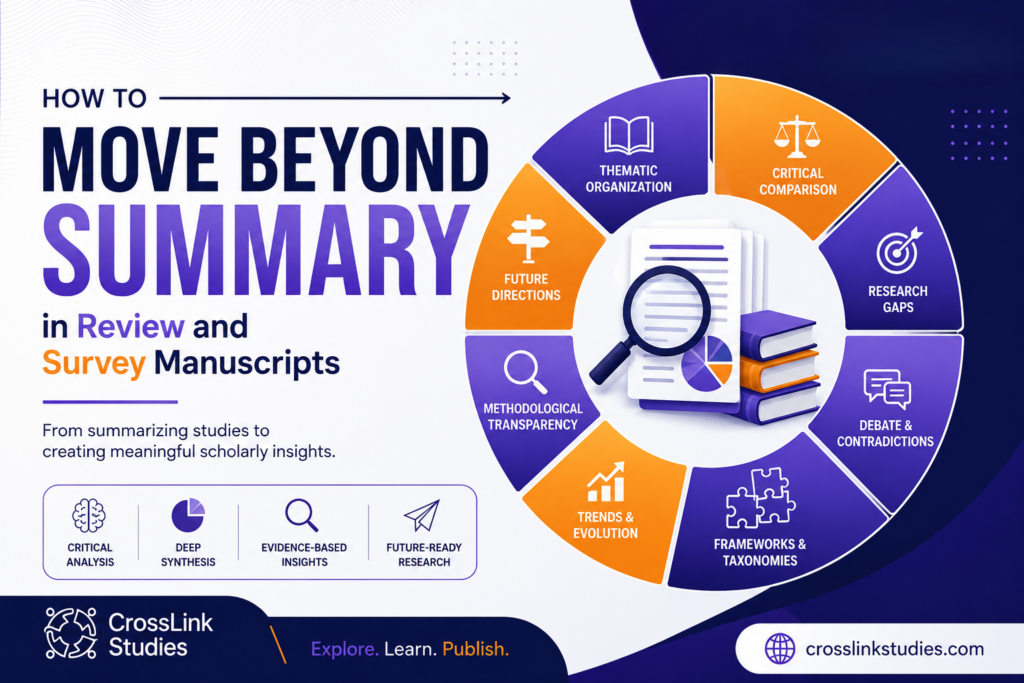
1. Organize Literature Around Themes, Not Individual Papers
One of the most effective improvements is replacing “study-by-study” narration with thematic synthesis. For UTJ, thematic organization is particularly valuable because research domains such as IoT, AI, pervasive computing, cybersecurity, and smart systems evolve rapidly and involve overlapping methodologies.
2. Compare Methodologies Critically
Strong review papers evaluate how studies were conducted, not only what they reported. Important analytical questions include:
- Which datasets are repeatedly used?
- Are evaluation metrics consistent across studies?
- Are experiments reproducible?
- Which methods dominate because of convenience rather than effectiveness?
- Are benchmark comparisons fair?
3. Identify Research Gaps Precisely
A vague statement such as “more research is needed” weakens academic credibility. Instead, high-quality survey papers identify specific unresolved issues.Precise gap identification increases the practical and scientific value of the manuscript.
4. Include Debate and Contradictions
UTJ’s review guidance specifically encourages “an element of debate.” A review manuscript becomes intellectually stronger when it discusses disagreements within the literature conflicting experimental outcomes, competing theoretical assumptions, contradictory performance claims, and differences in benchmark selection.
5. Develop a Conceptual Framework or Taxonomy
Many influential review papers introduce taxonomies, classification models, comparative frameworks, layered architectures, and evaluation matrices. These contributions transform the manuscript from a literature summary into a reference resource for future researchers.
6. Analyze Trends and Research Evolution
An advanced review should reveal how the field is evolving. Useful analytical dimensions include emerging technologies, shifts in methodology, growth in interdisciplinary approaches, and changes in evaluation standards. Trend analysis makes a review more forward-looking and strategically valuable.
Importance of Methodological Transparency
Many review submissions are rejected because the literature selection process is unclear. UTJ guidelines recommend explicitly describing search databases, search terms, inclusion criteria, exclusion criteria, screening procedures. A transparent methodology improves reproducibility, credibility, and reviewer confidence.
Common Mistakes That Reduce Review Quality
- Excessive Citation Without Analysis
- Lack of Research Questions
- Ignoring Recent Literature
- No Critical Evaluation
- Weak Conclusion Section
An effective conclusion should summarize analytical findings, highlight unresolved challenges, recommend future directions, and discuss practical implications.
What Editors and Reviewers Look for?
Editors evaluating review manuscripts often ask:
- Does the paper contribute new understanding?
- Is the review analytical rather than descriptive?
- Does the manuscript identify gaps and future opportunities?
- Is the literature selection process rigorous?
- Does the review help researchers navigate the field effectively?
Review articles that successfully answer these questions are more likely to pass peer review and become highly cited scholarly resources. CLS journals emphasize originality, methodological rigor, constructive peer review engagement, and contribution to global research advancement.
For authors submitting to Ubiquitous Technology Journal (UTJ), the goal should be to produce a manuscript that becomes a scholarly reference point for the field rather than a simple collection of citations. The most impactful review papers are those that help readers understand:
- what is known,
- what remains uncertain,
- why current limitations exist,
- and where the field should move next.