
How to Build a Publishable Research Argument for a CLS Journal?
In today’s competitive academic environment, a strong research idea alone is not enough. What distinguishes a publishable manuscript is a clear, logical, and evidence-driven research argument. For authors submitting to Ubiquitous Technology Journal (UTJ), this becomes even more critical due to its rigorous peer-review process, interdisciplinary scope, and commitment to global research impact.
A publishable research argument is not merely a claim, it is a structured narrative that connects a problem, methodology, evidence, and contribution into a coherent scholarly message.
Start with a Problem That Matters
Top-tier journals emphasize significance before sophistication. Your argument must begin with a problem that is relevant to global or societal challenges, aligned with interdisciplinary research themes and clearly defined and researchable.
CLS explicitly promotes knowledge exchange across all fields and global collaboration. Therefore, framing your problem within a broader scientific or societal context increases it publish ability. Ask yourself: Why should the academic community and society care about this problem?
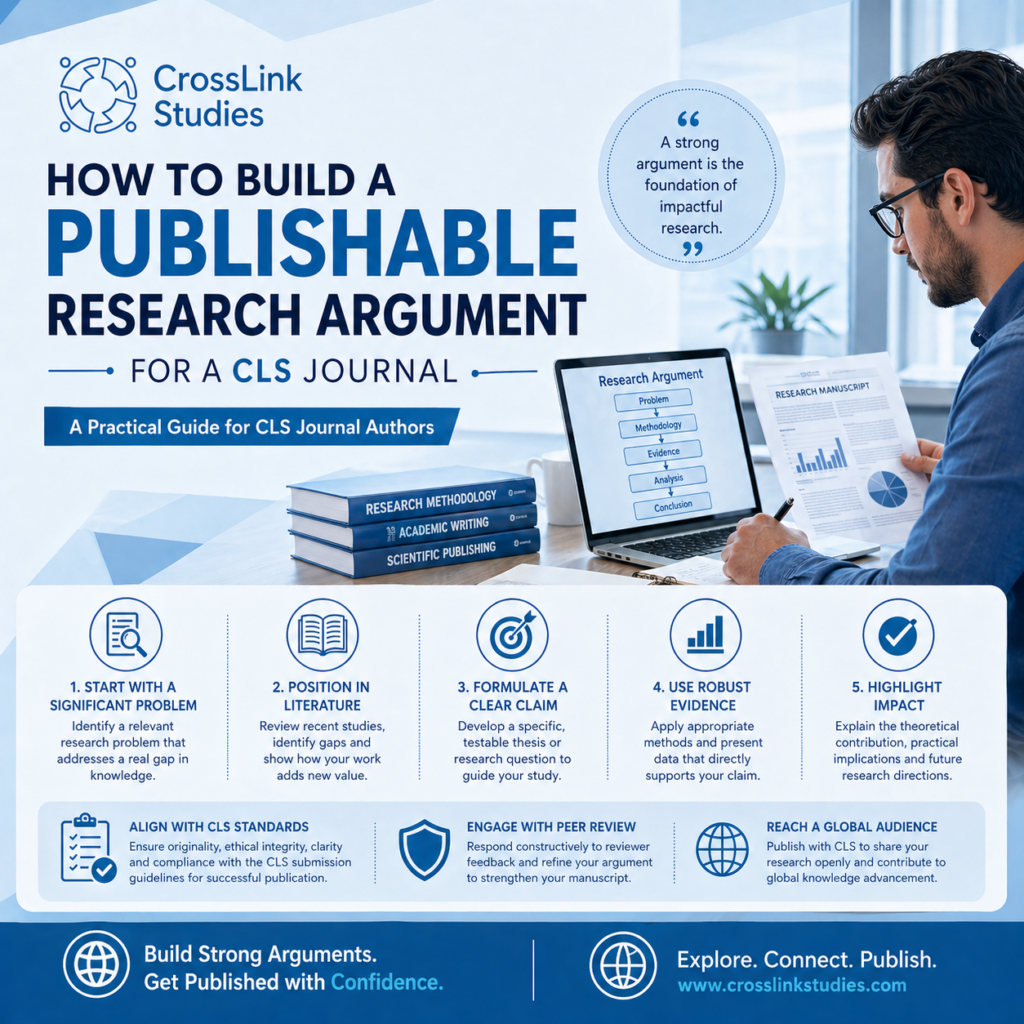
Position Your Work Within Existing Literature
A strong research argument is built on scholarly positioning. CLS consistently emphasize identifying gaps, contradictions, or limitations, demonstrating what is missing and avoiding mere summaries of literature. At CLS, originality and rigor are mandatory your work must “contribute significantly to your field”.
Effective Strategy:
- Move from broad field → specific gap → your contribution
- Use recent, high-impact studies to anchor your argument
Formulate a Clear and Defensible Claim
Your research argument should be distilled into a central thesis statement, supported by research questions or hypotheses. This claim must be, specific (not vague), testable (empirical or theoretical) and logically connected to your problem.
Weak: “This study explores AI.”
Strong: “This study demonstrates how AI-driven models improve manuscript quality while introducing bias risks in academic publishing.”
Build Logical Coherence Across Sections
A publishable argument is not fragmented it flows seamlessly across:
- Introduction → Literature Review → Methodology → Results → Discussion
CLS follows a structured editorial and peer-review process, including technical checks, editorial screening, and reviewer evaluation. Any inconsistency in logic weakens your manuscript during these stages.
Key Principle:
Each section must answer a specific role in your argument:
- Introduction: Why it matters
- Literature Review: What is missing
- Methodology: How you address it
- Results: What you found
- Discussion: Why it matters again
Strengthen the Argument with Robust Methodology
Top journals prioritize methodological credibility. CLS explicitly requires clear objectives, robust and transparent methods and data-supported conclusions.
Best Practices:
- Justify your choice of methods
- Explain why your approach is appropriate
- Ensure reproducibility and clarity
Your methodology is not just a procedure; it is evidence that your argument is trustworthy.
Use Evidence Strategically, Not Excessively
Evidence should directly support your claims, be clearly interpreted (not just presented) and avoid unnecessary data overload. A common mistake is presenting results without linking them back to the argument.
Address Limitations and Counterarguments
High-impact journals value intellectual honesty. A strong research argument acknowledges limitations, engages with alternative explanations, demonstrates critical thinking
This not only strengthens credibility but also aligns with CLS’s emphasis on ethical and rigorous research standards.
Highlight Contribution and Impact
Your discussion should clearly articulate theoretical contribution (What new knowledge is added?), practical implications (Who benefits and how?) and future research directions. CLS emphasizes global visibility, open access dissemination, and interdisciplinary collaboration, ensuring your work reaches a wide audience. A publishable argument answers:
“What changes because of this research?”
Align with CLS Scope and Standards
To maximize acceptance chances, ensure your topic fits CLS’s multidisciplinary scope, follow submission guidelines strictly and maintain ethical integrity and originality. Non-compliance with formatting or ethical standards can lead to immediate rejection.
Engage Constructively with Peer Review
Peer review is not a barrier it is part of refining your argument. CLS uses a rigorous review system with multiple expert evaluations. Authors who respond clearly to reviewer comments, revise thoughtfully and justify their decisions are far more likely to succeed.
For authors targeting Crosslink Studies, success lies in aligning your argument with rigor, openness, interdisciplinary, and global relevance. A well-crafted argument does not just get published it influences, informs, and advances knowledge.