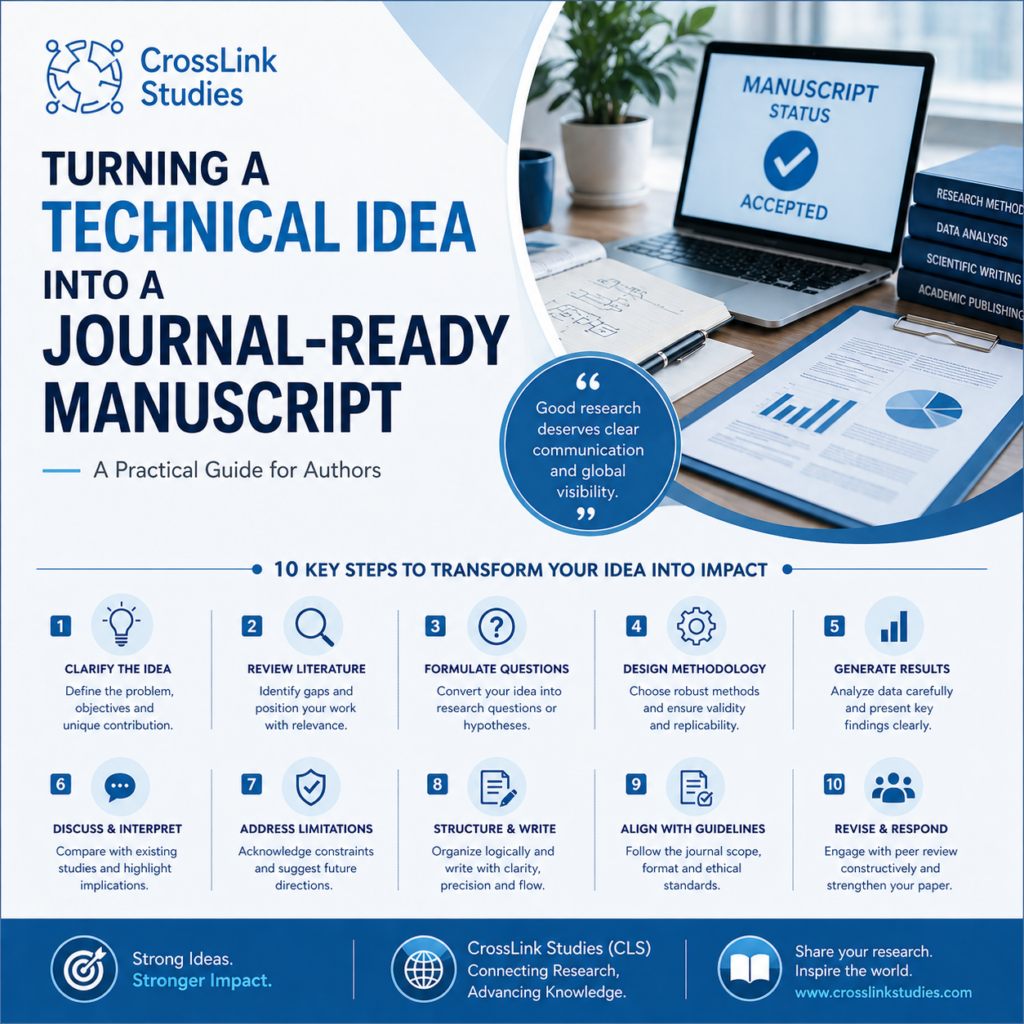
Turning a Technical Idea into a Journal-Ready Manuscript
Every research journey begins with a technical idea but only a fraction of these ideas evolves into publishable manuscripts. The difference lies not in complexity, but in clarity, structure, and scholarly positioning.
For authors targeting Crosslink Studies (CLS) journals like Ubiquitous Technology Journal (UTJ), transforming a technical concept into a journal-ready paper requires more than technical expertise. It demands a systematic approach aligned with international publishing standards, rigorous peer review expectations, and interdisciplinary relevance.
This guide outlines how to convert your idea into a clear, credible, and impactful manuscript ready for submission.
Clarify the Core Idea and Its Contribution
A technical idea becomes publishable only when its purpose and contribution are clearly defined.
Start by answering:
- What problem does your idea solve?
- Why is this problem important?
- What is new or different in your approach?
Top journals emphasize novelty and relevance. CLS, with its multidisciplinary scope, values research that addresses real-world challenges and advances knowledge across fields. So, reduce your idea to a one-sentence contribution statement. If it’s unclear, your manuscript will be too.
Translate Technical Complexity into Research Questions
Many submissions fail because they present technical detail without a clear research direction. Convert your idea into a main research question, supporting objectives or hypotheses. This step ensures your manuscript is not just descriptive but analytical and argument driven.
Example:
Instead of “We developed a model,” write:
“This study evaluates how the proposed model improves accuracy compared to existing methods.”
Position Your Idea Within the Literature
A journal-ready manuscript must show where your idea fits in existing research. Follow a structured approach review recent, high-impact studies, identify gaps, limitations, or inconsistencies and explain how your work addresses these gaps. CLS expects submissions to demonstrate originality and scholarly relevance, not just technical implementation. Avoid listing studies without analysis and ignoring recent developments the aim is critical comparison and clear justification of your contribution.
Design a Methodology That Supports Your Claim
Your idea must be backed by a methodologically sound framework. A strong methodology should clearly explain data sources, tools, and procedures, justify why these methods are appropriate and ensure reproducibility and transparency. CLS prioritize methodological rigor and follows a structured editorial screening where weak methods often lead to early rejection. Your methodology is evidence of credibility, not just a process description.
Present Results with Purpose
Results are not just outputs they are evidence supporting your argument. To strengthen your manuscript present findings clearly (tables, figures, concise text), highlight key patterns and insights and avoid unnecessary or excessive data. Most importantly every result should answer: “How does this support my research question?”
Build a Strong Discussion and Interpretation
This is where your manuscript becomes truly impactful. A high-quality discussion should interpret results in the context of existing research, explain why your findings matter and address unexpected outcomes. CLS values research that contributes to both theory and practice, so connect your findings to academic advancement and real-world applications.
Acknowledge Limitations and Strengthen Credibility
Top journals expect intellectual honesty. Include study limitations, assumptions and constraints and areas for improvement. Rather than weakening your paper, this enhances trust and scholarly integrity, aligning with CLS ethical standards.
Refine Structure and Academic Writing Quality
A technically strong paper can still be rejected due to poor structure or unclear writing. Ensure logical flow across sections, clear and concise language, consistent formatting.
Standard Structure:
- Abstract
- Introduction
- Literature Review
- Methodology
- Results
- Discussion
- Conclusion
Keep sentences precise and avoid unnecessary jargon.
Align with CLS Submission Standards
Before submission, ensure full compliance with CLS requirements formatting and style guidelines, ethical standards (originality, plagiarism-free), proper citations and references. CLS follows a rigorous peer-review and editorial process, where even minor deviations can delay or reject submissions.
Prepare for Peer Review and Revision
Publication is not the final step revision is part of the process. To succeed respond clearly to reviewer comments, revise with justification, not emotion, strengthen weak sections Authors who treat peer review as collaboration not criticism, significantly improve acceptance chances. For authors submitting to Crosslink Studies, success lies in combining technical excellence with clarity, credibility, and global relevance. A well-prepared manuscript does more than present an idea it communicates knowledge that advances research and creates impact.