How Accepted Papers Can Gain More Visibility After Publication
Publication is not the end of the research journey it is the beginning of visibility and impact. Even high-quality papers can go unnoticed if they are not actively promoted and positioned within the scholarly ecosystem.
Leading journals increasingly emphasize post-publication visibility strategies to maximize readership, citations, and real-world influence. For Crosslink Studies (CLS), enhancing visibility ensures that valuable findings reach the right academic and professional audiences.
Why Visibility Matters After Publication
In today’s digital research landscape, visibility directly affects citation impact, academic recognition, collaboration opportunities, societal and industry influence. A well-promoted paper is more likely to contribute meaningfully to ongoing research and innovation.
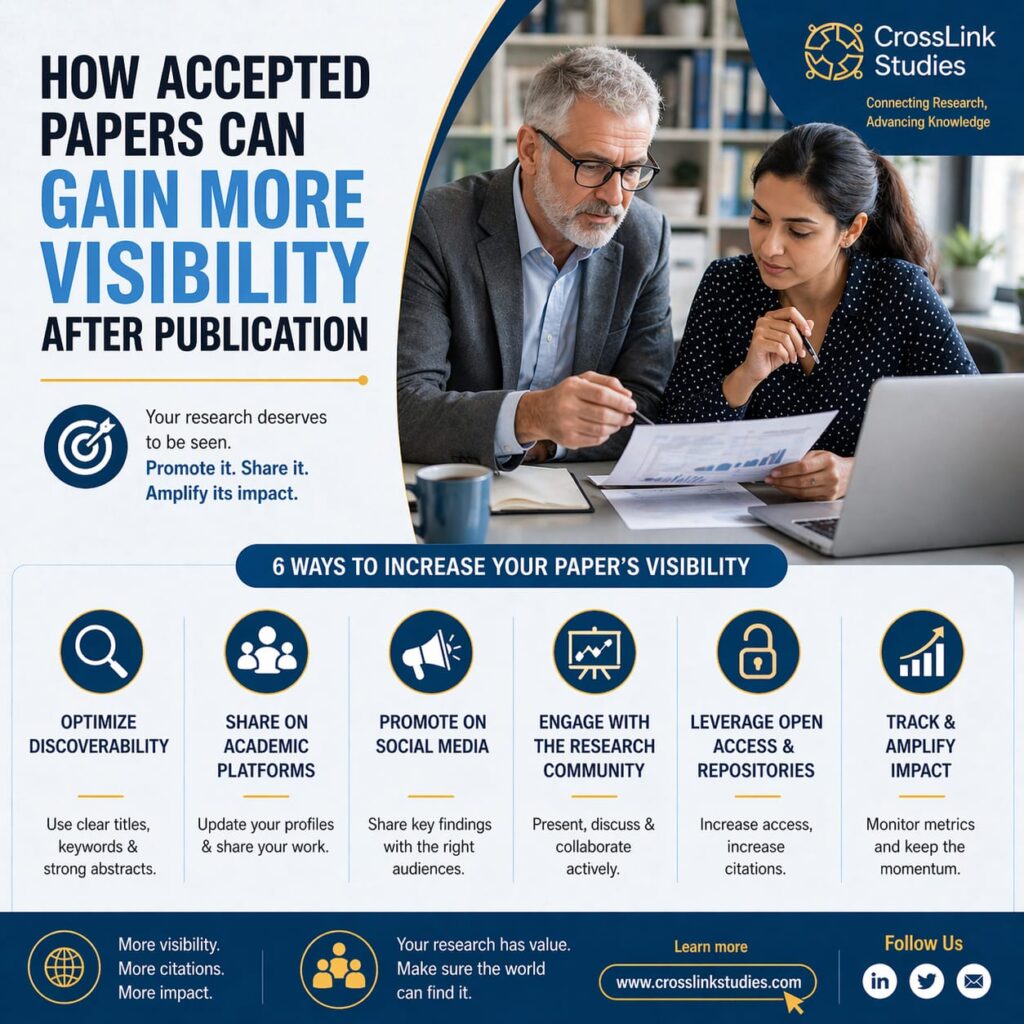
Optimize Your Article Metadata
Ensure that your paper is discoverable through: clear and precise title, relevant keywords, informative abstract. Search engines and indexing platforms rely heavily on metadata to surface your research.
Share Through Academic Networks
Promote your paper on platforms such as: research Gate, google Scholar profile and ORCID record. Keeping your academic profiles updated helps researchers find and cite your work more easily.
Use Social Media Strategically
Share your research on LinkedIn (professional audience), twitter/X (academic discussions), and institutional pages. Use concise summaries, visuals, and hashtags to increase engagement and reach.
Create Visual Summaries
Visual communication improves accessibility. Consider graphical abstracts, infographics and short explainer videos. These formats help communicate complex ideas quickly and attract broader audiences.
Engage with Your Research Community
Increase visibility by presenting at conferences and seminars, participating in and discussing your work in academic forums. Active engagement positions your research within ongoing scholarly conversations.
Collaborate with Co-authors and Institutions
Encourage co-authors and affiliated institutions to: share the publication on their platforms, include it in newsletters or press releases. Collective promotion amplifies reach and impact.
Leverage Open Access and Repositories
If permitted deposit your manuscript in institutional repositories, share preprints or accepted versions. Open access increases global accessibility and citation potential.
Track and Respond to Engagement
Monitor your paper’s performance through citation metrics, downloads and views, altimetry’s (mentions, shares, discussions). Engaging with readers and responding to queries can further enhance visibility and credibility.
Maintain Consistent Academic Presence
Visibility is sustained through ongoing activity regularly update your profiles, share related research outputs, continue contributing to discussions in your field. Consistency builds a recognizable academic identity.
Align with Journal Promotion Channels
Many journals, including Ubiquitous Technology Journal (UTJ), support visibility through featured articles, social media promotion, email newsletters. Collaborating with journal initiatives enhances exposure to targeted audiences.
Common Mistakes to Avoid
- Assuming publication alone ensures visibility
- Using overly technical language in promotions
- Ignoring digital platforms and networks
- Failing to update academic profiles
- Not engaging with the research community
These can limit the impact of otherwise strong research.
At Crosslink Studies (CLS), we encourage authors to actively participate in post-publication dissemination. We support ethical and responsible promotion, increased accessibility of research, engagement with global academic and industry audiences. Our goal is to ensure that published work achieves maximum visibility and meaningful impact, particularly in AI and interdisciplinary research. In modern scholarly publishing, impact is not just about what you publish but how effectively it is seen and used.