Five Ways Reviewers Can Save Time and Still Improve Quality
Peer review is essential to maintaining the integrity and quality of scholarly publishing but it is also time-intensive. Many reviewers balance research, teaching, and administrative responsibilities, making efficiency a critical concern.
Leading journals emphasize that efficient reviewing does not mean superficial reviewing. Instead, it requires a structured, focused, and strategic approach. For CLS (Crosslink Studies), particularly in fast-evolving fields like AI and technology, reviewers are encouraged to deliver high-quality evaluations within reasonable timeframes.
Why Efficiency Matters in Peer Review
Timely reviews accelerate editorial decisions, improve author experience, maintain journal competitiveness. However, speed should never compromise accuracy, fairness, or depth of evaluation. The goal is to optimize effort not reduce quality.
1. Start with a Structured Review Framework
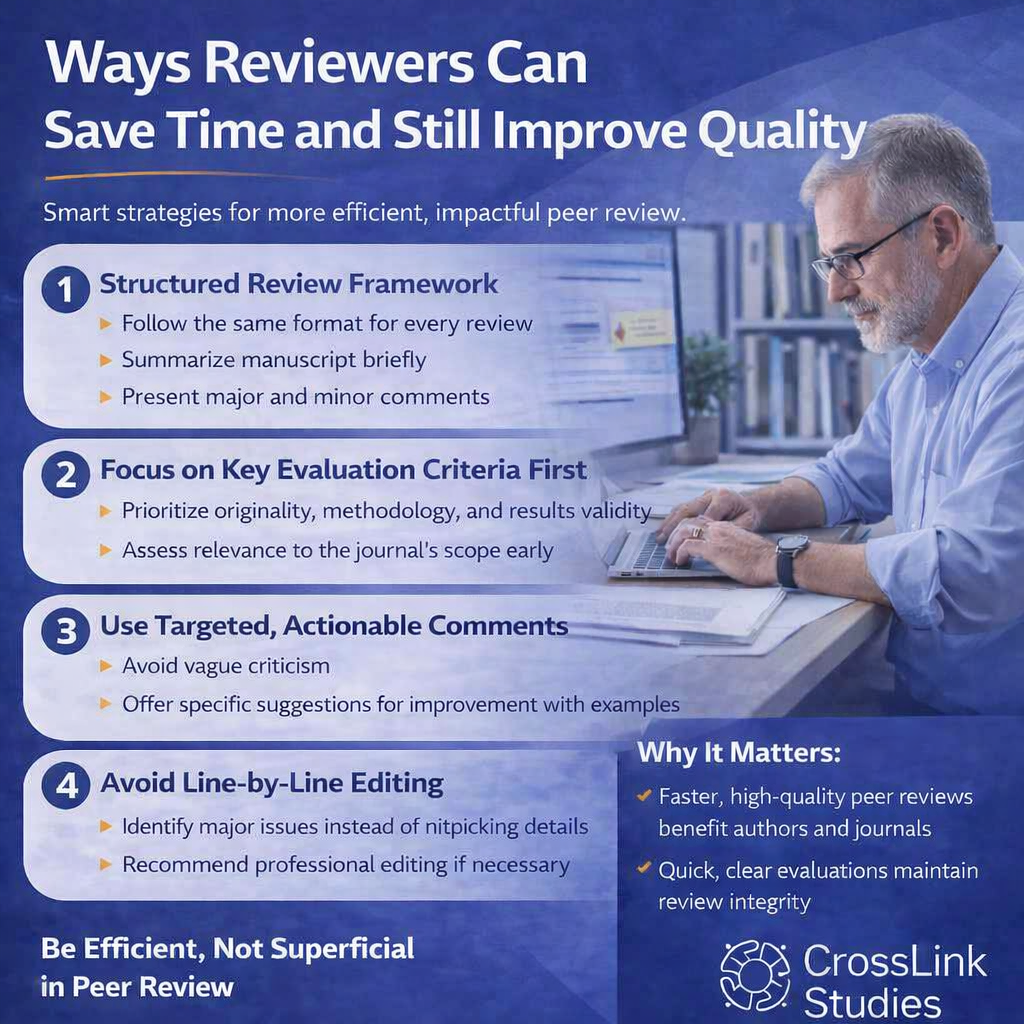
One of the most effective ways to save time is to follow a consistent structure for every review.
Recommended Structure
- Brief summary of the manuscript
- Major comments (methodology, novelty, results)
- Minor comments (clarity, formatting, references)
- Final recommendation
This approach helps reviewers stay focused, avoid repetitive reading, deliver clear and organized feedback.
2. Focus on Key Evaluation Criteria First
Top publishers recommend prioritizing core scientific elements include originality and contribution, methodological soundness, validity of results, relevance to the journal scope. Instead of commenting on every detail initially, reviewers should first determine:
➡️ Is this study fundamentally sound and publishable?
This prioritization saves time while ensuring critical issues are addressed early.
3. Use Targeted, Actionable Comments
Efficient reviewers avoid vague or overly long feedback. Instead, they provide specific observations, clear suggestions for improvement, concise explanations.
Example
- Inefficient: “The paper needs improvement.”
- Efficient: “The methodology section lacks detail on data pre-processing; please clarify steps for reproducibility.”
Targeted comments reduce unnecessary back-and-forth during revision.
4. Avoid Line-by-Line Editing
Reviewers are not copy editors. Spending excessive time on grammar and formatting can reduce efficiency.
Better Approach
- Highlight recurring issues (e.g., language clarity)
- Suggest professional editing if needed
- Focus on scientific content over stylistic perfection
5. Use Notes and Annotation Tools Effectively
Modern reviewing platforms allow reviewers to annotate PDFs, highlight key sections, add quick comments. Using these tools helps capture thoughts during the first read, reduce the need for re-reading, streamline the final report writing process. Efficient note taking significantly improves both speed and clarity.
Bonus Strategy: Set a Time Framework
Experienced reviewers often allocate:
- First read: 30–45 minutes
- Detailed evaluation: 60–90 minutes
- Final report writing: 30 minutes
Setting time boundaries helps maintain focus and productivity.
Common Pitfalls to Avoid
- Overanalysing minor issues early
- Writing excessively long, unfocused reviews
- Providing vague or generic comments
- Delaying reviews unnecessarily
Efficiency comes from clarity and prioritization, not rushing.
At Crosslink Studies (CLS), we value reviewers who combine timeliness, clarity, constructive insight. In rapidly evolving domains like AI and computing, efficient peer review ensures that high-quality research reaches the community without unnecessary delays. Efficient peer review is not about doing less it is about doing the right things effectively.
By adopting structured approaches, focusing on key issues, and delivering clear, actionable feedback, reviewers can save time while maintaining and even enhancing review quality. In modern scholarly publishing, the most effective reviewers are those who balance speed with substance.