
How to Write a Problem Statement for Applied Technology Research?
In applied technology research, the problem statement is not a formality, it is the intellectual core of the manuscript. It defines the real-world issue, frames the research direction, and justifies the need for innovation. Editors and reviewers at leading journals do not merely look for interesting topics; they look for clearly articulated problems that demand technically sound solutions.
For CLS Crosslink Studies and Ubiquitous Technology Journal (UTJ), where the focus lies on applied, interdisciplinary, and impact-driven research, the problem statement must demonstrate a strong connection between technological advancement and practical relevance. A weak or generic problem statement can undermine even technically sound work, while a precise and well-supported one can significantly strengthen the manuscript’s chances of acceptance.
The Role of a Problem Statement in UTJ Submissions
A well-crafted problem statement performs multiple critical functions:
- It anchors the research within a real-world context
- It demonstrates awareness of current technological limitations
- It positions the study within recent scholarly discourse
- It creates a logical pathway toward the proposed solution
From an editorial perspective, this section is often used to quickly assess:
- Whether the study aligns with UTJ’s applied scope
- Whether the problem is novel, relevant, and significant
- Whether the research has practical and measurable value
In short, the problem statement determines whether your research is worth reviewing in depth.
What Distinguishes a High-Impact Problem Statement
In high-quality journals, a strong problem statement is characterized by four essential qualities:
Precision
It clearly defines a specific, bounded issue, rather than a broad topic.
Contextual Relevance
It is grounded in a real application domain such as IoT, AI systems, smart infrastructure, healthcare technology, or energy systems.
Evidence-Based Justification
It is supported by recent literature (3–5 years) or observable system limitations.
Action ability
It leads directly to a researchable and solvable question, not just a conceptual discussion.
A problem statement should make it immediately clear what is wrong, where, why it matters, and what needs to change.
The CLS Structured Approach to Writing a Problem Statement
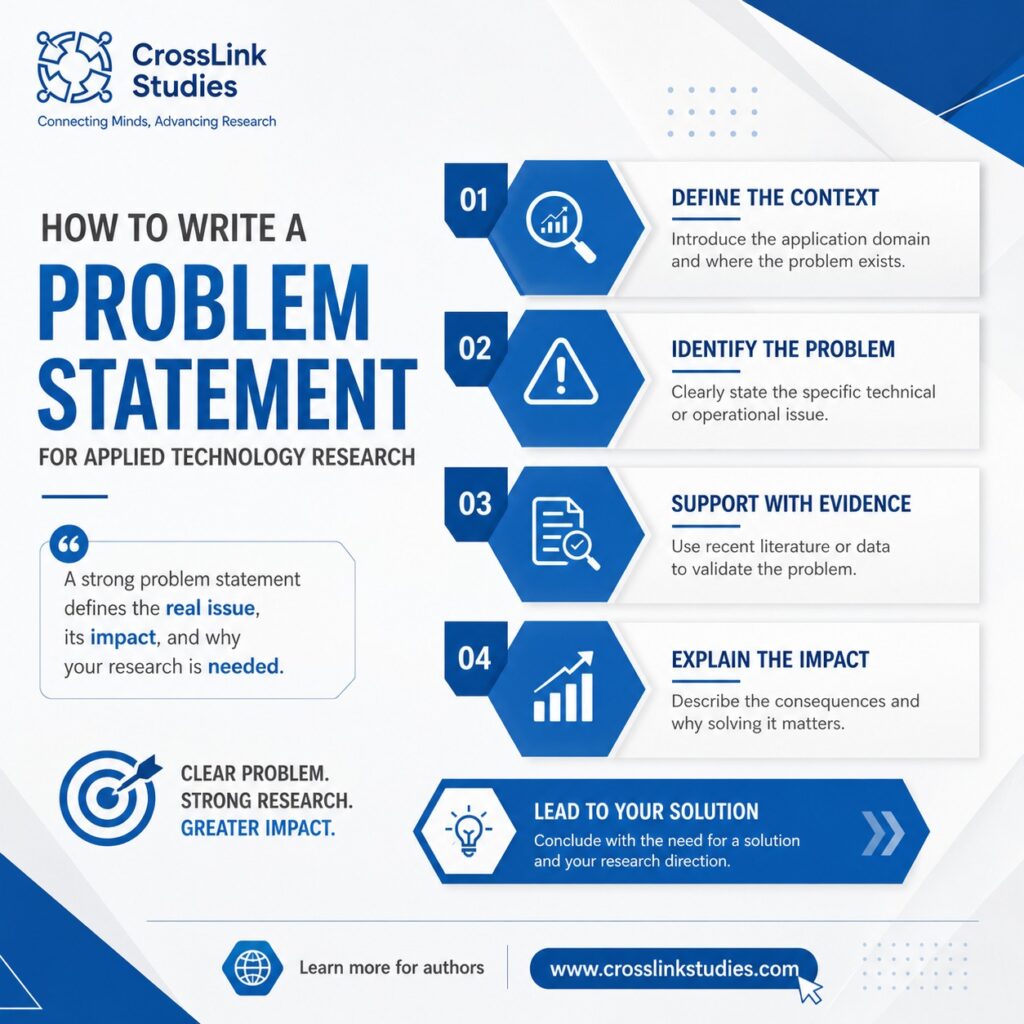
To meet the expectations of UTJ and similar high-impact journals, authors should follow a five-layer progression:
1. Establish the Applied Context
Begin by situating your research within a specific technological environment.
This is not a general introduction it is a focused entry point into the system or domain where the issue exists.
✔ Example domains: Smart cities, Edge computing systems, AI-driven analytics, Industrial automation. The goal is to answer: Where does this problem occur?
2. Narrow Down to a Specific System-Level Issue
Move from context to a clearly defined technical or operational limitation.
This is the most critical transition. Avoid vague phrasing and instead identify performance inefficiencies, scalability challenges, accuracy limitations and integration issues
✔ Strong example:
“Existing edge-based IoT systems experience delays in processing high-frequency real-time data streams.”
The goal is to answer: What exactly is not working?
3. Support the Problem with Recent Evidence
A credible problem is not assumed, it is demonstrated. Reference recent studies, highlight recurring limitations and show consistency across literature. Rather than listing studies, synthesize them to reveal a pattern of limitation. The goal is to answer: How do we know this problem is real and recognized?
4. Explain the Impact and Consequences
A problem becomes significant when its impact is clear.
Discuss how the issue affects system performance, real-world applications, users or stakeholders and scalability or deployment.
✔ Example:
“This limitation reduces system responsiveness in time-critical applications such as healthcare monitoring and autonomous systems.”
The goal is to answer: Why does this problem matter?
5. Transition Toward the Research Direction
Finally, guide the reader toward the need for a solution without fully presenting it. This is where the problem statement connects directly to your research contribution.
✔ Example transition:
“This highlights the need for adaptive frameworks capable of integrating real-time processing with scalable architectures.”
The goal is to answer: What kind of solution is needed?
Common Pitfalls That Reduce Impact
Even strong research can be weakened by poor problem formulation. Avoid:
❌ Framing a topic instead of a problem
❌ Using generic phrases like “more research is needed”
❌ Ignoring recent literature
❌ Overloading with technical detail too early
❌ Failing to explain real-world impact
❌ Jumping directly to the solution without justification
These issues signal lack of clarity and weak positioning.
CLS Problem Statement Evaluation Checklist
Before submission to UTJ, ensure:
✔ The problem is specific and clearly defined
✔ It is rooted in a real-world applied context
✔ It is supported by recent and relevant literature
✔ Its impact is clearly articulated
✔ It logically leads to your research contribution
✔ It aligns with interdisciplinary and applied research goals
A problem statement is not just the beginning of your paper; it is the foundation upon which everything else is built. In applied technology research, it must convincingly demonstrate that the issue is real, relevant, and solvable through your approach.
At CLS Crosslink Studies and UTJ, we encourage authors to approach the problem statement as a strategic argument, not a descriptive paragraph one that clearly positions their research within current challenges and future solutions. If your problem is precise, justified, and impactful, your research already stands on strong ground.