
Table Design for Engineering and Information Systems Papers
In scientific and technical publishing, tables are among the most important tools for presenting structured information, experimental comparisons, datasets, system parameters, and analytical outcomes. In engineering and information systems research, where precision and clarity are essential, a poorly designed table can reduce the readability and impact of an otherwise strong manuscript.
For authors submitting to the Ubiquitous Technology Journal (UTJ) by CLS Crosslink Studies, effective table design is especially critical because the journal focuses on technology-driven disciplines including ubiquitous computing, engineering systems, artificial intelligence, digital infrastructures, networking, cybersecurity, and information systems research. In these areas, tables often serve as the primary method for presenting experimental performance, algorithmic evaluations, simulation outputs, and system comparisons.
A professionally designed table improves manuscript quality by increasing readability, supporting reproducibility, and strengthening reviewer confidence in the presented research. Readers should be able to understand the structure and significance of a table without repeatedly searching the main text for clarification.
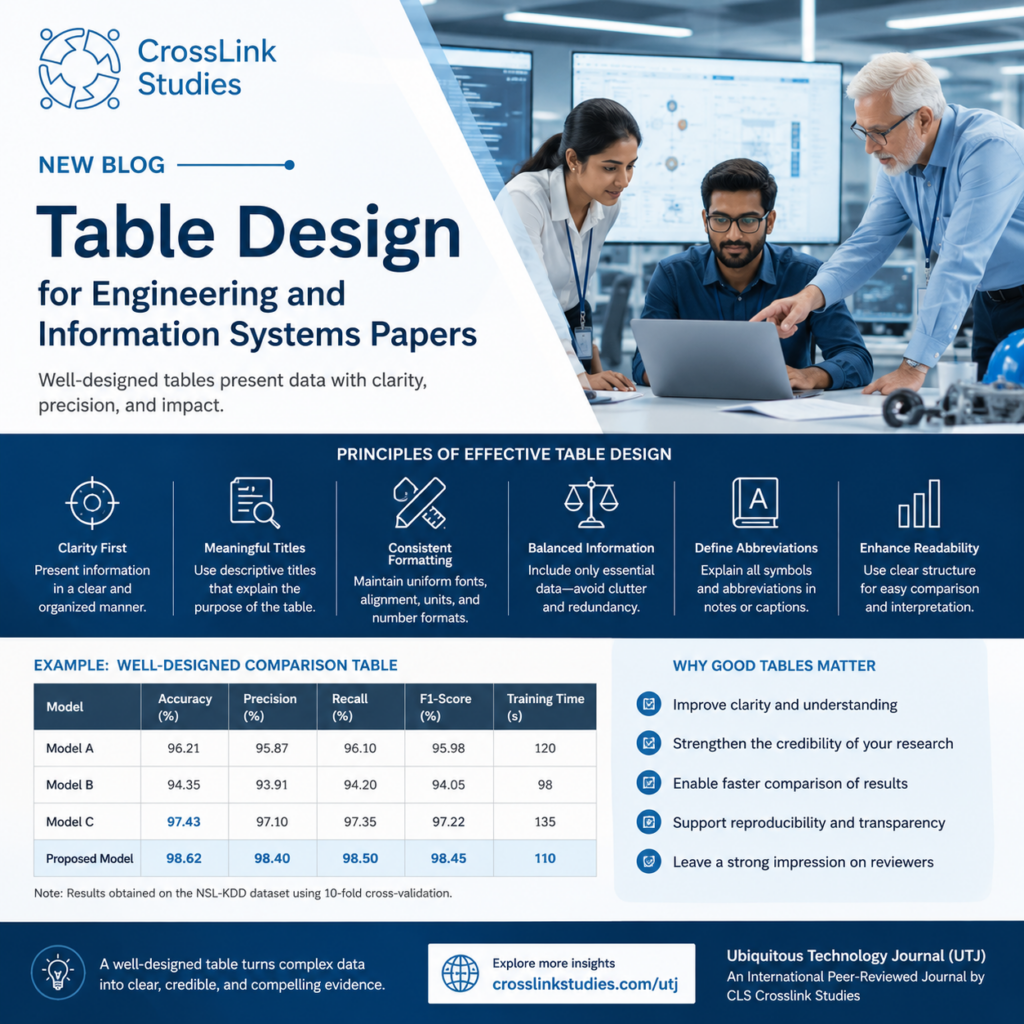
Why Table Design Matters in Scientific Publishing
One of the most important aspects of table design is clarity. Tables should present information in a logical and organized structure that allows readers to identify patterns, relationships, and comparisons immediately.
Overcrowded tables filled with excessive text, inconsistent formatting, or unnecessary columns create confusion and reduce scientific effectiveness. A clean table design improves comprehension and allows technical findings to become more accessible to both reviewers and readers. Because tables frequently present key experimental outcomes, their design quality directly influences how research is interpreted, evaluated, and cited.
Creating Effective Table Titles
An effective table title is equally important. Professional journals generally recommend concise yet descriptive titles that clearly explain the purpose of the table.
Weak titles such as:
- Results Table
- Experiment Data
- Performance Results
fail to communicate meaningful context.
A stronger title would specify the experiment, dataset, or evaluation objective. For example:
Table 3. Comparative Performance Analysis of Machine Learning Classification Models on the NSL-KDD Cybersecurity Dataset
This title immediately informs readers about the technical context, methodology focus, and research objective.
Maintaining Formatting Consistency
Consistency in formatting is a defining characteristic of professional engineering and information systems papers. Tables should maintain uniform font size, text alignment, cell spacing, decimal formatting and unit presentation. Inconsistent formatting gives the impression of weak manuscript preparation and may negatively affect reviewer perception.
Ensuring Numerical Accuracy and Precision
In technology and engineering research, numerical precision is highly important. Authors should avoid inconsistent decimal places or mixed unit systems within the same table. For example, presenting one value as:
- 95.2
and another as:
- 95.23456
creates visual imbalance and reduces readability. Tables should use standardized numerical formatting that reflects the analytical precision required by the study.
Designing High-Quality Comparison Tables
Comparison tables are among the most frequently used table formats in engineering and information systems research. These tables allow readers to evaluate algorithms, architectures, frameworks, protocols, or computational models efficiently. An effective comparison table typically includes clearly defined parameters, standardized evaluation metrics, consistent measurement units, proper value alignment and logical ordering of methods. When structured effectively, the tables provide immediate analytical insight.
Avoiding Information Overload
One of the most common weaknesses in technical manuscripts is excessive information density. Authors often attempt to place large amounts of information into a single table, creating layouts that are difficult to read and interpret. If a table contains too many variables, datasets, or experimental conditions, consider dividing the content into multiple tables, separating primary and supplementary results and presenting trends through figures instead of large data tables.
Defining Abbreviations and Technical Symbols
Abbreviations and symbols within tables should always be clearly defined. Readers should not be required to search through the methodology section to interpret technical notation.
Examples include CNN (Convolutional Neural Network), IoT (Internet of Things), SDN (Software-Defined Networking), FPGA (Field-Programmable Gate Array), QoS (Quality of Service). These terms should either be introduced earlier in the manuscript or explained in a table note.
Using Table Notes Effectively
Table notes provide additional context that improves interpretation without cluttering the main table structure. Appropriate uses of table notes include defining abbreviations, explaining datasets, describing experimental conditions, and clarifying statistical significance
Common Uses of Tables in Engineering and Information Systems Research
Tables play a central role in communicating technical findings across engineering and information systems disciplines. They are commonly used for dataset summaries, system architecture comparisons, hardware and software specifications, experimental configurations, benchmark evaluations and user study outcomes. Because these tables often communicate the core contribution of a study, their quality significantly influences manuscript effectiveness.
Designing Tables for Digital Publishing
Modern scholarly communication increasingly occurs through digital platforms. Consequently, tables must remain accessible across different devices and screen sizes.
Authors should avoid excessively compressed layouts, complex nested structures, overly wide tables and small, unreadable text. Instead, they should prioritize clear spacing, logical alignment, simplified structures and mobile-friendly readability. Well-designed tables improve accessibility and enhance reader engagement in online publishing environments.
Avoiding Redundancy Between Tables and Figures
Another frequently overlooked issue is the duplication of information across tables and figures. Authors sometimes present identical results in both formats without adding analytical value.
As a general guideline:
- Use tables when precise numerical values are important.
- Use figures when trends, patterns, and relationships are the primary focus.
Selecting the appropriate presentation format improves manuscript organization and reduces redundancy.
The Impact of Table Quality on Peer Review
Peer reviewers often assess the professionalism of a manuscript through the quality of its visual presentation. Poorly designed tables may suggest weak organization, insufficient attention to detail and limited technical clarity.
Conversely, professionally formatted tables communicate analytical precision, scientific rigor, careful manuscript preparation and research maturity.
Best Practices for UTJ Authors
For authors preparing submissions to the Ubiquitous Technology Journal (UTJ), table design should align with the journal’s emphasis on technical innovation, structured research communication, and high-quality scholarly presentation. Before submission, authors should ensure that every table:
✓ Has a descriptive title
✓ Supports a specific research objective
✓ Uses consistent formatting
✓ Maintains numerical precision
✓ Defines abbreviations clearly
✓ Avoids unnecessary complexity
✓ Enhances rather than duplicates the main text
Following these practices improves readability, strengthens scientific communication, and increases the overall professionalism of the manuscript.
In competitive scholarly publishing environments, thoughtful table design is not optional; it is an essential component of professional scientific communication. By focusing on clarity, consistency, precision, and reader accessibility, authors can ensure that their tables effectively communicate research findings and contribute to a stronger, more persuasive manuscript.