
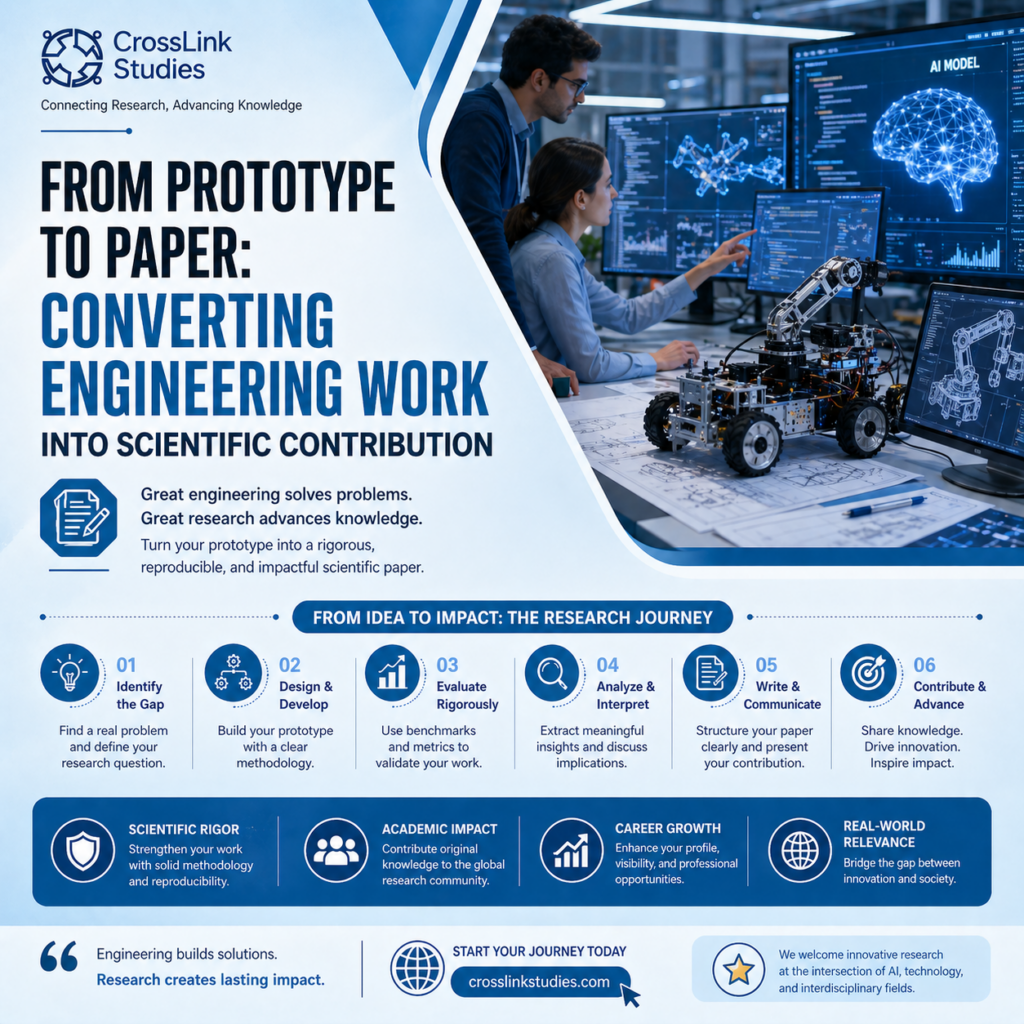
From Prototype to Paper: Converting Engineering Work into Scientific Contribution
Many impactful innovations begin as engineering prototypes working systems, models, or tools designed to solve real-world problems. However, transforming these practical outputs into publishable scientific contributions requires more than functionality; it demands rigor, clarity, and generalizable insight.
For Ubiquitous Technology Journal (UTJ), which emphasizes AI, technology, and interdisciplinary research, bridging the gap between engineering practice and academic publication is essential for advancing credible and reusable knowledge.
Why Prototypes Alone Are Not Enough
A prototype demonstrates that something works but academic publishing asks:
- Why does it work?
- How does it compare to existing approaches?
- What new knowledge does it contribute?
Scientific papers must move beyond implementation to provide validated, reproducible, and theoretically grounded insights.
Step 1: Identify the Core Contribution
Before writing, clearly define:
- What is novel in your work?
- Is it a new method, system, dataset, or framework?
- How does it advance the field?
A strong paper centers on one clear, meaningful contribution, not just a working system.
Step 2: Connect Engineering Work to Research Questions
Transform your prototype into a research narrative by asking:
- What problem does it solve?
- What hypothesis or research question does it address?
- What gap in the literature does it fill?
This step shifts your work from application-driven to knowledge-driven.
Step 3: Ground Your Work in Existing Literature
A scientific paper must demonstrate awareness of prior work. Compare your prototype with existing methods, highlight differences and improvements, and position your contribution within the field. This establishes context, credibility, and relevance.
Step 4: Formalize the Methodology
Engineering solutions must be described in a structured and reproducible way. This includes system architecture or model design, algorithms and workflows and data sources and preprocessing steps. Clarity in methodology ensures that others can replicate and build upon your work.
Step 5: Provide Rigorous Evaluation
A prototype becomes a scientific contribution when it is systematically evaluated.
This includes benchmark comparisons, quantitative metrics (accuracy, efficiency, etc.) and ablation or sensitivity analysis. Evaluation transforms claims into evidence-based conclusions.
Step 6: Interpret Results Critically
Go beyond reporting results explain them.
- Why does your approach perform better (or worse)?
- What are the limitations?
- What insights can others learn?
Interpretation demonstrates depth of understanding and scientific value.
Step 7: Ensure Reproducibility and Transparency
Ubiquitous Technology Journal (UTJ), emphasize code and data availability, clear experimental setup and transparent reporting. Reproducibility strengthens trust and long-term impact.
Step 8: Structure the Paper Effectively
Follow a standard academic structure:
- Abstract
- Introduction
- Related Work
- Methodology
- Results and Discussion
- Conclusion
A clear structure improves readability and editorial evaluation.
Step 9: Refine Language and Presentation
Engineering reports often focus on technical detail, but journal papers require concise and precise writing, logical flow of ideas and clear figures and tables. Effective communication enhances accessibility and impact.
Step 10: Align with Journal Scope and Standards
Before submission to UT ensure alignment with AI, technology, or interdisciplinary themes, follow author guidelines strictly and highlight both practical and theoretical contributions. Alignment increases the chances of successful peer review.
Common Challenges to Avoid
- Describing only implementation without analysis
- Lack of comparison with existing work
- Insufficient evaluation or weak metrics
- Overly technical writing without clear narrative
- Ignoring reproducibility requirements
These issues can prevent strong engineering work from becoming publishable research. At Crosslink Studies (CLS), we value research that successfully integrates practical innovation (engineering solutions), scientific rigor (methodology and validation) and knowledge contribution (insight and advancement). We encourage authors to transform prototypes into papers that are not only functional but also informative, reproducible, and impactful. Converting a prototype into a scientific paper is about translating practice into knowledge. In modern research, innovation matters, but explaining, validating, and sharing that innovation is what creates lasting impact.