
How to Write Figure Captions That Explain Technical Findings?
In high-quality scientific publishing, figures are not decorative additions, they are evidence. A well-designed figure can summarize an entire experiment, workflow, or analytical outcome within seconds. However, even the most technically advanced visualization loses impact if the caption fails to explain what readers are seeing and why it matters.
For researchers submitting to Ubiquitous Technology Journal (UTJ) by CLS Crosslink Studies, strong figure captions are especially important because the journal focuses on technical and applied research where visual interpretation plays a central role in communicating findings. This blog explains how to write professional figure captions that clearly communicate technical findings and improve the quality, readability, and credibility of your manuscript.
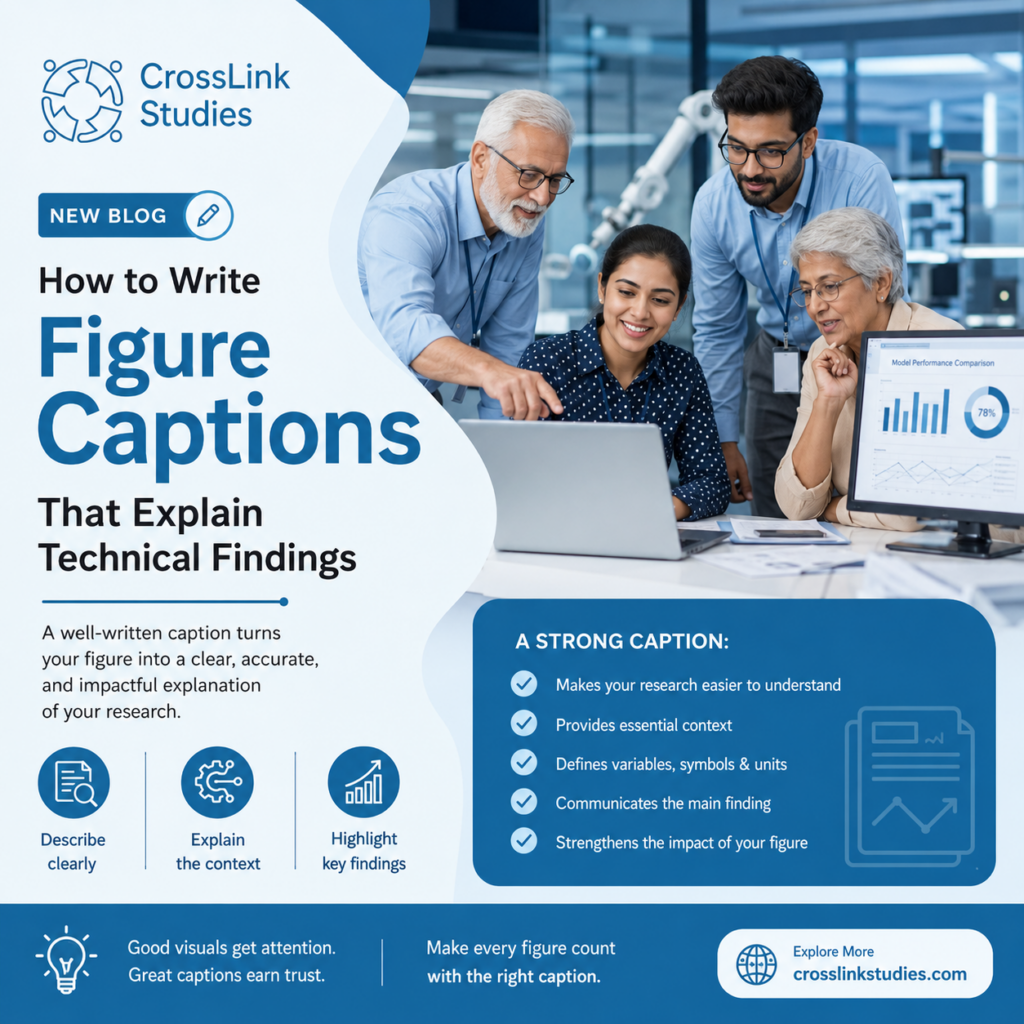
Why Figure Captions Matter in Scientific Publishing
A figure caption performs more than a labeling function. It guides readers through the scientific meaning of a visual element. In UTJ, reviewers often evaluate figures before reading the full methodology section. Poor captions can create confusion even when the research itself is strong.
An effective caption helps readers understand the purpose of the figure, interpret data correctly, identify variables, abbreviations, and symbols, recognize experimental conditions, understand the technical significance of results and connect the figure to the broader research objective. Research on scientific figure comprehension shows that readers combine visual interpretation with captions to determine the main takeaway from technical graphics.
Characteristics of a High-Quality Figure Caption
Professional journals generally expect captions to be concise but sufficiently detailed. A strong caption typically contains four key elements.
1. A Clear Description of the Figure
Start by identifying what the figure represents.
Instead of writing:
“Performance graph of the model.”
Write: “Figure 3. Accuracy comparison of the proposed deep learning framework and baseline CNN models across five benchmark datasets.” The reader should immediately understand the subject and context of the figure.
2. Explanation of Technical Variables and Symbols
Scientific visuals often contain abbreviations, symbols, color indicators, or parameter labels. Captions should define them clearly.
For example:
- Define acronyms such as IoT, CNN, NLP, or FPGA
- Explain color coding in heatmaps
- Clarify axes, units, and markers
- Identify experimental groups or simulation parameters
3. Interpretation of the Main Finding
Many authors only describe what appears in the figure but fail to explain the technical outcome. A professional caption should briefly communicate the scientific significance.
Weak caption: “Results of latency testing.”
Improved caption: “Figure 5. Network latency under varying traffic loads, demonstrating that the proposed routing protocol reduces average latency by approximately 18% compared to conventional dynamic routing methods.” This transforms the caption from a label into an analytical explanation.
4. Sufficient Context Without Excessive Length
A caption should be informative but not overloaded with methodology details. Good captions are specific, technically accurate, reader-focused and self-contained. Avoid turning captions into full paragraphs of discussion.
Common Problems Found in Figure Captions
Many manuscripts submitted to technology and engineering journals contain recurring caption problems that reduce publication quality.
Overly Short Captions
Captions such as:
- “Simulation results”
- “Experimental setup”
- “Model architecture”
do not provide enough information for interpretation.
Repetition of Main Text
Some authors repeat entire paragraphs from the results section. Captions should summarize essential meaning, not duplicate discussion content.
Undefined Abbreviations
Technical abbreviations must be defined either in the figure itself or in the caption.
For example:
- Wrong: “QoS improvement under SDN conditions”
- Better: “Quality of Service (QoS) improvement under Software-Defined Networking (SDN) conditions”
Missing Statistical or Experimental Context
Figures involving datasets, algorithms, benchmarks, or measurements should specify dataset name, experimental environment, number of samples and statistical indicators.
Recommended Structure for Technical Figure Captions
A practical structure used in CLS is:
Figure Number + Topic + Technical Context + Main Finding
Example:
“Figure 7. Confusion matrix of the proposed hybrid AI classifier on the CICIDS2017 cybersecurity dataset, showing improved attack detection accuracy for low-frequency intrusion categories.”
This format is professional, informative, and publication-ready.
Example: Weak vs Strong Figure Caption
Weak Caption
“Figure 2. Proposed system.”
Problems: Too vague, no technical explanation, no indication of contribution and no context
Strong Caption
“Figure 2. Architecture of the proposed IoT-enabled healthcare monitoring framework integrating wearable sensors, cloud-based analytics, and real-time anomaly detection for patient monitoring.”
Why it works: explains components, defines application area, highlights technical purpose and improves reader understanding.
Figure Captions in Computer Science and Engineering Research
Since Ubiquitous Technology Journal (UTJ) focuses on ubiquitous computing, digital systems, AI, networking, and applied technologies, authors should pay special attention to captions involving system architectures, workflow diagrams, algorithm comparisons, neural network structures, performance benchmarks and IoT frameworks. In technology-focused research, captions should communicate both functionality and technical contribution.
Best Practices Followed by Leading Journals
CLS consistently recommend the following figure-caption standards:
| Best Practice | Purpose |
| Number figures sequentially | Maintains organization |
| Keep captions self-contained | Improves readability |
| Define symbols and abbreviations | Prevents confusion |
| Mention units and scales | Ensures technical accuracy |
| Explain major findings | Highlights contribution |
| Use professional terminology | Maintains scholarly tone |
| Avoid excessive detail | Preserves clarity |
| Maintain consistency across figures | Improves manuscript quality |
How Figure Captions Influence Peer Review
Reviewers often judge manuscript quality through visual presentation. Poor captions can create the impression that results are incomplete, data interpretation is weak, experimental design lacks clarity and authors are unfamiliar with publication standards.
Conversely, well-written captions demonstrate scientific professionalism, technical understanding and attention to detail. For authors submitting to CLS Crosslink Studies, Ubiquitous Technology Journal (UTJ), professionally written figure captions can substantially improve manuscript clarity, reviewer perception, and overall publication quality.
The most effective captions do three things simultaneously:
- Describe the figure clearly
- Explain the technical context
- Highlight the scientific finding
When captions achieve these objectives, figures become more persuasive, accessible, and impactful within the scholarly communication process.