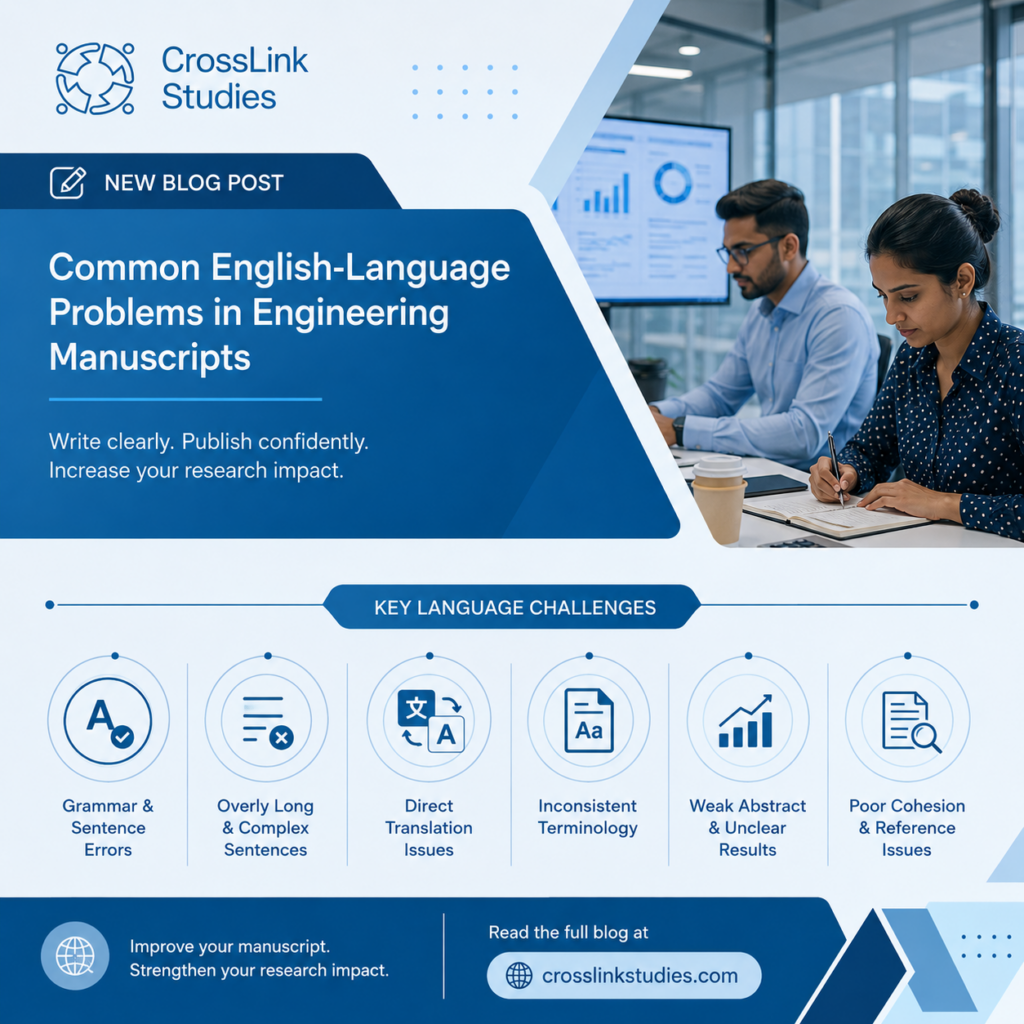
Common English-Language Problems in Engineering Manuscripts
Engineering research is built on innovation, experimentation, and technical accuracy. However, even groundbreaking research can face delays, major revisions, or rejection when the manuscript contains significant English-language issues. In many peer-reviewed engineering journals, language quality is evaluated alongside scientific merit because unclear writing can obscure important findings and reduce the impact of valuable research.
Editors and reviewers frequently encounter manuscripts that demonstrate strong technical contributions but struggle with readability, grammar, sentence structure, and academic style. These issues not only increase the review burden but also make it difficult for readers to understand the novelty and significance of the work.
For researchers seeking publication in international engineering journals, mastering scientific English is no longer optional, it is an essential component of scholarly communication.
1. Grammatical Errors That Affect Technical Clarity
One of the most common reasons manuscripts receive language-related revision requests is the presence of grammatical inaccuracies.
Incorrect:
The results shows that the algorithm perform efficiently.
Correct:
The results show that the algorithm performs efficiently.
Problems involving subject-verb agreement, incorrect article usage (a, an, the), and inconsistent verb tenses often reduce the professionalism of a manuscript.
Best Practice
Use present tense when discussing established knowledge and past tense when describing completed experiments and observations.
Example:
- Present: “Machine learning algorithms improve predictive performance.”
- Past: “The proposed model achieved 95% classification accuracy.”
2. Overly Long and Complex Sentences
Engineering authors often attempt to include multiple ideas within a single sentence. This creates confusion and reduces readability.
Problematic Example
The proposed framework which was developed using multiple optimization strategies and tested under different network conditions demonstrated improved performance while reducing latency and increasing throughput which confirms its applicability for real-world deployment.
Improved Version
The proposed framework was developed using multiple optimization strategies. It was tested under different network conditions. The results demonstrated improved performance, reduced latency, and increased throughput, confirming its suitability for real-world deployment.
3. Direct Translation from Native Languages
Many manuscripts are written by translating content directly from a native language into English. Although technically correct, such translations often produce unnatural sentence structures.
Example
Translated Style:
In this paper, the discussion about the proposed model is made.
Natural Academic Style:
This paper discusses the proposed model.
4. Excessive Use of Passive Voice
Engineering literature traditionally relied heavily on passive constructions. Modern journals increasingly encourage balanced use of active voice because it improves clarity and engagement.
Example
Passive:
The experiment was conducted and the data were analyzed.
Active:
We conducted the experiment and analyzed the data.
Active voice clearly identifies actions and often reduces unnecessary wordiness.
5. Inconsistent Technical Terminology
Technical consistency is essential in engineering manuscripts.
Example
An author may use deep learning model, proposed network, artificial intelligence system and classification framework to describe the same method throughout the paper. Such inconsistency confuses reviewers and readers.
Recommendation
Define terminology clearly and use the same term consistently across the title, abstract, methodology, results, and conclusions.
6. Weak Abstract Writing
The abstract is often the first section read by editors, reviewers, and researchers. A poorly written abstract can negatively influence the initial assessment of the manuscript.
Common Problems
Excessive background information, missing research objectives, lack of quantitative results and unclear conclusions.
Effective Structure
A strong engineering abstract should include:
- Research problem
- Objective
- Methodology
- Key findings
- Practical implications
Readers should understand the entire study within a few minutes of reading the abstract.
7. Improper Use of Technical Acronyms
Engineering disciplines frequently use abbreviations and acronyms. Problems occur when abbreviations are introduced without explanation.
Incorrect
CNN achieved better performance than traditional methods.
Correct
Convolutional Neural Network (CNN) achieved better performance than traditional methods. After the first definition, the abbreviation may be used consistently throughout the manuscript.
8. Poor Cohesion Between Sections
Many manuscripts contain well-written individual sections but lack logical flow between them.
Typical Issues
- Abrupt transitions
- Repetition of information
- Results presented without explanation
- Conclusions introducing new concepts
Each section should naturally connect to the next:
Introduction → Literature Review → Methodology → Results → Discussion → Conclusion
9. Ambiguous Presentation of Results
Reviewers expect clear and precise reporting of experimental findings.
Weak Statement
The model performed well.
Strong Statement
The proposed model achieved 96.3% accuracy, outperforming existing methods by 8.4%.
10. Citation and Referencing Language Issues
Language quality extends beyond the main text. Authors frequently make mistakes such as inconsistent citation styles, incorrect author names, missing publication information and poor integration of references into sentences.
Language Quality as a Competitive Advantage
In today’s highly competitive publishing environment, reviewers evaluate not only the novelty of research but also how effectively it is communicated. Well-structured English writing allows editors and reviewers to focus on the scientific contribution rather than language corrections.
For engineering researchers, improving language quality can significantly enhance manuscript acceptance probability, reviewer engagement, citation potential and international visibility. Language editing should therefore be viewed as a critical stage of manuscript preparation rather than a final cosmetic adjustment.
Before submission, carefully review your manuscript for language accuracy, technical consistency, logical structure, and readability. A technically sound study supported by professional scientific writing stands a far greater chance of successfully navigating peer review and contributing meaningfully to the global engineering community. High-quality research begins with innovation, but its impact depends on clear communication.