
Writing Pseudocode That Supports Scientific Understanding
Why Pseudocode Matters in Scientific Publishing
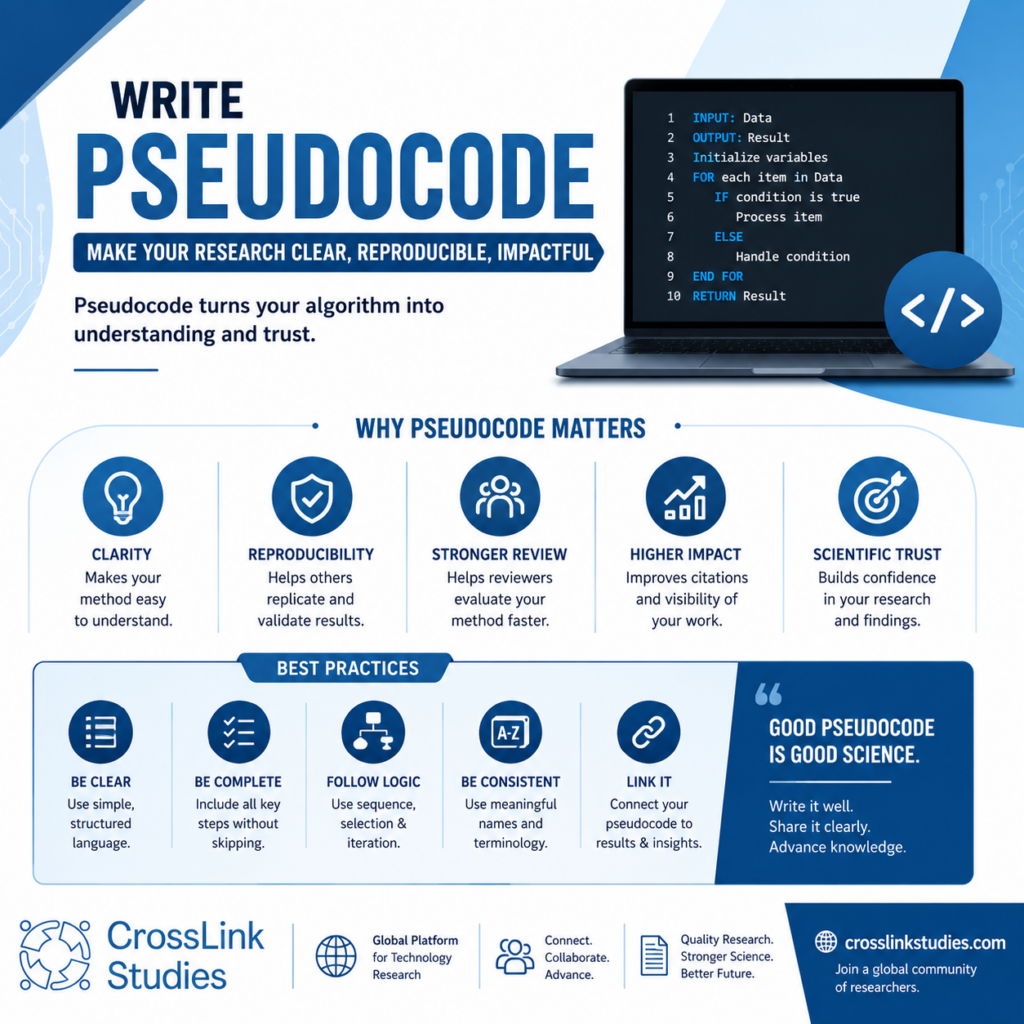
In modern scholarly communication especially in engineering, computing, and applied sciences pseudocode is no longer optional; it is a bridge between theory and reproducibility. It allows authors to present algorithmic logic in a structured yet language-independent way, helping readers understand how results are generated rather than just what they are.
Pseudocode is best understood as a clear, compact, and unambiguous representation of an algorithm, designed for human understanding rather than machine execution. Its growing presence in scientific papers reflects its role in enhancing clarity, reproducibility, and interdisciplinary accessibility.
For journals like Ubiquitous Technology Journal (UTJ), under Crosslink Studies, where methodological transparency is essential, well-written pseudocode directly strengthens the scientific rigor and credibility of submissions.
Alignment with UTJ and High-Impact Journal Standards
CLS emphasize Reproducibility in methods, clarity of algorithmic processes and logical structure in methodology sections. Similarly, UTJ requires manuscripts to clearly present methods in a way that allows replication and validation. Pseudocode plays a crucial role in fulfilling this requirement by:
- Eliminating ambiguity in algorithm descriptions
- Supporting reviewers in evaluating correctness
- Enabling other researchers to reproduce results efficiently
In short, pseudocode strengthens the Materials & Methods or Algorithm Design section often the backbone of technical manuscripts.
Core Principles of Scientific Pseudocode Writing
1. Clarity Over Syntax
Pseudocode should avoid programming-specific syntax and focus on logical steps. It is structured English with algorithmic precision, not actual code.
✔ Good practice:
FOR each data point in dataset:

    IF value > threshold:

        increment counter
✘ Poor practice:
Scan dataset and count values > thresholdThe second example lacks sufficient detail for reproducibility.
2. Completeness Without Overload
A strong pseudocode must:
- Cover all logical steps
- Avoid skipping “obvious” operations
- Provide enough detail for implementation
Incomplete descriptions weaken scientific validity and may lead to rejection during peer review.
3.Logical Structure and Flow
Use standard constructs:
- Sequence (step-by-step execution)
- Selection (IF–ELSE conditions)
- Iteration (loops)
This ensures consistency with global academic standards.
4. Consistent Notation and Terminology
- Use meaningful variable names
- Maintain consistency across the manuscript
- Align terms with those used in figures, tables, and equations
5. Integration with Scientific Narrative
Pseudocode should not stand alone. It must be referenced in the text, explained conceptually and linked to results and evaluation.
Example:
“Algorithm 1 presents the proposed optimization process, which minimizes computational overhead while maintaining accuracy.”
6. Where to Place Pseudocode in a Manuscript
For CLS and UTJ-style articles, pseudocode is best positioned in:
- Methodology Section (primary location)
- Proposed Model / Algorithm Section
- Appendix (for extended algorithms)
Ensure each pseudocode block is numbered (Algorithm 1, Algorithm 2, etc.), a short descriptive title is included and formatting is consistent throughout the paper.
Common Mistakes to Avoid
❌ Writing code instead of pseudocode
❌ Skipping key computational steps
❌ Using ambiguous or vague language
❌ Overcomplicating simple logic
❌ Not linking pseudocode to experimental results
One of the most frequent errors is assuming a step is “obvious” and omitting it this reduces reproducibility and clarity.
Enhancing Scientific Impact Through Pseudocode
Well-crafted pseudocode contributes to higher citation potential (due to usability), better peer-review outcomes, cross-disciplinary understanding and improved teaching and knowledge transfer.
Recent research trends show increasing use of pseudocode in scholarly literature, highlighting its importance in algorithmic communication and knowledge extraction .
Practical Checklist for Authors (CLS-Ready)
Before submission to UTJ or CLS journals, ensure:
✔ Algorithm is clearly described in pseudocode
✔ Steps are logically ordered and complete
✔ Variables and operations are defined
✔ Pseudocode is referenced in the text
✔ Formatting follows journal consistency
✔ Supports reproducibility of results
Pseudocode is more than a technical addition, it is a scientific communication tool that enhances clarity, reproducibility, and impact. For authors submitting to Crosslink Studies and UTJ, mastering pseudocode writing is essential for meeting international publishing standards and producing high-quality, credible research.
By integrating clear, structured, and complete pseudocode into your manuscript, you not only improve readability but also contribute to the advancement of transparent and reproducible science.