
Database Selection for Literature Reviews in Technology Domains
In contemporary academic publishing, the quality of a literature review depends not only on critical analysis and synthesis but also on the strength of its database selection strategy. For review articles in technology-focused disciplines such as artificial intelligence, cybersecurity, software engineering, data science, Internet of Things (IoT), and ubiquitous computing, selecting the right databases is a foundational methodological decision.
Crosslink Studies(CLS) journals like Ubiquitous Technology Journal (UTJ), authors are expected to justify their literature search process clearly and describe the databases used for identifying relevant studies. UTJ specifically encourages transparent methodology reporting, including databases, search terms, and study selection procedures for review articles.
Why Database Selection Matters
A literature review is only as reliable as the sources it includes. Technology research evolves rapidly, and relying on limited or inappropriate databases can result in missing high-impact studies, incomplete evidence synthesis, biased conclusions and reduced reproducibility. Database selection directly influences literature coverage, study quality, research validity and citation diversity.
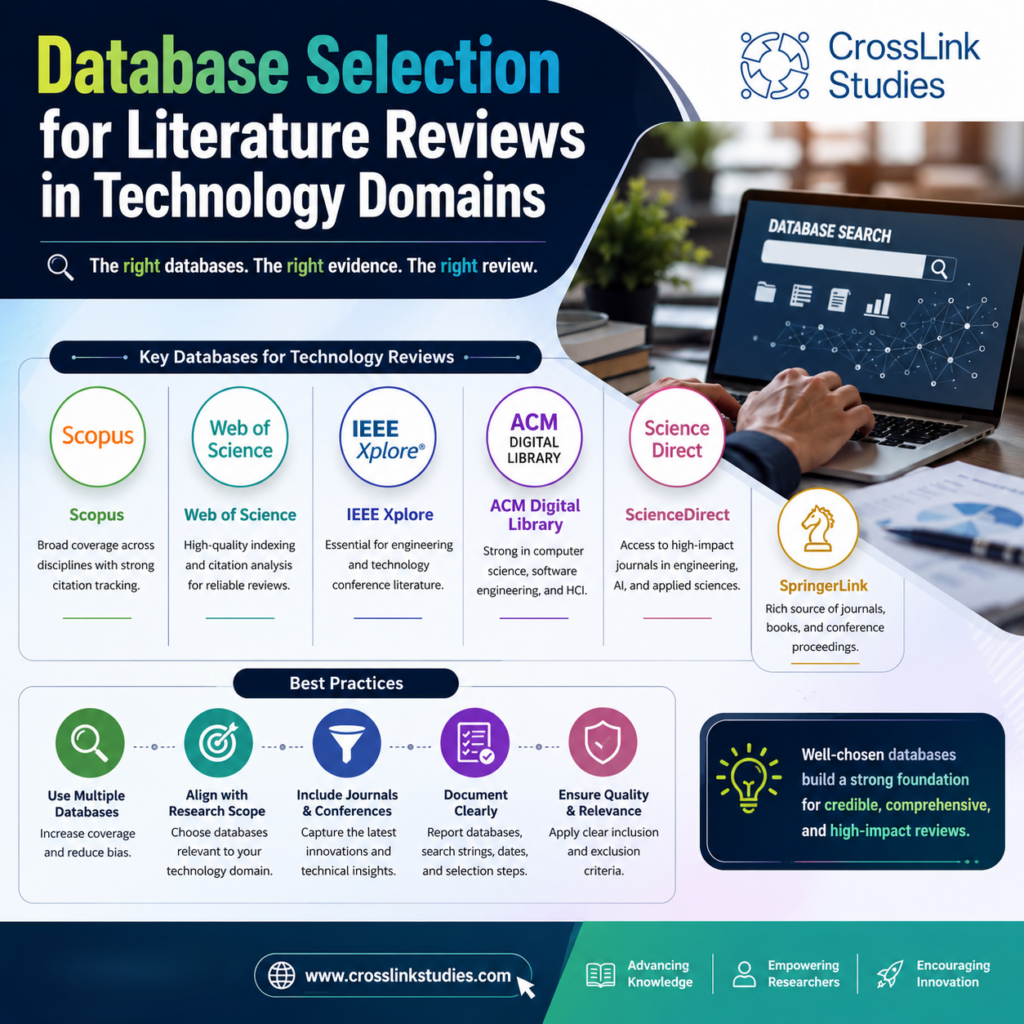
Understanding Database Types in Technology Research
Technology-domain literature reviews often require combining multiple databases because no single database covers all scholarly publications comprehensively.
Different databases specialize in different types of content:
| Database Type | Primary Coverage |
| Citation Databases | Broad interdisciplinary indexing |
| Publisher Databases | Publisher-specific journals and proceedings |
| Technical Databases | Engineering and computing research |
| Medical Databases | Healthcare and biomedical technology |
| Grey Literature Sources | Reports, theses, white papers |
Core Databases for Technology Literature Reviews
Scopus
Scopus is one of the largest multidisciplinary citation databases and is widely used for systematic reviews and bibliometric studies.
Strengths
Broad interdisciplinary coverage, strong citation tracking, high-quality indexing standards and useful for trend analysis and bibliometric mapping.
Best Used For
Artificial intelligence, data science, IoT research, emerging interdisciplinary technologies. Scopus is particularly valuable for identifying highly cited and recent publications across multiple disciplines.
Web of Science
Web of Science is another highly respected citation database commonly used in rigorous review studies.
Strengths
Strong quality control, citation indexing and impact analysis, reliable metadata and excellent for systematic reviews.
Best Used For
High-impact technology research, citation analysis and longitudinal review studies.
IEEE Xplore
IEEE Xplore is one of the most important databases for engineering and computer science research.
Strengths
High-quality technical conference papers, strong coverage of software engineering and AI, industry-focused innovations and cutting-edge computing research.
Best Used For
Computer engineering, machine learning, embedded systems, networking and communication technologies and cybersecurity. Technology review papers that exclude IEEE Xplore often miss influential conference-based innovations.
ACM Digital Library
ACM Digital Library is essential for computer science and human-computer interaction research.
Strengths
Strong software engineering coverage, high-quality conference proceedings, human-computer interaction research and advanced computing topics,
Best Used For
Software engineering reviews, user experience research, human-centred computing, algorithmic studies. ACM is especially important for technology reviews involving computing methodologies and software systems.
Science Direct
ScienceDirect provides access to Elsevier journals across technology and engineering domains.
Strengths
High-impact journal access, strong interdisciplinary research and applied engineering and AI coverage.
Best Used For
Smart systems, industrial technology, AI applications and computational sciences.
Springer Link
SpringerLink offers extensive access to technology and engineering journals, books, and conference proceedings.
Strengths
Emerging technology coverage, strong academic book chapters and computer science proceedings.
Best Used For
Systematic reviews, emerging computing technologies and interdisciplinary digital systems.
Google Scholar
Google Scholar is commonly used as a supplementary search tool rather than the sole database.
Strengths
Broad accessibility, grey literature coverage and citation discovery.
Limitations
Limited filtering precision, duplicate indexing, inconsistent quality control. Google Scholar is useful for identifying additional references and grey literature but should not be the only database used in high-quality reviews.
Choosing Databases Based on Research Objectives
Database selection should always align with the research question and technology domain.
Example: Software Engineering Review
Recommended databases: ACM Digital Library, IEEE Xplore, Scopus
Importance of Multi-Database Searching
High-quality review articles rarely rely on a single database. Different databases index different publishers, conferences, and journals. Multi-database searching helps researchers increase literature coverage, reduce publication bias, improve evidence diversity and strengthen reproducibility. Systematic review guidelines consistently emphasize transparent and comprehensive search procedures. For software engineering and technology research, combining technical databases with citation databases is considered best practice.
Common Mistakes in Database Selection
Many review manuscripts face rejection because of weak literature search design.
Using Only Google Scholar
Google Scholar alone lacks sufficient filtering precision and indexing consistency for rigorous reviews.
Ignoring Conference Proceedings
In technology fields, major innovations often appear first in conferences rather than journals.
Failing to Justify Database Choice
Authors should explain why selected databases are relevant to the research topic.
Overlooking Grey Literature
For emerging technology areas, reports and technical documents may provide valuable insights.
Missing Interdisciplinary Sources
Technology research increasingly overlaps with healthcare, business, education, and social sciences.
Best Practices for CLS and UTJ Authors
Authors preparing literature reviews for CLS journals should adopt a transparent and systematic database selection strategy.
Use Multiple High-Quality Databases
Avoid narrow literature coverage.
Match Databases to the Research Domain
Database selection should directly support the study objectives.
Include Both Journals and Conferences
Technology research evolves rapidly through conference publications.
Document the Search Process Clearly
Report databases used, search dates, search strings and filtering procedures
The Role of Database Selection in Research Quality
Database selection is not a minor technical detail. It is a central methodological component that influences the scientific credibility of a literature review. A well-designed database strategy demonstrates scholarly rigor, strengthens peer-review confidence, and improves the overall impact of the manuscript. As technology research continues to expand rapidly across interdisciplinary domains, authors must approach database selection strategically rather than relying on convenience or familiarity.
Strong reviews are built on comprehensive evidence, transparent methodology, and reproducible search practices. For researchers preparing manuscripts for CLS and UTJ, combining reputable multidisciplinary, technical, and domain-specific databases can significantly improve methodological quality and publication readiness.