
Avoiding Cherry-Picked Results in AI Performance Reporting
Artificial Intelligence (AI) systems are increasingly influencing critical sectors including healthcare, finance, cybersecurity, education, transportation, and scientific discovery. As AI research rapidly expands, the accuracy and integrity of performance reporting have become essential to maintaining public trust and scientific credibility. One of the most concerning issues in modern AI evaluation is the practice of cherry-picking results, selectively presenting only favorable outcomes while ignoring limitations, failed experiments, or inconsistent findings.
For scholarly journals and researchers, avoiding cherry-picked reporting is not only an ethical responsibility but also a scientific necessity. At Crosslink Studies (CLS) and the Ubiquitous Technology Journal (UTJ) research transparency, methodological rigor, reproducibility, and ethical publication practices remain central to the peer-review and editorial process.
Understanding Cherry-Picked Results in AI Research
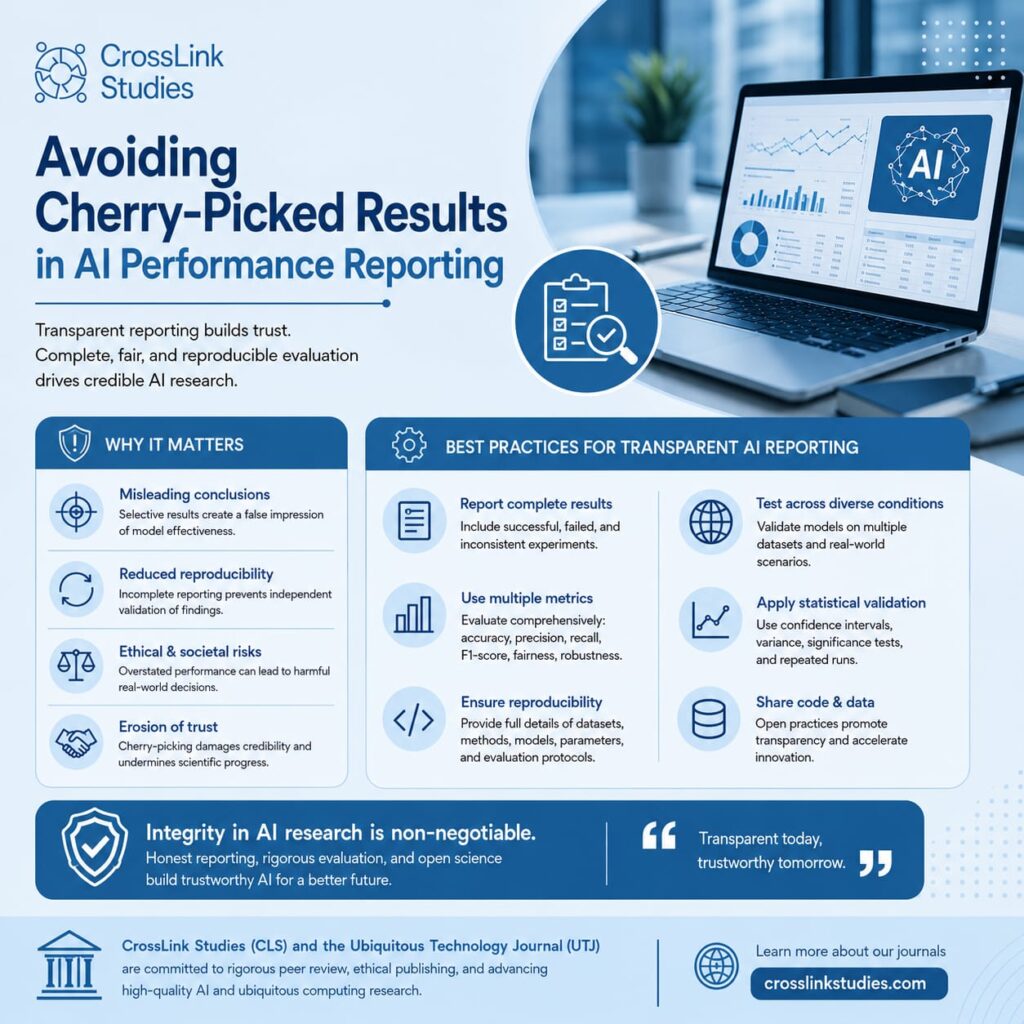
Cherry-picking occurs when researchers selectively report experiments or metrics that support a preferred conclusion while excluding unfavorable or contradictory evidence. In AI performance reporting, this may involve reporting only the highest-performing model run, ignoring failed experiments or unstable result, selecting datasets that favor the proposed method and omitting baseline comparisons, and highlighting accuracy while hiding weaknesses in recall, fairness, robustness, or generalization. Although such practices may temporarily improve perceived performance, they ultimately weaken scientific integrity and reduce the reproducibility of research findings.
Why Cherry-Picking is Dangerous in AI Research
1. Misleading Scientific Conclusions
Selective reporting creates an inaccurate impression of model effectiveness. Researchers, reviewers, and practitioners may adopt methods that perform poorly outside carefully selected scenarios.
2. Reduced Reproducibility
Reproducibility is a cornerstone of credible scientific research. When experimental details or negative findings are hidden, independent researchers cannot reliably validate published results.
3. Biased Technological Development
AI systems trained or evaluated on selective evidence may unintentionally reinforce biases, unfair decision-making, or unreliable automation.
4. Ethical and Societal Risks
In high-impact domains such as healthcare diagnostics, autonomous systems, or cybersecurity, overstated AI performance may result in harmful real-world consequences.
5. Erosion of Research Trust
Scientific progress depends on transparency and honesty. Cherry-picked reporting can damage the credibility of authors, institutions, journals, and the broader research community.
Common Forms of Cherry-Picking in AI Studies
- Selective Metric Reporting
Researchers may report only accuracy while ignoring precision, recall, F1-score, calibration, robustness, or fairness metrics.
- Dataset Selection Bias
Using datasets that disproportionately favor a proposed method without evaluating diverse or realistic conditions.
- Ignoring Negative Results
Failed experiments, unstable training behavior, or inconsistent outcomes are excluded from publication.
- Incomplete Baseline Comparisons
Comparisons are made against weak or outdated methods instead of current state-of-the-art approaches.
- Hyper parameter Manipulation
Excessive tuning on benchmark datasets can artificially inflate reported performance without demonstrating genuine generalization.
Best Practices for Transparent AI Performance Reporting
To strengthen scientific reliability and maintain ethical standards, researchers should adopt comprehensive reporting practices.
Report Complete Experimental Results
Include both successful and unsuccessful findings. Negative results often provide valuable scientific insight and help prevent duplication of ineffective approaches.
Use Multiple Evaluation Metrics
AI systems should be evaluated comprehensively using appropriate performance indicators relevant to the application domain.
Provide Reproducible Methodology
Authors should clearly document dataset sources, preprocessing methods, model architectures and hyperparameters
Evaluate Across Diverse Conditions
Robust AI systems should be tested across multiple datasets, environments, and real-world scenarios to demonstrate generalizability.
Include Statistical Validation
Reporting confidence intervals, variance, significance testing, and repeated experimental runs improves the reliability of findings.
Share Code and Data When Possible
Open research practices promote transparency, accelerate innovation, and support collaborative scientific advancement.
The Role of Peer Review in Preventing Cherry-Picked Reporting
Rigorous peer review serves as a critical safeguard against selective reporting practices. Reviewers and editors should carefully examine experimental completeness, fairness of comparisons and reproducibility of methods.
At CLS strong emphasis is placed on rigorous peer review, ethical research conduct, and transparent editorial oversight to ensure high-quality scholarly publication standards. The editorial and peer-review framework of UTJ encourages submissions that demonstrate originality, methodological rigor, comprehensive analysis, and ethical research reporting.
Transparency as a Foundation for Responsible AI
As AI technologies continue to influence society at scale, transparent performance reporting is becoming increasingly important. Responsible AI research should prioritize scientific honesty, reproducibility and ethical accountability. At CLS we believe that responsible scholarly communication is essential for advancing impactful and reliable research across computer science, engineering, and emerging technologies. Through rigorous peer review, ethical publishing standards, and open-access dissemination, CLS and UTJ remain committed to supporting high-quality AI and ubiquitous computing research.