
Proofreading Technical Equations and Symbols Before Publication
In scholarly publishing, precision is fundamental to effective research communication. While authors often devote significant attention to research design, data analysis, literature review, and manuscript structure, one critical aspect is sometimes overlooked during the final stages of publication: the proofreading of technical equations and symbols.
For researchers working in engineering, mathematics, physics, computer science, economics, statistics, data science, and other quantitative disciplines, equations are more than supporting content they are a central component of the scientific narrative. A single misplaced symbol, incorrect subscript, formatting inconsistency, or mathematical typo can alter the meaning of an equation, affect reproducibility, mislead readers, and potentially compromise the credibility of the published work.
As manuscripts move through copyediting, typesetting, and production workflows, equations and special symbols may undergo formatting changes that introduce unintended errors. Consequently, careful proofreading before publication is essential to ensure that mathematical expressions accurately represent the author’s intended methodology, analysis, and findings.
Why Equations and Symbols Require Special Attention
Unlike standard text, technical equations rely on precise notation and formatting conventions. Every symbol, operator, superscript, subscript, Greek character, and mathematical expression carries specific meaning. In many disciplines, equations communicate methodological frameworks, statistical models, optimization functions, theoretical formulations, and computational algorithms. Readers often rely on these equations to replicate experiments, validate results, or extend existing research.
Even minor inaccuracies can have substantial consequences. For example:
- An incorrect exponent may alter a model’s behavior.
- A missing negative sign can reverse analytical outcomes.
- An incorrect variable definition may create confusion throughout the manuscript.
- A formatting error in a denominator can change the interpretation of a formula.
- A misplaced subscript may affect parameter identification.
Understanding the Production Risk
Many authors assume that accepted equations remain unchanged during production. However, equations frequently pass through multiple stages before publication. Depending on the journal’s workflow, equations may be:
- Converted between software formats.
- Re-typeset by production teams.
- Reformatted to meet publication standards.
- Integrated into XML publishing systems.
- Adjusted for online and print display.
During these transitions, technical issues can occur. Special characters may not render correctly, symbols may be substituted unintentionally, and formatting structures may be altered. Although production teams implement quality-control procedures, authors remain the most qualified individuals to verify the correctness of technical content.
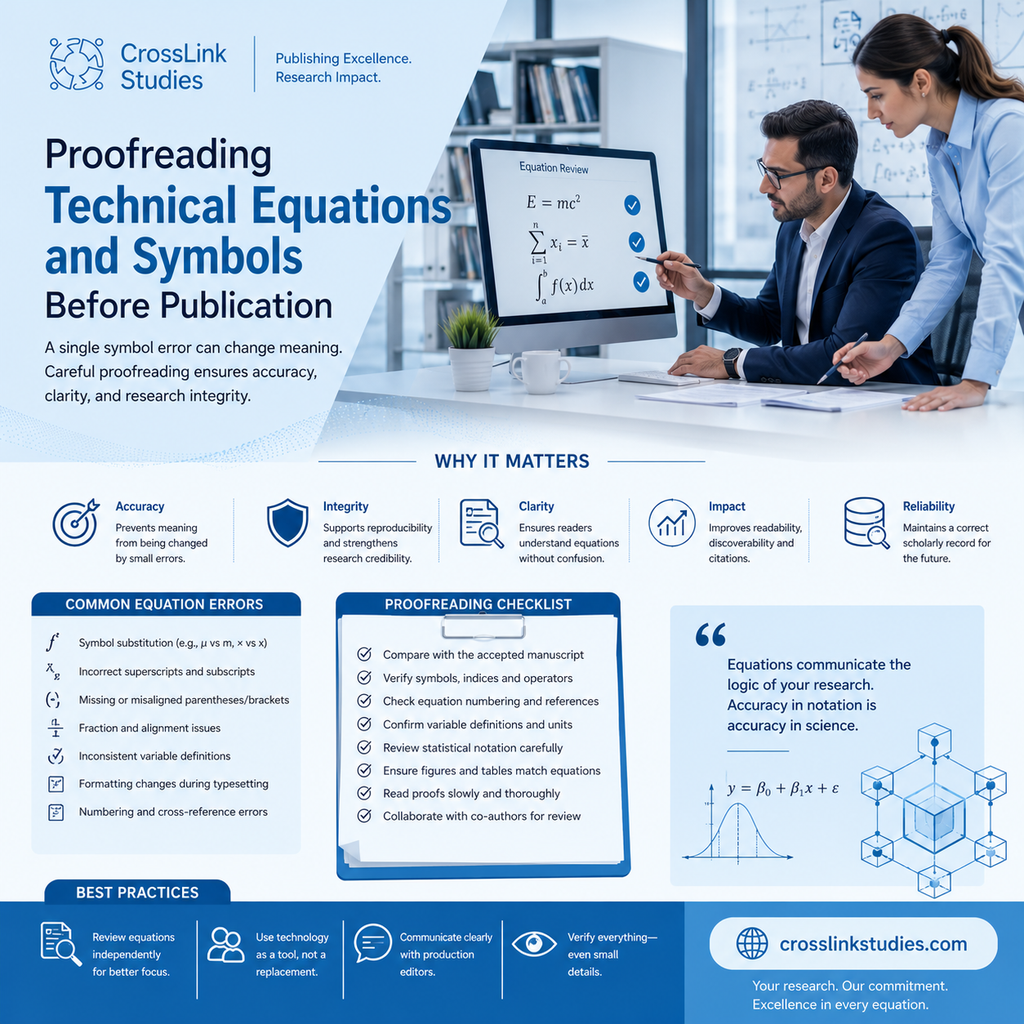
Common Equation Errors Identified During Proofreading
Symbol Substitution Errors
One of the most frequent problems involves symbol replacement during typesetting.
Greek letters such as α, β, γ, λ, μ, and σ may be incorrectly rendered or replaced by visually similar characters. Mathematical operators may also be altered unintentionally.
For example:
- μ may appear as m.
- ν may appear as v.
- η may appear as n.
- × may appear as x.
Incorrect Superscripts and Subscripts
Superscripts and subscripts are commonly used to distinguish variables, parameters, indices, and mathematical operations. Typesetting errors may result in missing superscripts, incorrect positioning, lost subscripts and altered formatting hierarchy. For instance, a parameter represented as Xₜ may mistakenly appear as Xt, changing its intended meaning.
Parentheses and Bracket Errors
Mathematical expressions frequently rely on proper grouping structures. A missing bracket or misplaced parenthesis can change an equation entirely. Common issues include unbalanced parentheses, missing braces, incorrect nesting structures and altered denominator grouping.
Fraction and Equation Alignment Problems
Fractions often experience formatting challenges during production. Potential issues include misaligned numerators and denominators, missing fraction bars, incorrect equation spacing, broken multiline equations. Authors should verify that equations appear exactly as intended and remain readable in both print and digital formats.
Variable Definition Inconsistencies
Equation accuracy extends beyond the mathematical expression itself. Variables introduced in equations should be defined consistently throughout the manuscript. Authors should verify that:
- Every symbol is explained.
- Definitions remain consistent.
- Variable names match corresponding tables and figures.
- Units of measurement are correctly reported.
Establishing a Systematic Proofreading Strategy
Review Equations Independently from the Main Text
One effective technique is to review all equations separately before reading the manuscript as a whole. By focusing exclusively on mathematical content, authors can identify errors that might otherwise be overlooked during general proofreading. Creating a checklist of all equations and comparing them directly with the accepted manuscript can improve accuracy.
Compare Proofs Against the Final Accepted Version
Authors should never rely solely on memory when reviewing proofs. Instead, they should compare equation numbering, mathematical expressions, variable definitions, statistical notation, symbol formatting. A side-by-side comparison between the accepted manuscript and the production proof often reveals discrepancies quickly.
Verify Equation Numbering and Cross-References
During production, equation numbering may change due to formatting adjustments. Authors should ensure that:
- Equation numbers are sequential.
- In-text references point to the correct equations.
- Tables and figures reference the appropriate mathematical expressions.
- Supplementary materials remain aligned with published numbering.
The Importance of Discipline-Specific Notation Standards
Different academic disciplines follow distinct notation conventions. Authors should ensure that production formatting does not inadvertently alter discipline-specific conventions. Maintaining consistency with established standards enhances clarity and supports scholarly communication within specialized research communities.
Proofreading Statistical Symbols and Analytical Outputs
Statistical reporting requires particular attention because even small notation errors can affect interpretation. Researchers should carefully verify:
- P-values.
- Confidence intervals.
- Standard errors.
- Regression coefficients.
- Statistical significance indicators.
- Correlation coefficients.
- Model parameters.
For example, confusion between p and P, β and B, or σ and s may lead readers to misunderstand analytical findings.
Collaborating with Co-Authors During Proof Review
Proofreading should not be the responsibility of a single individual whenever possible. Co-authors often possess expertise in different aspects of the research and may identify issues overlooked by others. A practical approach involves assigning responsibilities:
- One author reviews equations.
- Another checks references.
- Another verifies figures and tables.
- The corresponding author consolidates corrections.
Leveraging Technology Without Replacing Human Oversight
Modern publishing tools have improved equation handling considerably. Software platforms can assist with consistency checks, formatting validation, and reference management. However, automated systems cannot fully evaluate scientific meaning. Human expertise remains essential because:
- Software may not recognize discipline-specific notation.
- Contextual errors can go undetected.
- Symbol substitutions may appear visually correct but be scientifically incorrect.
Protecting Research Integrity Through Technical Accuracy
Accurate equations are not merely formatting details; they are essential components of research integrity. Readers, reviewers, educators, and future researchers depend on published equations to understand methodologies and reproduce findings. Errors in mathematical expressions can hinder scientific progress and reduce confidence in published work. Careful proofreading demonstrates a commitment to precision, transparency, and scholarly responsibility. It ensures that the published record accurately reflects the author’s research and supports the broader goals of scientific communication.
Conclusion
The final proof stage represents one of the most important opportunities for authors to safeguard the accuracy of their research before publication. While textual corrections are important, technical equations and symbols deserve special scrutiny because they communicate the fundamental logic, methodology, and analytical framework of scholarly work.
By systematically reviewing equations, verifying notation, checking variable definitions, comparing proofs with accepted manuscripts, and collaborating with co-authors, researchers can significantly reduce the risk of publication errors.
In today’s increasingly data-driven and technically sophisticated research environment, precision in mathematical communication is essential. Thorough proofreading of equations and symbols not only improves publication quality but also strengthens reproducibility, credibility, and the long-term value of the scholarly record. Ultimately, attention to technical accuracy before publication reflects the same commitment to excellence that underpins rigorous and impactful research.