
How to Write an Abstract That Survives First Editorial Screening?
In academic publishing, the abstract is your first and sometimes only chance to impress the editor. Before reviewers are even invited, editors quickly assess whether your manuscript is worth sending forward. A weak abstract can lead to immediate desk rejection, regardless of the quality of your research.
Leading publishers emphasize that a strong abstract must be clear, concise, structured, and aligned with the journal’s scope. This guide explains how authors submitting to Ubiquitous Technology Journal can craft an abstract that successfully passes the first editorial screening.
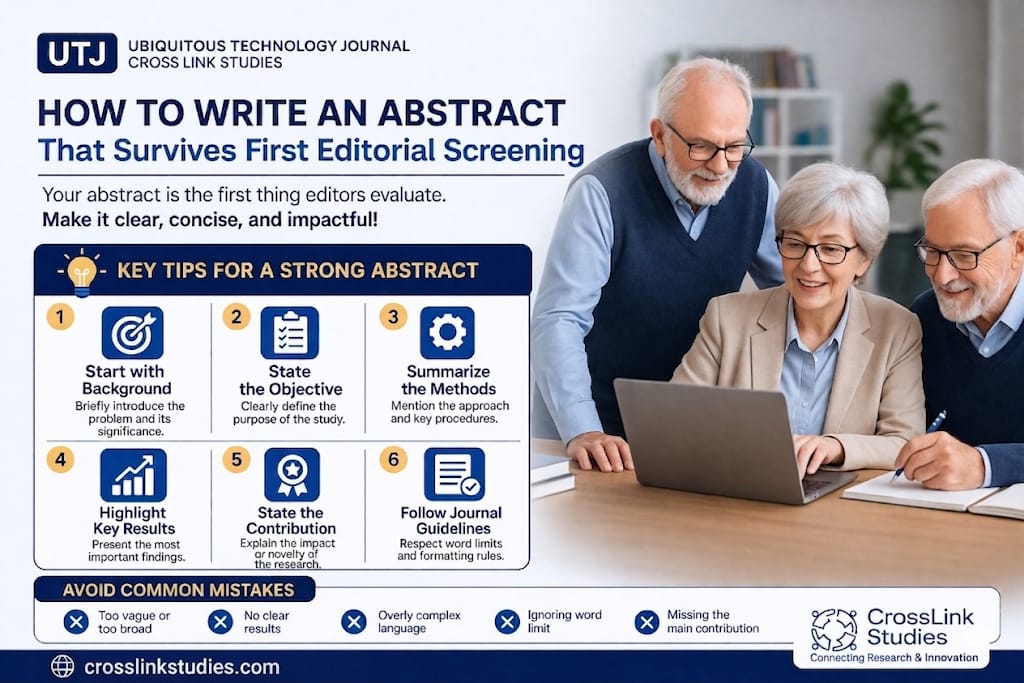
Why the Abstract Matters More Than You Think?
Editors use the abstract to quickly evaluate relevance to journal scope, research quality and rigor, novelty and contribution, clarity of communication. A well-written abstract acts as a decision-making tool, helping editors determine whether your manuscript proceeds to peer review.
The Ideal Structure of a High-Quality Abstract
Top journals follow a logical and reader-friendly structure. Even when not explicitly required, your abstract should clearly include:
1. Background / Problem
What is the research problem and why does it matter?
2. Objective
What does your study aim to achieve?
3. Methodology
How was the research conducted?
4. Key Results
What are the most important findings?
5. Conclusion / Contribution
Why do these findings matter?
This structured flow helps readers understand your work quickly and effectively.
Key Characteristics of an Abstract That Passes Editorial Screening
Clarity and Simplicity
Editors prefer clear, direct language over complex wording. Avoid unnecessary jargon and write for a broad academic audience, use simple sentences, avoid overly technical expressions.
Concise but Complete (150–250 Words)
Most journals including UTJ expect abstracts within a strict word limit which include only essential information, avoid long explanations or background details.
Strong Focus on Results and Contribution
One of the biggest mistakes is writing an abstract that focuses only on the problem and method but fails to clearly present results. Authors should highlight key findings, state the contribution explicitly. Editors are looking for: “What is new and why it matters?”
Alignment with the Full Paper
Your abstract must accurately reflect your manuscript, no exaggerated claims, no missing or inconsistent results. A misleading abstract can lead to rejection even before peer review.
Strict Adherence to Journal Guidelines
Each journal has specific requirements regarding word count, structure (structured vs unstructured), keywords. Failure to follow these guidelines is a common reason for rejection. For UTJ authors carefully review the submission guidelines before drafting your abstract.
No Citations, Figures, or Abbreviations
Abstracts should be self-contained avoid references and citations, avoid figures, tables, and uncommon abbreviations.
Written Last, Not First
Although it appears first, the abstract should be written after completing the full paper. Authors should ensure accuracy, captures key findings effectively.
Common Mistakes That Lead to Immediate Rejection
Avoid these frequent errors:
❌ Too vague (no clear results or contribution)
❌ Too descriptive (only background, no findings)
❌ Overly technical or difficult language
❌ Not aligned with journal scope
❌ Ignoring formatting or word limits
❌ Copy-pasting from the main text
Your abstract is not just a summary; it is a gateway to peer review. At Crosslink Studies the editorial screening process prioritizes:
✔ Relevance to scope
✔ Clear contribution
✔ Methodological soundness
✔ Professional presentation