
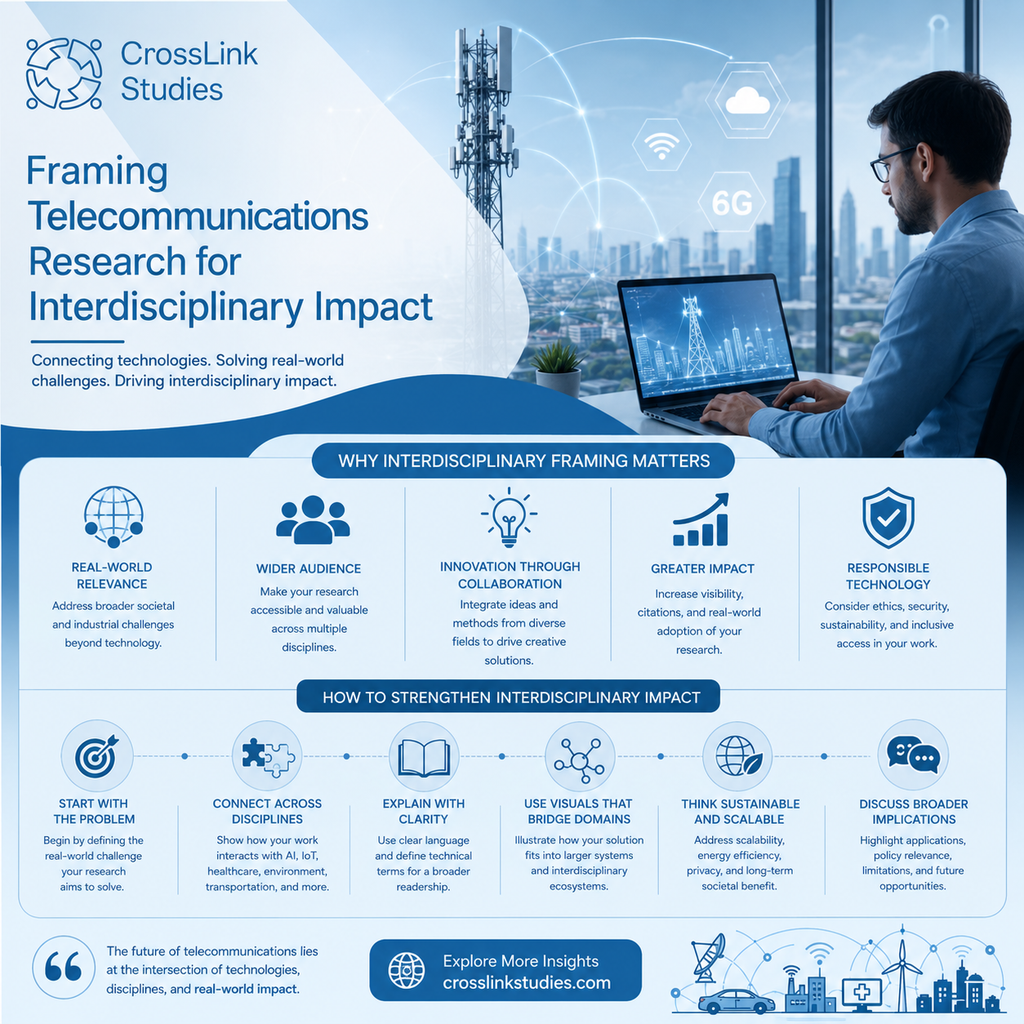
Framing Telecommunications Research for Interdisciplinary Impact
Telecommunications has evolved far beyond its traditional focus on communication networks and signal transmission. Today, it underpins digital transformation across healthcare, transportation, manufacturing, agriculture, finance, education, environmental monitoring, cybersecurity, and smart cities. Technologies such as 5G and 6G networks, Internet of Things (IoT), edge computing, artificial intelligence (AI), satellite communications, software-defined networking (SDN), and cloud-native infrastructures are increasingly developed and applied within interdisciplinary contexts.
As the influence of telecommunications expands, so do the expectations of scholarly journals, reviewers, funding agencies, and research communities. High-quality research is no longer evaluated solely on technical novelty; it is also assessed on its broader relevance, practical applicability, and potential to solve complex societal and industrial challenges. Consequently, authors who effectively frame their telecommunications research for interdisciplinary audiences significantly increase the visibility, usability, and impact of their work.
At Crosslink Studies (CLS), researchers are encouraged to communicate technical excellence while demonstrating how telecommunications innovations contribute to broader scientific, industrial, and societal advancement. Well-framed interdisciplinary research enables discoveries to reach readers beyond telecommunications engineering, fostering collaboration across disciplines and accelerating innovation.
Understanding Interdisciplinary Research in Telecommunications
Interdisciplinary research integrates knowledge, methodologies, and perspectives from multiple academic disciplines to address challenges that cannot be solved effectively within a single field. In telecommunications, this often involves combining expertise from areas such as:
- Artificial Intelligence and Machine Learning
- Computer Science
- Cybersecurity
- Internet of Things (IoT)
- Data Science
- Healthcare Informatics
- Environmental Sciences
- Transportation Engineering
- Economics and Public Policy
- Smart Manufacturing
- Robotics
- Geographic Information Systems (GIS)
Rather than viewing telecommunications as an isolated engineering discipline, interdisciplinary research positions communication technologies as enabling infrastructure that supports innovation across diverse domains.
Begin with the Real-World Problem
Many manuscripts begin immediately by describing a communication protocol, routing algorithm, antenna design, or optimization technique. While technically accurate, this approach often limits the perceived significance of the research. Instead, authors should first establish the broader challenge their work addresses.
For example, rather than introducing a new network optimization algorithm directly, explain the larger issue:
“As healthcare increasingly relies on remote patient monitoring, reliable low-latency communication has become essential for delivering continuous medical services in rural and resource-constrained regions.”
Clearly Explain the Societal and Industrial Relevance
Editors and reviewers increasingly value research that demonstrates meaningful applications. Instead of presenting telecommunications solely as a networking challenge, explain how the proposed solution benefits other sectors.
Examples include:
- AI-assisted wireless networks improving emergency response.
- 6G communications enabling autonomous transportation.
- IoT platforms supporting precision agriculture.
- Satellite communication enhancing disaster resilience.
- Edge computing improving industrial automation.
- Secure communication protocols protecting healthcare data.
Speak to Readers Beyond Telecommunications
Technology journals often receive submissions from multidisciplinary teams, and reviewers may possess expertise in computer science, artificial intelligence, cybersecurity, software engineering, biomedical engineering, or information systems rather than telecommunications alone. When introducing specialized terminology, provide concise explanations.
For example:
“Network slicing enables multiple virtual networks to operate on shared physical infrastructure while meeting different performance requirements for diverse applications.”
Demonstrate Integration with Emerging Technologies
Telecommunications research increasingly intersects with rapidly evolving technologies. Authors should explicitly describe how their work complements or enhances developments in related disciplines.
Examples include:
Artificial Intelligence
Explain how machine learning improves resource allocation, spectrum management, anomaly detection, predictive maintenance, or traffic forecasting.
Internet of Things
Describe how communication protocols enable reliable connectivity among distributed sensors and smart devices.
Edge and Cloud Computing
Discuss how distributed computing architectures reduce latency while supporting real-time applications.
Cybersecurity
Highlight mechanisms that ensure secure communication, authentication, privacy preservation, and resilience against cyber threats.
Digital Twins
Illustrate how telecommunications infrastructure supports synchronized physical and virtual environments for industrial monitoring.
Highlight Methodological Contributions
Interdisciplinary framing extends beyond application areas. Authors should also explain how their methodology contributes to research communities outside telecommunications. For example, if a study develops a novel optimization algorithm, clarify whether the approach could also benefit logistics, healthcare scheduling, robotics, or cloud computing.
Use Accessible Visual Communication
Figures should communicate interdisciplinary relationships rather than focusing exclusively on communication architectures.
Instead of presenting only protocol stacks or network diagrams, include illustrations showing how telecommunications interacts with broader systems.
Discuss Scalability, Sustainability, and Ethical Considerations
Contemporary telecommunications research is increasingly evaluated through the lens of responsible innovation. Authors should discuss questions such as:
- Can the proposed system scale to large deployments?
- What are the computational and energy requirements?
- How does the solution contribute to sustainable digital infrastructure?
- Are privacy and security adequately addressed?
- Does the technology improve equitable access to communication services?
Strengthen the Discussion Section
Many manuscripts conclude by simply restating experimental results. A stronger discussion interprets findings within broader interdisciplinary contexts.
Consider questions such as:
- How might policymakers use these findings?
- Could healthcare providers benefit from this communication model?
- What opportunities exist for industrial implementation?
- How does the research support future smart city development?
- What challenges remain for real-world deployment?
Collaborate Across Disciplines
The most influential telecommunications publications increasingly emerge from collaborative research teams. Working with experts from healthcare, environmental science, transportation, economics, cybersecurity, or data science enables researchers to:
- Develop more realistic problem statements.
- Access diverse datasets.
- Validate solutions under practical conditions.
- Improve methodological robustness.
- Increase publication opportunities in interdisciplinary journals.
Common Mistakes That Limit Interdisciplinary Impact
Several recurring issues reduce the broader influence of telecommunications manuscripts:
- Focusing exclusively on network performance metrics without discussing practical applications.
- Assuming all readers possess telecommunications expertise.
- Overusing technical jargon without explanation.
- Ignoring societal, economic, or environmental implications.
- Presenting isolated technical contributions without demonstrating integration with emerging technologies.
Practical Checklist Before Submission
Before submitting your telecommunications manuscript, consider the following questions:
- Does the introduction explain the broader interdisciplinary challenge?
- Have specialized networking concepts been clearly defined?
- Is the practical significance of the research explicitly discussed?
- Are applications across multiple domains identified?
- Do figures illustrate interdisciplinary relationships?
- Are ethical, security, privacy, and sustainability considerations addressed?
- Does the discussion extend beyond technical performance to societal and industrial implications?
Conclusion
Telecommunications research is no longer confined to improving network throughput, reducing latency, or enhancing spectrum efficiency. It now serves as the digital backbone of intelligent healthcare, autonomous transportation, smart manufacturing, precision agriculture, environmental monitoring, and countless other transformative technologies. As these fields continue to converge, researchers must communicate not only the technical sophistication of their work but also its broader scientific and societal value.
Framing telecommunications research for interdisciplinary impact requires more than adding application examples. It involves positioning the research within real-world challenges, explaining specialized concepts with clarity, demonstrating integration with complementary technologies, and highlighting contributions that extend beyond a single discipline. This approach enables editors, reviewers, policymakers, industry professionals, and researchers from diverse backgrounds to recognize the significance of the work.
At Crosslink Studies (CLS), we encourage authors to prepare manuscripts that combine technical innovation with interdisciplinary relevance. Research that is accessible, collaborative, and application-driven not only reaches a wider audience but also contributes more effectively to scientific progress and technological advancement. By thoughtfully framing telecommunications research within broader contexts, authors can maximize the visibility, influence, and long-term impact of their scholarly contributions.