
Publishing Robotics and Automation Studies in UTJ
Robotics and automation are transforming manufacturing, healthcare, agriculture, transportation, logistics, and intelligent infrastructure. Advances in autonomous systems, collaborative robots, machine vision, embedded computing, and artificial intelligence are enabling machines to perform increasingly complex tasks with greater precision and adaptability. Yet, developing an innovative robotic system is only one part of producing publishable research. Authors must also demonstrate what their technology contributes, how reliably it performs, and why its findings matter to the wider engineering and computing community.
For researchers preparing manuscripts for the Ubiquitous Technology Journal (UTJ), published by Crosslink Studies (CLS), these considerations are particularly important. UTJ welcomes research across computer science and engineering, including industrial robotics, ubiquitous computing, artificial intelligence, embedded systems, automation, control, and related technological applications. Its interdisciplinary scope provides opportunities to communicate advances that connect robotic systems with intelligent computing, sensing, communication, and real-world problem-solving.
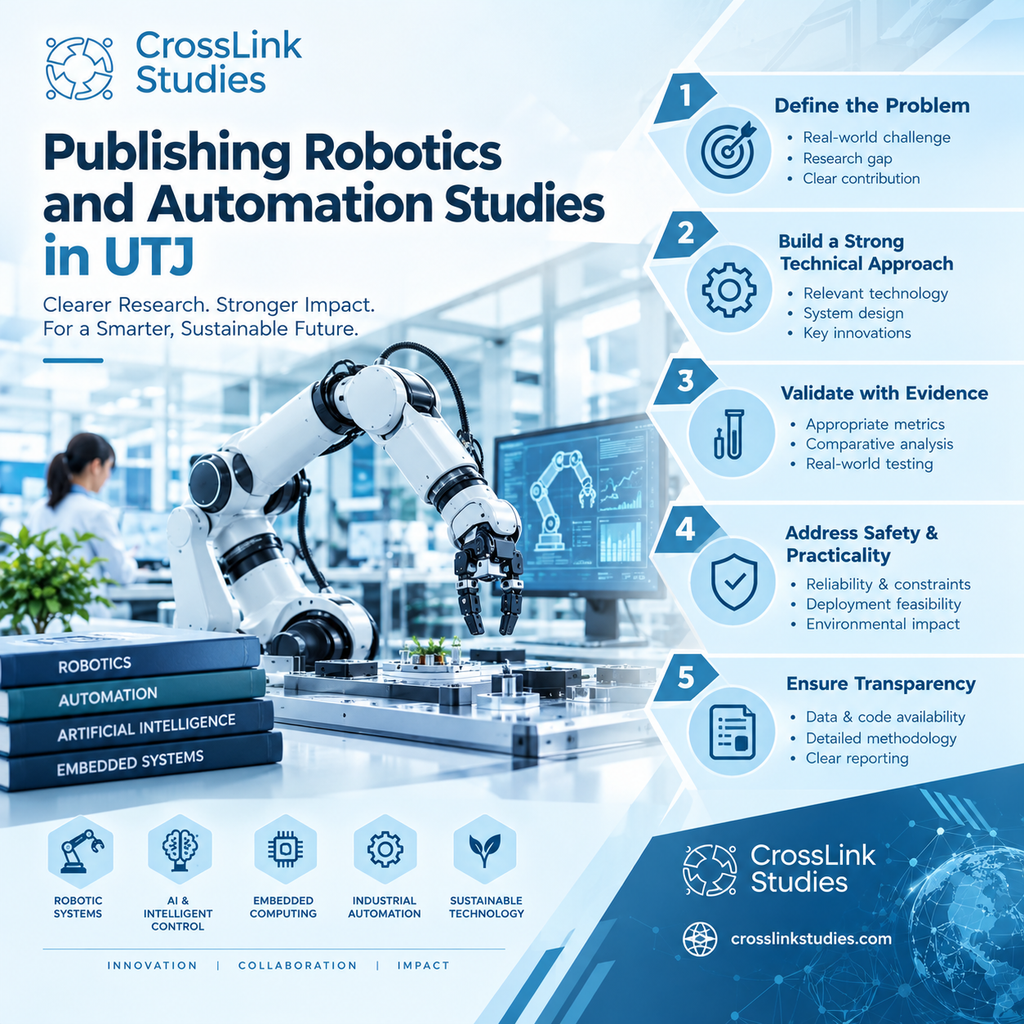
The central challenge for authors is to move beyond describing a robotic design or automation framework and establish a convincing scientific contribution. A strong manuscript combines a clearly defined research problem, a justified technical approach, appropriate experimental validation, transparent reporting, and conclusions supported by evidence.
Define the Research Problem Before Introducing the Technology
A compelling robotics manuscript begins with a problem that requires investigation. Authors sometimes introduce a robot, control algorithm, or automation platform without sufficiently explaining which limitation in existing research the proposed approach addresses. The introduction should establish the practical or scientific challenge, summarize relevant developments, identify an unresolved limitation, and explain how the proposed research responds to it. A useful starting point is to answer three questions:
- What is the problem? Identify the technical limitation or operational challenge.
- What remains unresolved? Explain the shortcomings of existing methods.
- What does this study contribute? State the proposed improvement and how it will be evaluated.
A clearly framed problem provides a consistent direction for the entire manuscript, from the literature review and methodology to the results and conclusion.
Establish a Specific and Defensible Technical Contribution
Robotics research frequently combines established components, including sensors, actuators, microcontrollers, communication modules, control algorithms, and machine-learning models. Integrating these components into a working system can be valuable, but authors must explain the research contribution beyond the existence of the integrated platform. Novelty may involve a new control strategy, improved motion planning, a more efficient perception method, a different system architecture, or a validated solution to a previously difficult operating condition. Authors should distinguish between what is new, what is adapted from existing research, and what is used as a baseline.
To communicate novelty effectively:
- Compare the proposed approach with relevant existing methods.
- Identify the specific limitation addressed by the research.
- Explain the technical difference between the proposed method and established alternatives.
- Demonstrate the contribution through appropriate analysis or experiments.
Describe the System Architecture and Methodology Clearly
A robotics manuscript should provide enough technical detail for readers to understand how the system operates and assess whether its design is appropriate for the stated objective. Depending on the study, the methodology may include mechanical components, sensor configurations, embedded hardware, software architecture, control logic, communication protocols, and data-processing procedures.
Authors should explain how these components interact and why particular design decisions were made. A system architecture diagram can help readers understand the relationships among components before examining individual implementation details. The methodology should also distinguish between the proposed method and the experimental setup used to evaluate it. This distinction is important because a system may perform well under one set of conditions without demonstrating that its underlying method is generally superior.
Validate Performance Through Rigorous Experiments
Experimental validation is central to credible robotics and automation research. A functioning prototype demonstrates feasibility, but it does not necessarily establish superior performance, reliability, or generalizability. The evaluation should be designed around the research question and the specific contribution being claimed.
For a robotic navigation system, relevant measures might include path length, completion time, collision frequency, localization error, and success rate. For an automated inspection system, evaluation could focus on detection precision, recall, processing latency, and performance under different lighting or operating conditions.
A strong evaluation should address four areas:
- Baseline Comparison: Compare the proposed method with suitable existing approaches.
- Repeatability: Conduct sufficient trials to understand performance variability.
- Operating Conditions: Test the system under relevant environmental or workload changes.
- Limitations: Report failures, weaknesses, and conditions in which performance deteriorates.
Where appropriate, authors should report statistical uncertainty, confidence intervals, or other measures of variability. Comparisons should use consistent experimental conditions so that apparent improvements can reasonably be attributed to the proposed approach.
Discuss Safety, Reliability, and Practical Deployment
Robotic systems often operate in environments where failures have consequences for people, equipment, productivity, or infrastructure. A technically successful demonstration may therefore be insufficient if the manuscript does not consider reliability and operational constraints.
For collaborative robots, safety may involve collision avoidance, force limitations, workspace monitoring, and interaction with human operators. For autonomous mobile robots, relevant issues may include sensor failure, unexpected obstacles, communication interruptions, and recovery from navigation errors. Not every study must investigate every safety dimension. However, authors should identify the risks and constraints relevant to their particular application.
Practical feasibility also deserves attention. A proposed system may achieve high accuracy while requiring expensive sensors, extensive computing resources, specialized infrastructure, or frequent manual intervention.
Make Results Reproducible and Reporting Transparent
Reproducibility enables other researchers to examine, verify, and extend published findings. UTJ author guidance similarly emphasizes detailed methodology and the sharing of relevant data and code to support reproducible research.
For robotics and automation studies, transparency may require reporting:
- Hardware specifications, sensor configurations, and relevant calibration procedures.
- Software frameworks, libraries, and version information.
- Algorithm parameters and control settings.
- Experimental environments, test scenarios, and evaluation procedures.
- Data-processing methods and performance calculations.
Figures and tables should reinforce transparency. System diagrams can communicate architecture, flowcharts can explain control procedures, and comparative tables can summarize performance across methods. Each visual should have a clear purpose, an informative caption, and an explicit connection to the manuscript’s argument.
Structure the Manuscript for UTJ Submission
A technically strong study must also be presented in a clear and consistent scholarly format. UTJ’s published submission guidance specifies IEEE-style references and provides a manuscript template. It also outlines an expected structure covering the introduction, proposed method where applicable, research methodology, results and discussion, and conclusion. Authors should consult the current official instructions before submission.
A practical manuscript structure is:
Introduction: Establish the problem, research gap, objectives, and contribution.
Proposed Method: Explain the new algorithm, architecture, control strategy, or system design, where applicable.
Research Methodology: Describe implementation, experimental procedures, datasets, equipment, and evaluation criteria.
Results and Discussion: Present the findings, compare them with relevant alternatives, and interpret their significance.
Conclusion: Summarize the principal contribution, acknowledge limitations, and identify specific directions for further research.
The abstract should communicate the problem, approach, principal findings, and conclusion concisely. The title should identify the main research contribution without unnecessary wording or unexplained abbreviations. Before submission, authors should verify that the manuscript follows the required template, uses sequential IEEE-style citations, includes appropriately numbered figures and tables, and satisfies the journal’s submission checklist.
Conclusion
Publishing robotics and automation research requires more than developing a functioning system or presenting an innovative algorithm. A convincing manuscript establishes a meaningful research problem, demonstrates a specific technical contribution, validates performance through appropriate experiments, and explains the limitations of the proposed approach.
For researchers considering UTJ, these principles provide a practical framework for presenting work in autonomous systems, industrial robotics, intelligent control, machine vision, embedded computing, and related areas. By combining methodological rigor with transparent reporting and a clear explanation of technological significance, authors can make their findings more useful to reviewers, researchers, and practitioners.
Ultimately, strong robotics research advances knowledge by demonstrating not only what a system can accomplish, but also why its approach is valuable, how reliably it performs, and under which conditions its contribution can be trusted.