
Writing Clear Inclusion and Exclusion Criteria for Survey Papers
Survey-based research plays a central role in modern scientific inquiry, particularly in interdisciplinary domains such as software engineering, artificial intelligence, education, healthcare, management sciences, and digital transformation. However, one of the most overlooked methodological weaknesses in many survey manuscripts is the absence of clearly defined inclusion and exclusion criteria. Poorly defined selection boundaries reduce transparency, weaken reproducibility, and raise concerns during peer review.
Crosslink Studies(CLS) journals like Ubiquitous Technology Journal (UTJ), in author guidelines authors must demonstrate that participant selection decisions are systematic, justified, and aligned with the research objectives. CLS emphasizes ethical publishing standards, transparent peer review, and reproducible research practices.
Why Inclusion and Exclusion Criteria Matter
Inclusion and exclusion criteria define who is eligible to participate in a survey study and who is intentionally omitted. These criteria establish the boundaries of the study population and directly influence the validity, reliability, and generalizability of findings.
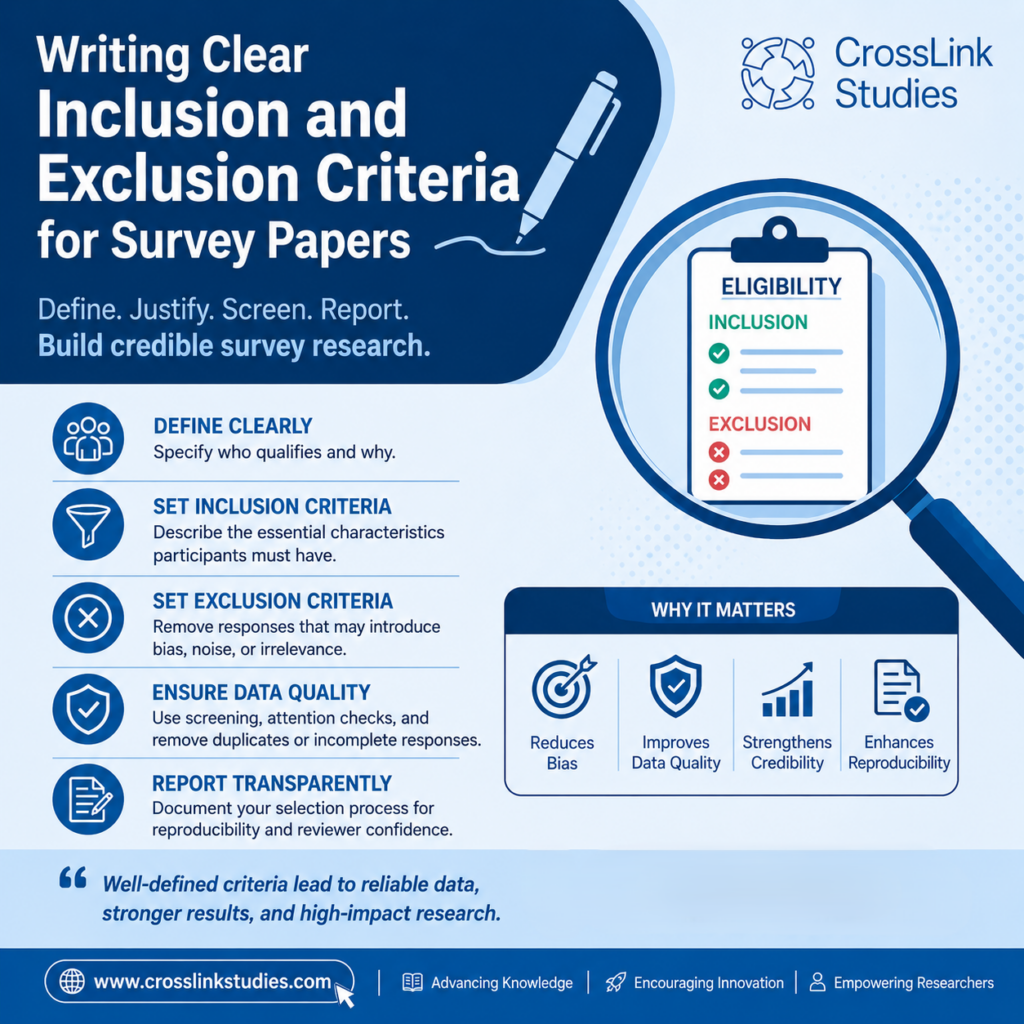
Well-constructed criteria help researchers maintain methodological consistency, reduce sampling bias, improve data quality, ensure ethical participant selection and strengthen reproducibility.
Understanding the Difference
Inclusion Criteria
Inclusion criteria specify the characteristics participants must possess to be considered eligible for the survey. These are directly connected to the research objectives and target population. Typical inclusion criteria may include academic or professional background, years of experience, geographic location, industry domain, age range and research involvement.
For example, in a software engineering survey exploring DevOps adoption:
- Participants must be software professionals
- Participants must have at least one year of DevOps experience
- Participants must currently work in agile environments
Exclusion Criteria
Exclusion criteria identify participants who may technically fit the broader population but should be removed due to factors that could compromise the integrity or relevance of the study.
Examples include incomplete survey responses, duplicate submissions, participants without practical experience, respondents outside the study scope and automated or invalid responses, Exclusion criteria protect the dataset from noise, bias, and low-quality responses.
Common Mistakes in Survey Manuscripts
Many manuscripts submitted to scholarly journals experience delays or rejection because authors fail to justify participant selection procedures adequately. The most common issues include:
1. Overly Broad Criteria
Broad eligibility statements weaken the focus of the study and create ambiguity regarding the intended population.
Poor example:
“Anyone interested in AI could participate.”
Improved example:
“Participants were required to have at least one year of professional or academic experience working with machine learning systems.”
2. Missing Justification
Criteria should never appear arbitrary. Every requirement must support the research objective. For example, excluding undergraduate students from a survey on industrial cybersecurity practices may be justified because the study investigates professional implementation environments.
3. Mixing Inclusion and Exclusion Conditions
Authors often combine both categories into a single paragraph, making the methodology difficult to interpret. Clear separation improves readability and reviewer comprehension.
4. Ignoring Data Quality Controls
Modern survey studies should include explicit quality filters such as removal of incomplete submissions, elimination of duplicate entries and attention-check validation.
How CLS Approach Eligibility Criteria
CLS consistently emphasize transparent reporting standards, reproducibility, and methodological rigor in empirical research. Reporting frameworks for survey research similarly highlight the importance of explicitly documenting participant selection procedures and eligibility definitions.
UTJ generally expect authors to define the target population precisely, explain recruitment procedures and justify inclusion and exclusion decisions.
Best Practices for CLS and UTJ Authors
Authors preparing manuscripts for CLS journals should adopt a structured and reviewer-friendly approach when writing eligibility criteria.
Align Criteria with Research Objectives
Every criterion should directly support the study goals. Avoid unnecessary restrictions that reduce representativeness without methodological justification.
Use Measurable Conditions
Criteria should be specific and verifiable rather than subjective.
Keep the Scope Realistic
Excessively narrow criteria can limit sample size and reduce external validity. Conversely, overly broad criteria may introduce irrelevant responses.
Document Screening Procedures
Authors should clearly explain:
- How participants were screened
- How invalid responses were identified
- Whether duplicate submissions were removed
- Which responses were excluded after data cleaning
Maintain Ethical Transparency
If vulnerable populations or restricted demographics are excluded, authors should explain the ethical or methodological rationale appropriately. Ethical transparency is increasingly important in peer-reviewed publishing.
Example Structure for a Survey Paper
A strong methodology section may present eligibility criteria as follows:
Inclusion Criteria
- Participants must currently work in software development or related IT roles
- Participants must have at least two years of professional experience
- Participants must have prior exposure to agile development methodologies
Exclusion Criteria
- Incomplete responses were removed
- Duplicate submissions were excluded
- Responses completed in unrealistically short durations were discarded
- Participants without professional software industry experience were excluded
The Role of Eligibility Criteria in Research Quality
Clear inclusion and exclusion criteria are not merely administrative details. They are foundational components of credible survey methodology. For UTJ, where submissions often span emerging technological and societal domains, rigorous participant selection becomes even more critical. Strong eligibility criteria improve reproducibility, strengthen peer-review outcomes, and increase the overall scholarly impact of the manuscript.
For authors submitting to CLS journals and UTJ, carefully structured eligibility definitions can significantly improve manuscript quality and peer-review readiness. Well-written criteria communicate professionalism, strengthen scientific validity, and position the study within the standards expected by internationally recognized academic publishers.