Why Webpage Citations Should Be Used Carefully in Research Papers
The digital age has transformed how researchers discover, access, and share information. With an abundance of online resources available at the click of a button, webpages have become an increasingly common source of information during literature searches and manuscript preparation. While online content can provide timely updates, policy documents, datasets, technical guidance, and institutional reports, researchers must exercise caution when citing webpages in scholarly publications.
Unlike peer-reviewed journal articles, webpages often undergo limited quality control, may change over time, and can disappear without notice. As a result, excessive reliance on web-based sources can weaken the credibility, reproducibility, and long-term value of academic research. Understanding when and how to use webpage citations appropriately is therefore essential for maintaining scholarly rigor.
The Difference Between Scholarly Sources and Webpages
Academic research is built upon evidence that has been critically evaluated through established scholarly processes. Journal articles, conference proceedings, books, and systematic reviews typically undergo editorial assessment and peer review before publication.
In contrast, webpages vary significantly in reliability. Some are maintained by reputable organizations, government agencies, research institutions, and international bodies, while others may contain unverified opinions, outdated information, or commercially motivated content. Because the quality of online information is highly variable, researchers should distinguish between authoritative web resources and sources that lack academic credibility.
The key principle is simple: a webpage should not automatically be considered equivalent to a peer-reviewed scholarly source.
The Challenge of Content Instability
One of the most significant limitations of webpage citations is their lack of permanence.
Web content can be modified, relocated, or removed entirely without warning. A webpage cited today may present different information a year later, making it difficult for future readers to verify the original source. This phenomenon, often referred to as “link rot” or content drift, creates challenges for research transparency and reproducibility.
When readers cannot access or verify cited information, confidence in the research record may be reduced. For this reason, researchers should prioritize stable and archival sources whenever possible.
When Webpage Citations Are Appropriate
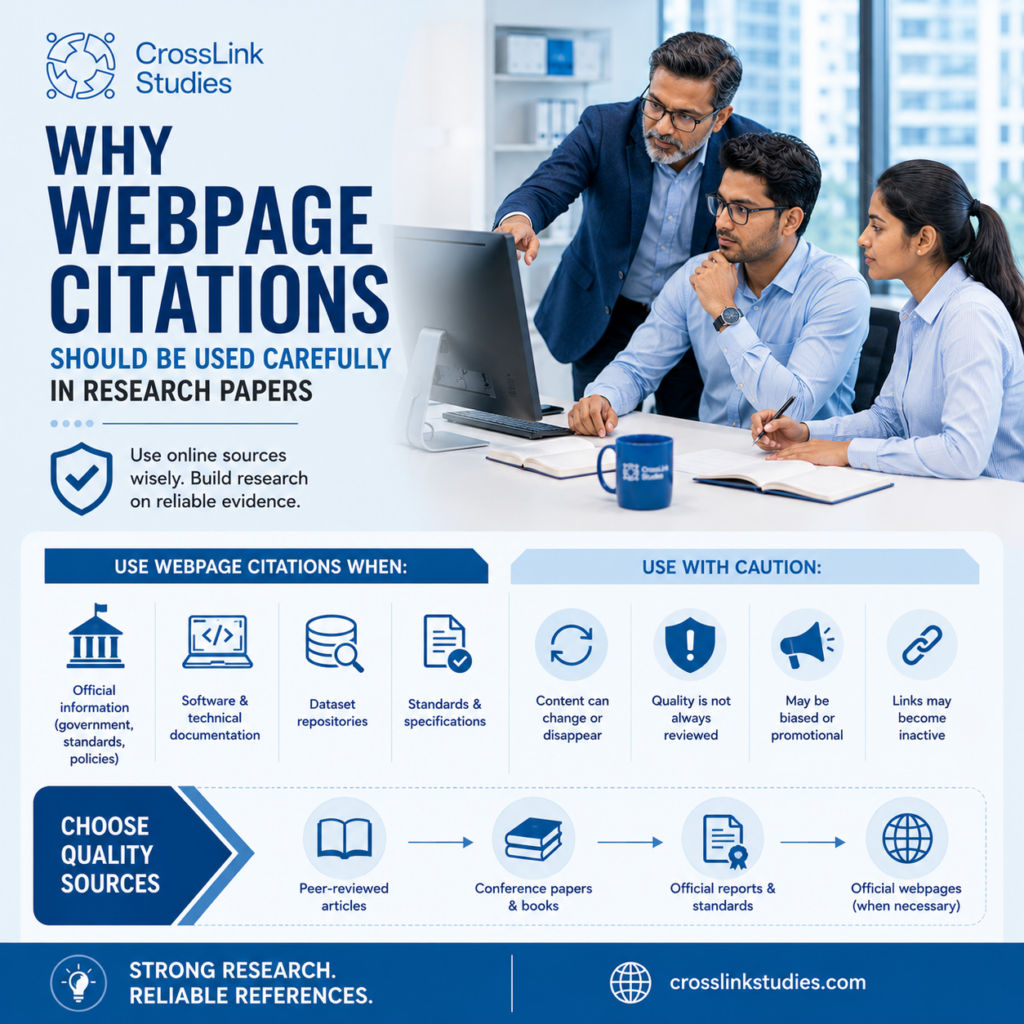
Although webpage citations require caution, they remain valuable in specific situations where authoritative information is primarily published online.
Appropriate uses may include:
1. Government and Regulatory Documents
Government agencies frequently publish legislation, policy frameworks, statistical reports, public health guidelines, and regulatory standards exclusively through official websites.
2. International Organizations
Organizations such as the United Nations, World Health Organization, and other recognized institutions often provide authoritative reports, datasets, and policy documents that are essential for research.
3. Institutional Reports and Technical Documentation
Universities, research institutes, and professional organizations may publish technical manuals, standards, software documentation, and official reports that are not available through traditional journal channels.
4. Data Repositories
Open data platforms and institutional repositories can provide valuable datasets that support transparency and reproducibility.
In these cases, webpage citations can strengthen a manuscript when they supplement—not replace the scholarly literature.
Risks of Overusing Web-Based Sources
Overreliance on webpage citations can create several problems for academic manuscripts.
· Reduced Academic Credibility
A manuscript supported primarily by webpages rather than peer-reviewed literature may appear insufficiently grounded in established scholarship.
· Verification Difficulties
Readers and reviewers may struggle to confirm information if webpages have been updated or removed since the manuscript was written.
· Variable Quality Standards
Many websites do not employ editorial review processes comparable to academic journals, increasing the risk of inaccuracies.
· Potential Bias
Commercial, political, or promotional websites may present information selectively, introducing bias into the research process. For these reasons, webpages should generally serve as supporting references rather than primary evidence sources.
Best Practices for Citing Webpages
Researchers can improve the quality and reliability of webpage citations by following several best practices.
Evaluate the Source Authority
Before citing a webpage, consider:
- Who is responsible for the content?
- Is the organization reputable and recognized within the field?
- Is the information evidence-based and properly documented?
- Is the webpage regularly maintained and updated?
Record Access Dates
Because web content can change over time, researchers should include the date on which the information was accessed whenever required by the citation style.
Prefer Persistent Identifiers
Whenever available, use resources that provide persistent identifiers, archived versions, or stable URLs.
Cross-Verify Information
Important claims obtained from webpages should be validated against peer-reviewed publications whenever possible.
Follow Journal Guidelines
Many journals provide specific instructions regarding the use of internet sources. Authors should carefully review submission guidelines to ensure compliance with editorial requirements.
Considerations During Peer Review
Reviewers and editors frequently assess the quality and reliability of references when evaluating manuscripts. A reference list dominated by webpages may raise concerns regarding the strength of the evidence base.
Strong manuscripts demonstrate engagement with current scholarly literature while using web-based sources selectively and strategically. Authors who balance authoritative online resources with peer-reviewed evidence are more likely to meet the expectations of reviewers and editors.
The Future of Digital Referencing
As scholarly communication continues to evolve, digital resources will play an increasingly important role in research. Open science initiatives, institutional repositories, research data platforms, and digital archives are expanding access to valuable information worldwide.
However, the growth of online information also reinforces the need for critical evaluation. Researchers must remain vigilant in distinguishing between authoritative digital resources and sources that lack scholarly reliability. Responsible citation practices are essential for preserving the integrity, transparency, and reproducibility of scientific knowledge.
Webpage citations can enrich research papers by providing access to current policies, official reports, datasets, and technical information. Nevertheless, they should be used thoughtfully and with careful evaluation. Because webpages may lack peer review, change over time, or disappear entirely, they should complement rather than replace established scholarly sources. By prioritizing authoritative resources, verifying information, and adhering to journal citation standards, researchers can ensure that their work remains credible, transparent, and valuable to the academic community. In an era of rapidly expanding digital information, careful citation practices are not merely a technical requirement, they are a cornerstone of responsible scholarship.