How to Reduce Reviewer Confusion Through Better Organization?
Authors often assume that reviewers focus exclusively on scientific novelty, methodology, and results. While these factors are undeniably important, another issue frequently influences the peer-review process: manuscript organization.
Many technically sound submissions receive extensive revision requests because reviewers struggle to follow the research narrative. When a manuscript lacks logical flow, contains misplaced information, or presents ideas inconsistently, reviewers may spend more time interpreting the paper than evaluating its scientific contribution.
Reviewer confusion can lead to misunderstandings, unnecessary criticism, requests for clarification, and longer review cycles. In some cases, valuable research may be overlooked simply because the manuscript structure makes the study difficult to understand.
Why Organization Matters in Peer Review
Reviewers are typically experts volunteering their time to evaluate submissions. They often review multiple manuscripts within limited timeframes. A well-organized manuscript allows reviewers to quickly understand the research problem, the knowledge gap, the proposed methodology, and the significance of the findings. When these elements are clearly presented, reviewers can focus on the quality of the research itself rather than deciphering the manuscript.
Conversely, poor organization creates unnecessary cognitive effort, increasing the likelihood of confusion and critical comments.
Common Organizational Problems That Confuse Reviewers
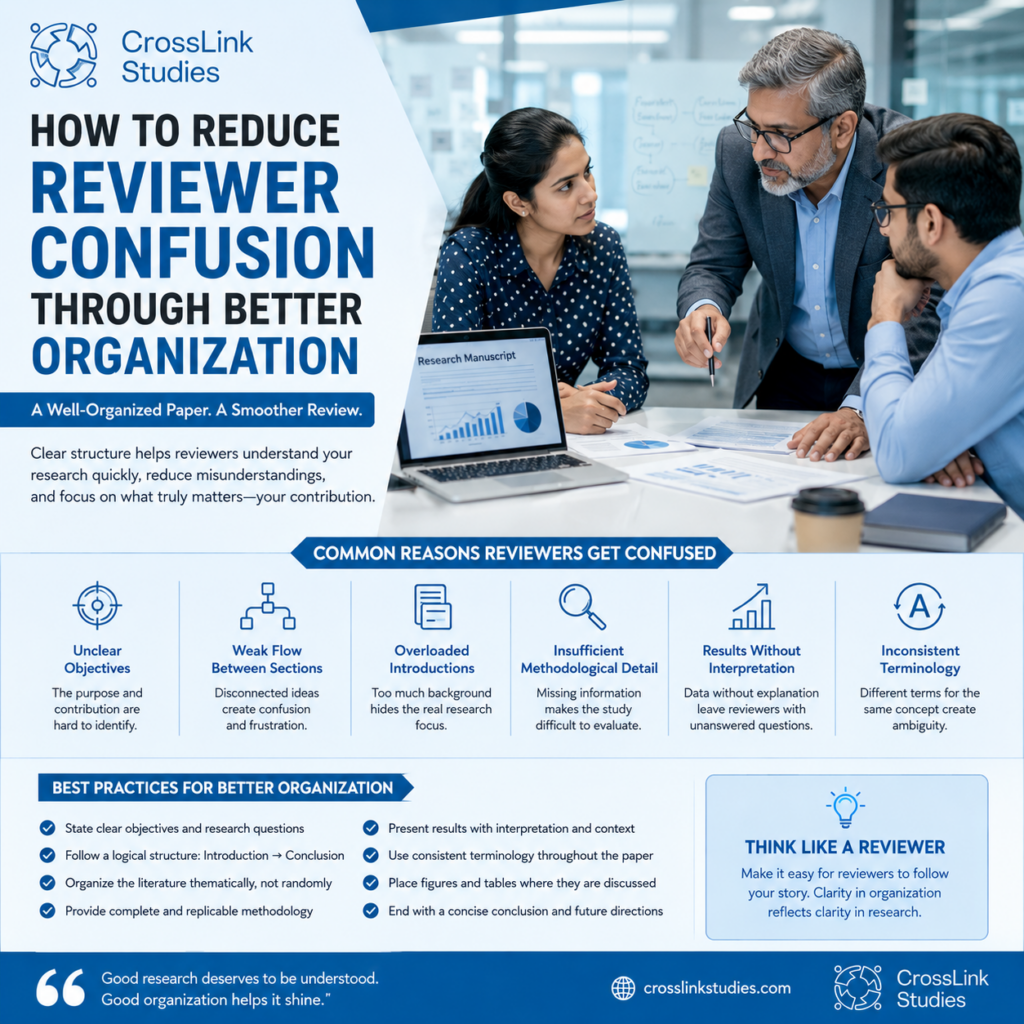
1. Unclear Research Objectives
One of the most common reviewer concerns is uncertainty about the purpose of the study. Many introductions provide extensive background information but fail to clearly explain:
- What problem is being addressed?
- Why is the problem important?
- What gap exists in current research?
- How does the study contribute?
Better Approach
By the end of the introduction, readers should clearly understand the research objective, the hypothesis or research question and the expected contribution. A concise statement of purpose provides a roadmap for the entire manuscript.
2. Weak Flow Between Sections
Reviewers often encounter manuscripts where sections appear disconnected. For example:
- The literature review discusses topics unrelated to the methodology.
- Results are presented before methods are fully explained.
- Conclusions introduce information not discussed previously.
Such inconsistencies force reviewers to repeatedly navigate between sections to understand the study.
Better Approach
Each section should naturally lead into the next:
Introduction → Literature Review → Methodology → Results → Discussion → Conclusion
This progression helps reviewers follow the research journey without interruption.
3. Overloaded Introductions
Many authors attempt to demonstrate expertise by including excessive background information. While context is important, lengthy introductions can obscure the main research objective.
Signs of an Overloaded Introduction
Multiple pages of historical background, extensive discussion unrelated to the study, excessive citations without analysis and delayed presentation of research objectives.
4. Poorly Structured Literature Reviews
A literature review should do more than summarize previous studies. Reviewer confusion often arises when authors present studies as isolated summaries rather than creating a coherent narrative.
Weak Structure
Study A found this.
Study B found that.
Study C reported something else.
This approach resembles a bibliography rather than a critical review.
Strong Structure
Group literature according to themes, methodologies, technologies and research trends. Then identify limitations and explain how the current study addresses them. This approach demonstrates critical thinking and establishes the rationale for the research.
5. Insufficient Methodological Detail
Reviewers cannot evaluate research they do not fully understand. Common issues include missing dataset descriptions, unclear experimental procedures and undefined variables.
Better Approach
Provide sufficient detail for replication. Ask a simple question:
“Could another researcher reproduce this study using only the information provided?”
If the answer is no, additional clarification is needed.
6. Results Without Interpretation
Many manuscripts present tables, graphs, and numerical findings without explaining their significance. Reviewers may then ask: Why do these results matter? How do they compare with previous studies? What insights do they provide?
7. Inconsistent Terminology
Reviewer confusion often results from inconsistent naming. For example, an author may refer to the same concept as smart system, intelligent platform and automated framework. Define terminology once and maintain consistency throughout the manuscript. Consistency improves readability and reduces ambiguity.
8. Poor Figure and Table Placement
Figures and tables should support the narrative, not interrupt it. Reviewers frequently encounter figures introduced without explanation and tables appearing before discussion and missing references within the text.
Better Approach
Follow a simple sequence:
- Introduce the figure or table.
- Present the figure or table.
- Interpret the findings.
This structure ensures that visual elements enhance understanding rather than create confusion.
9. Weak Section Headings
Generic headings often fail to guide readers through the manuscript.
Less Effective
- Results
- Discussion
- Analysis
More Informative
- Performance Evaluation of the Proposed Framework
- Comparative Analysis with Existing Methods
- Impact of Network Parameters on System Efficiency
Specific headings help reviewers navigate complex research more efficiently.
10. Conclusions That Introduce New Information
A conclusion should summarize and synthesize the study, not present new findings. Reviewers often question conclusions that introduce concepts not previously discussed.
Practical Strategies for Creating Reviewer-Friendly Manuscripts
Before submission, authors should evaluate their manuscript using the following checklist:
Clarity Checklist
✓ Is the research objective clearly stated?
✓ Does each section support the study objective?
✓ Are transitions between sections logical?
✓ Are figures and tables properly introduced and explained?
✓ Is terminology used consistently?
✓ Are findings interpreted rather than merely reported?
✓ Does the conclusion reflect the manuscript content?
✓ Can a reviewer understand the research without repeatedly searching for information?
The Reviewer’s Perspective
A useful exercise before submission is to read the manuscript from a reviewer’s perspective. Imagine opening the paper for the first time and asking:
- What problem is being solved?
- Why is it important?
- How was the study conducted?
- What was discovered?
- Why do the findings matter?
A well-structured paper guides reviewers through the research process, minimizes confusion, improves comprehension, and allows scientific contributions to be evaluated fairly. By prioritizing clarity, logical progression, and consistent organization, authors can reduce unnecessary revision requests and significantly improve their chances of publication success.