
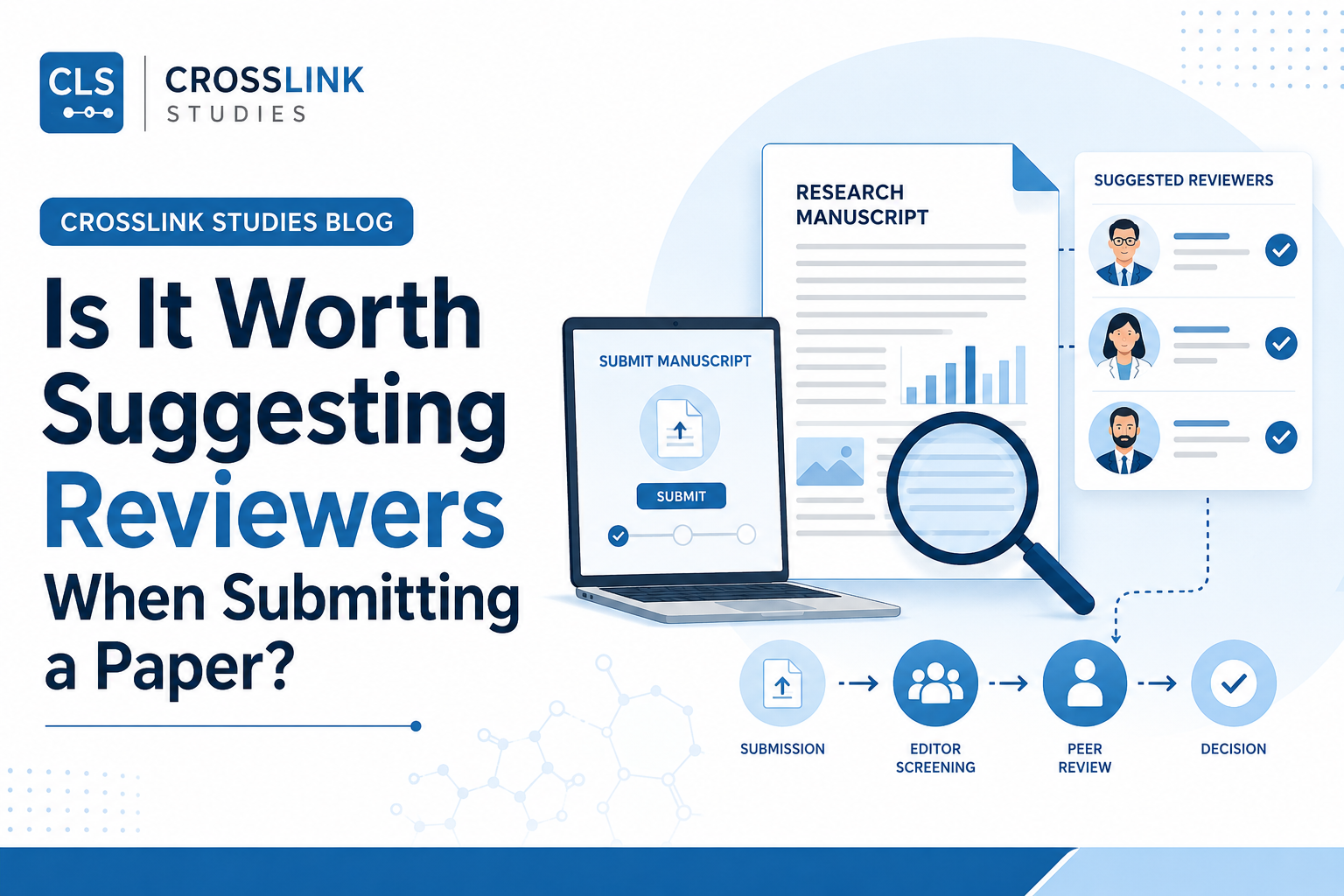
Is It Worth Suggesting Reviewers When Submitting a Paper?
When submitting a journal article, review article, or survey manuscript, authors are often asked to suggest potential reviewers. For many researchers, this step feels uncertain: Will suggested reviewers actually be used? Could suggesting reviewers look biased? Is it better to leave the decision entirely to the editor?
The short answer is: yes, it is worth suggesting reviewers—provided the suggestions are ethical, relevant, and transparent. Reviewer recommendations can help editors identify qualified experts, especially for highly specialized, interdisciplinary, or emerging research areas. However, authors should never treat reviewer suggestions as a way to influence the outcome of peer review.
At CrossLink Studies [CLS], authors may be invited to suggest suitable reviewers and request reviewer exclusions, provided these preferences do not compromise impartial and comprehensive evaluation. For the Ubiquitous Technology Journal submission process, authors are requested to suggest three potential reviewers, while the final reviewer selection remains under editorial control.
Why Journals Ask Authors to Suggest Reviewers
Editors manage many submissions across different domains, including computer science, software engineering, information systems, computer engineering, applied sciences, and emerging technologies. Even experienced editorial boards may need additional insight when a manuscript addresses a narrow technical problem, a new methodology, or a cross-domain research question.
Suggested reviewers can help editors:
- identify specialists who understand the manuscript’s technical depth;
- locate experts in emerging or niche research areas;
- reduce delays in finding available reviewers;
- improve the match between manuscript scope and reviewer expertise;
- build a broader and more diverse reviewer pool.
This does not mean the editor will automatically invite the suggested reviewers. Most journals reserve the right to accept, reject, or verify author recommendations. CLS also maintains editorial independence and a peer-review process conducted through autonomous editorial boards.
The Main Benefit: Better Expertise Matching
For advanced research manuscripts, reviewer expertise matters. A paper on federated learning security, blockchain-based healthcare systems, software defect prediction, edge intelligence, or formal verification may require reviewers with very specific technical backgrounds.
When authors suggest appropriate reviewers, they help the editor understand the research community surrounding the work. A strong reviewer suggestion tells the editor:
“This manuscript should be assessed by someone with expertise in this particular method, dataset, theoretical framework, or application domain.”
That can be especially useful for review and survey manuscripts, where the reviewer must evaluate not only technical correctness but also coverage, taxonomy, search strategy, synthesis quality, and contribution to the field.
The Risk: Conflicts of Interest
Reviewer suggestions become problematic when authors recommend people who may not be independent. A suggested reviewer should not be someone who has a personal, financial, institutional, or close professional relationship with the authors.
Avoid suggesting:
- current or recent co-authors;
- colleagues from the same institution;
- thesis supervisors, students, or close collaborators;
- project partners or grant collaborators;
- close personal contacts;
- researchers with known personal conflicts;
- competitors who may not be able to provide an impartial review.
COPE’s ethical guidance emphasizes that reviewers should disclose competing interests and avoid reviewing when conflicts may prevent fair and unbiased evaluation. CLS terms also prohibit manipulation of the review process and undisclosed conflicts.
What Makes a Good Reviewer Suggestion?
A strong reviewer recommendation is not just a name. It should demonstrate that the person is qualified, independent, and relevant to the manuscript.
A suitable suggested reviewer should have:
- recent publications in the manuscript’s research area;
- recognized expertise in the method, theory, or application domain;
- an institutional email address;
- no close relationship with the authors;
- no obvious conflict of interest;
- the ability to provide a fair, technical, and constructive evaluation.
For example, if your manuscript presents a new deep learning model for software vulnerability detection, a good reviewer might be a researcher who has published recent work on software security, machine learning for code analysis, or empirical software engineering—but who has not collaborated with your team.
Should You Suggest Well-Known Scholars?
Yes, but carefully. Senior researchers and highly cited scholars may be excellent choices, but they are often busy and may decline review invitations. It is usually better to suggest a balanced list that includes both established experts and active mid-career researchers who publish regularly in the topic area.
A useful strategy is to suggest reviewers who are:
- technically qualified;
- active in the field;
- independent from your research group;
- likely to understand the manuscript’s contribution;
- not so overcommitted that they are unlikely to respond.
Editors value reviewer suggestions that are realistic, not simply prestigious.
Should You Recommend Researchers You Cited?
Often, yes. Your reference list can be a good starting point because it identifies scholars working in the same area. However, do not suggest someone only because you cited them. Check whether their expertise matches the manuscript’s specific contribution.
For review and survey articles, consider suggesting experts from different subtopics covered in the manuscript. This can help ensure that the evaluation is balanced rather than dominated by one school of thought or methodology.
Can Suggested Reviewers Improve Acceptance Chances?
Reviewer suggestions should not be viewed as a shortcut to acceptance. A manuscript is accepted based on originality, methodological rigor, clarity, ethical compliance, technical contribution, and relevance to the journal’s scope.
However, appropriate reviewer suggestions may improve the quality of the review process. If the manuscript reaches reviewers with suitable expertise, the authors are more likely to receive informed, constructive, and technically meaningful feedback.
In that sense, suggesting reviewers can indirectly support a better publication journey—not by influencing the decision, but by helping the editor obtain fair and expert evaluation.
Best Practices for Authors
When suggesting reviewers, authors should follow four principles: relevance, independence, transparency, and professionalism.
Provide complete details where requested, including the reviewer’s full name, affiliation, institutional email, research area, and possibly a short reason for the recommendation. Do not use private email addresses unless journal guidelines allow them. Do not suggest fake identities, fabricated emails, or reviewers who cannot be verified.
A professional reviewer suggestion may look like this:
Suggested reviewer: Dr. [Name]
Affiliation: [University/Institution]
Email: [Institutional email]
Area of expertise: [Relevant research area]
Reason for suggestion: Dr. [Name] has recent publications on [topic/method] and is independent from the authors.
When Should You Oppose a Reviewer?
Some of CLS submission systems allow authors to identify reviewers who should be excluded. This should be used responsibly. It is appropriate when there is a real concern about conflict of interest, direct competition, personal dispute, or prior circumstances that may affect impartiality.
Do not oppose reviewers simply because they are rigorous, critical, or likely to challenge your work. Peer review is meant to test the strength of a manuscript.
Final Answer: Is It Worth It?
Yes. Suggesting reviewers is worth doing when the journal requests or permits it. It helps editors identify qualified experts, supports efficient peer review, and can improve the technical quality of feedback.
But reviewer suggestions must be made ethically. Authors should recommend independent experts—not friends, collaborators, or preferred evaluators. The editor remains responsible for selecting reviewers and safeguarding the fairness of the process.
For researchers submitting high-quality journal articles, reviews, and survey manuscripts, the best approach is simple:
Suggest reviewers who are knowledgeable enough to evaluate your work, independent enough to be fair, and professional enough to strengthen the peer-review process.