
Writing a Negative Result Paper That Still Contributes Knowledge
In academic publishing, researchers often associate successful research with statistically significant findings, improved model performance, or experimentally validated hypotheses. However, not all valuable research produces positive or expected outcomes. In many scientific and technological disciplines, negative results can provide equally important contributions by identifying limitations, disproving assumptions, exposing methodological weaknesses, and guiding future investigations toward more reliable directions.
Crosslink Studies journals like Ubiquitous Technology Journal (UTJ), emphasize originality, methodological rigor, analytical depth, and practical contribution rather than simply positive experimental results.
A well-written negative result paper does not present failure as weakness. Instead, it demonstrates scientific maturity, transparency, and critical insight that can strengthen the broader research ecosystem.
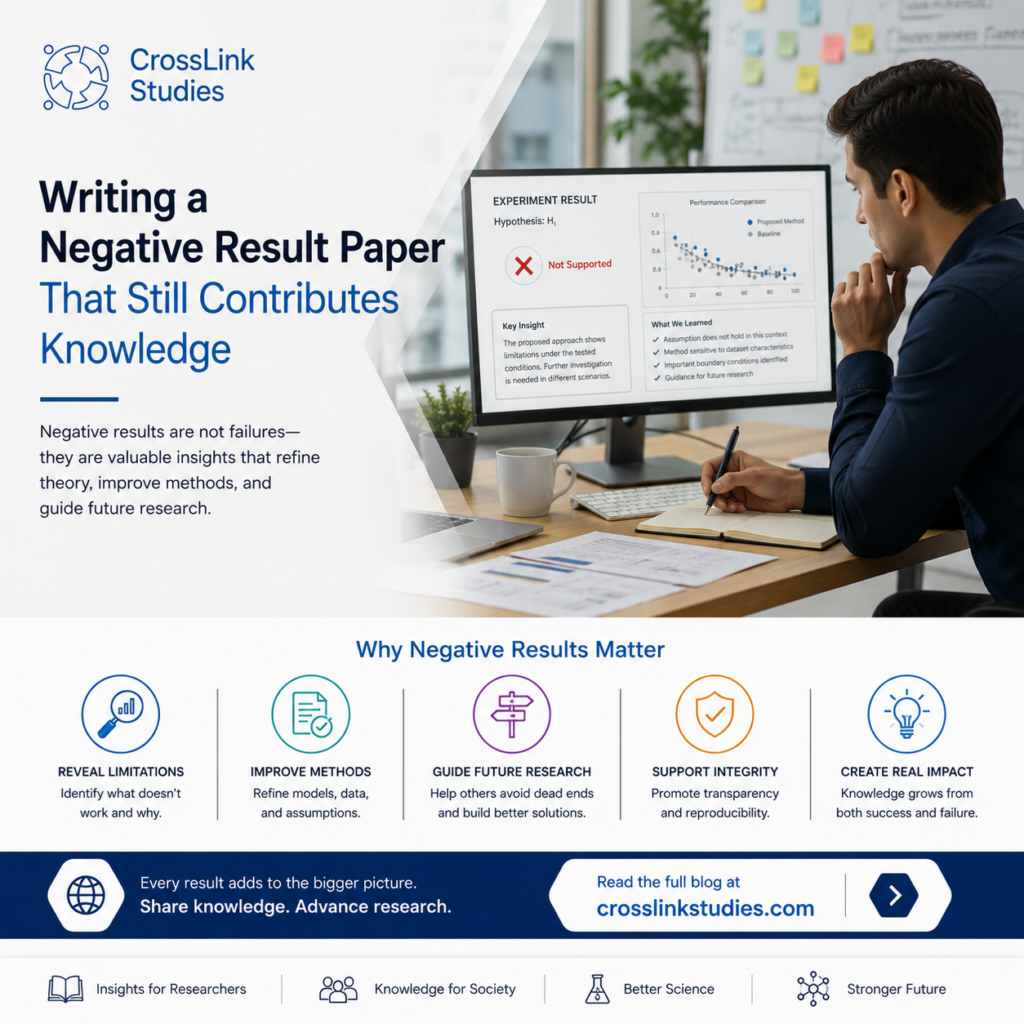
Understanding Negative Results in Research
Negative results occur when research outcomes do not support the original hypothesis, expected model behavior, or anticipated performance improvements. This may include machine learning models failing to outperform baseline systems, algorithms producing inconsistent results, smart system implementations not achieving predicted efficiency, or experimental frameworks generating statistically insignificant outcomes.
In technology and computing research, negative findings are especially valuable because they reveal real-world constraints that are often ignored in overly optimistic discussions.
Why Negative Result Papers Still Matter
One of the major problems in academic publishing is publication bias, where journals and researchers prioritize only positive findings. This creates an incomplete scientific record because unsuccessful experiments and contradictory outcomes remain unpublished.
As a result, ineffective methodologies continue being repeated, unrealistic expectations emerge around technologies, and research reproducibility becomes weaker. Negative result papers contribute knowledge by identifying limitations, refining theoretical assumptions, improving experimental transparency, and supporting evidence-based scientific progress.
In emerging technology fields such as artificial intelligence, ubiquitous computing, robotics, and intelligent systems, understanding what does notwork can be just as important as understanding what does.
Focus on Insight Rather Than Failure
A common mistake when writing negative result papers is framing the study purely around unsuccessful outcomes. High-quality academic writing instead focuses on theinsights generated through the research process. For example, instead of writing: “The proposed model failed to improve prediction accuracy.” a stronger scholarly approach would be: “Experimental findings indicate that the proposed model exhibits performance instability under sparse and heterogeneous datasets, highlighting important limitations in current optimization assumptions.”
This shifts the discussion from failure toward analytical contribution. Professional research writing should demonstrate:
- what was learned,
- why the outcome occurred,
- what limitations were identified,
- and how future studies can build upon the findings.
Structure the Paper Around Scientific Value
Negative result papers should maintain the same professional structure expected in UTJ clear research objectives, strong methodological design, transparent experimentation, critical analysis, and evidence-based discussion.
The methodological rigor of the study is often more important than whether the hypothesis was confirmed. Strong papers usually emphasize reproducibility, dataset limitations, experimental conditions and parameter sensitivity. For UTJ analytical interpretation carries substantial importance because it demonstrates the practical realities of implementing advanced systems in real-world environments.
Avoid Defensive or Apologetic Language
One weakness frequently observed in negative result discussions is overly defensive writing. Researchers sometimes attempt to justify or minimize negative findings instead of analyzing them objectively. Avoid phrases such as:
- “Unfortunately, the experiment failed.”
- “The results were disappointing.”
- “The model did not work properly.”
Professional academic writing maintains neutral and analytical language. Instead, use:
- “The findings reveal important operational constraints.”
- “The results highlight scalability limitations under dynamic conditions.”
- “Experimental evaluation demonstrates inconsistencies requiring further optimization.”
Emphasize Reproducibility and Transparency
Modern research increasingly values transparency and reproducibility, particularly in AI, machine learning, and ubiquitous computing research.
Negative result papers become highly impactful when they openly describe failed assumptions, document experimental settings clearly, provide reproducible methodologies, and discuss why expected outcomes were not achieved.
Transparent reporting strengthens scientific integrity and enables future researchers to improve upon existing limitations rather than unknowingly repeating them.This is especially important in computational research environments where reproducibility challenges remain widespread.
Connect Findings with Future Research Directions
A strong negative result paper should not end with failure. Instead, it should identify future optimization opportunities, alternative methodological pathways, revised theoretical assumptions, or emerging research questions.
The Importance of Negative Results in Emerging Technologies
In rapidly evolving technological domains, unrealistic expectations often dominate academic and industrial discussions. Publishing negative findings helps create a more balanced and evidence-based understanding of emerging technologies.
This is particularly important in areas such as artificial intelligence, autonomous systems, smart healthcare, cybersecurity, block chain, edge computing, and Internet of Things (IoT) architectures.
Without transparent reporting of limitations and failed implementations, technological progress becomes distorted by selective success narratives. Responsible innovation requires acknowledging both technological strengths and operational weaknesses.
Negative findings help strengthen scientific integrity by exposing limitations, refining methodologies, improving reproducibility, and guiding future innovation toward more reliable solutions. In technology and ubiquitous computing research, these contributions are essential for developing realistic, transparent, and evidence-based advancements.
For researchers contributing to UTJ and emerging technology platforms, the goal should not be to avoid negative outcomes, but to transform them into meaningful scientific knowledge that advances the field responsibly and constructively.