
IEEE Reference Style: Frequent Mistakes and Fixes
Why Accurate Referencing Matters
References are more than a formal requirement in scholarly publishing. They demonstrate the foundation of a study, acknowledge prior contributions, support scientific claims, and enable readers to verify information independently. In engineering, computer science, information technology, and related disciplines, IEEE style remains one of the most widely adopted citation formats.
Despite its widespread use, many manuscripts submitted to journals and conferences contain referencing errors that can delay peer review, require extensive revisions, or negatively affect the perceived quality of the work. Understanding the most common mistakes can help researchers prepare cleaner, more professional submissions.
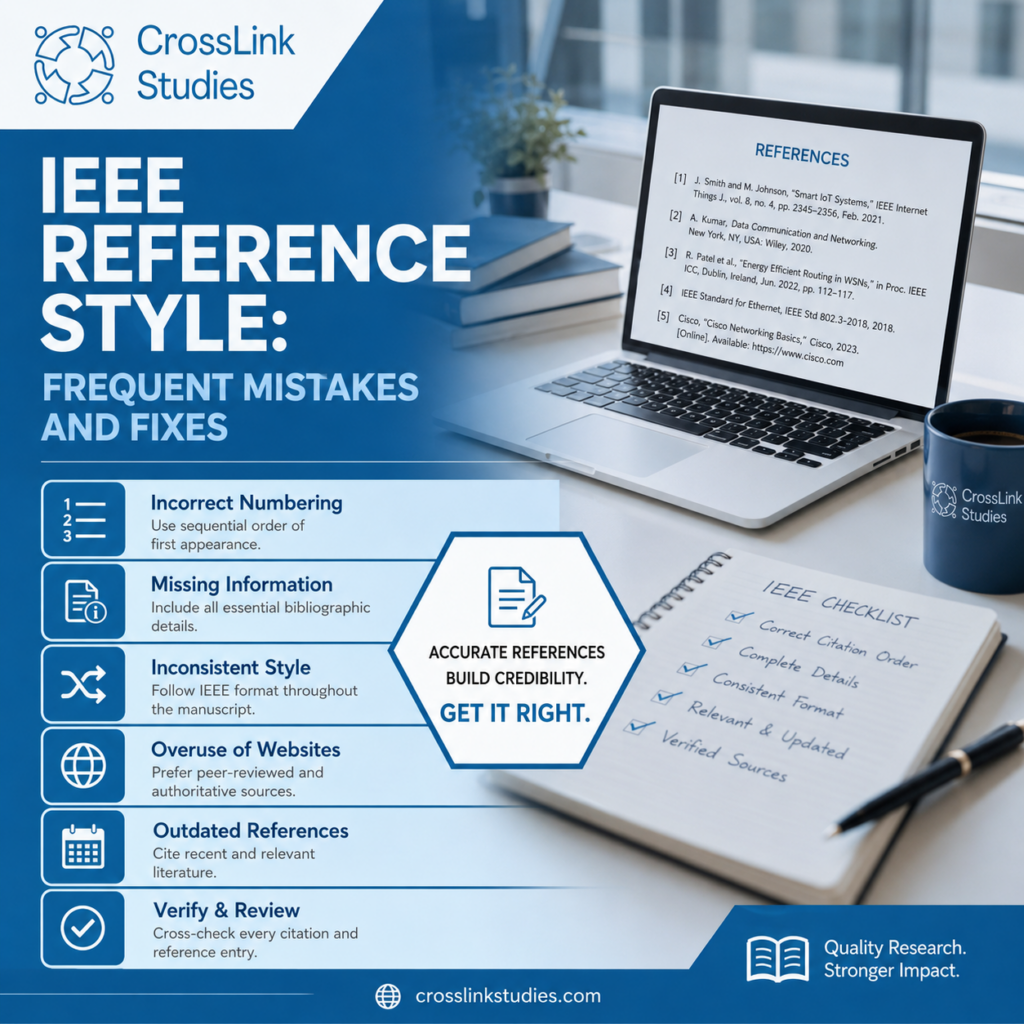
Common IEEE Referencing Mistakes
1. Inconsistent Citation Numbering
One of the most frequent errors is assigning citation numbers incorrectly. IEEE uses a numerical system where references are numbered according to the order of first appearance in the text.
Incorrect:
A source cited first in the introduction appears as [8].
Correct:
The first cited source should be [1], followed by [2], [3], and so forth.
Authors should verify numbering carefully after adding or removing references during manuscript revisions.
2. Missing Essential Bibliographic Information
References often lack important details such as page numbers, volume numbers, publication year, DOI, publisher information, or conference location.
Fix:
Ensure that every reference contains all required elements according to the source type, whether it is a journal article, conference paper, book, technical report, or online resource.
3. Mixing Citation Styles
Researchers sometimes combine IEEE formatting with APA, Harvard, or Vancouver conventions.
Incorrect:
(Smith, 2023)
Correct:
[5]
Consistency is essential. A manuscript should follow a single citation style throughout.
4. Overreliance on Websites
Web resources can be useful, but excessive dependence on websites instead of peer-reviewed literature may weaken academic credibility.
Fix:
Prioritize high-quality journal articles, conference proceedings, standards, and authoritative technical publications. Use websites primarily for official documentation or factual verification.
5. Outdated References
Technology evolves rapidly. Excessive reliance on old literature may suggest insufficient awareness of recent developments.
Fix:
Include current and relevant studies while retaining foundational references that remain influential in the field.
6. Incorrect Author Names and Titles
Misspelled author names, incomplete titles, or formatting inconsistencies are surprisingly common.
Fix:
Cross-check every reference against the original publication source before submission.
7. Citing Sources Not Included in the Reference List
Some manuscripts contain citation numbers within the text that do not appear in the bibliography.
Fix:
Perform a final audit to ensure that every in-text citation has a matching reference entry and vice versa.
Practical Strategies for Error-Free References
Researchers can significantly reduce referencing mistakes by:
- Using reference management software consistently.
- Importing citation data directly from trusted databases.
- Reviewing IEEE formatting requirements before submission.
- Checking reference numbering after each major revision.
- Verifying DOI information whenever available.
- Conducting a final reference audit prior to manuscript submission.
The Editorial Perspective
Reviewers and editors often notice referencing quality early in the evaluation process. Well-structured references indicate attention to detail, scholarly rigor, and familiarity with disciplinary standards. Conversely, citation inconsistencies can create unnecessary concerns about manuscript preparation and overall research quality.
Accurate referencing may appear to be a small component of a manuscript, but it contributes substantially to professionalism, credibility, and publication readiness. IEEE referencing is straightforward when applied consistently, yet small errors can accumulate and affect the presentation of otherwise strong research. By avoiding common mistakes such as incorrect numbering, incomplete bibliographic information, mixed citation styles, and outdated sources, authors can improve manuscript quality and facilitate a smoother peer-review process. Careful attention to references reflects the same scholarly discipline expected throughout the research itself.