
Writing a Title Under Ten Words Without Losing Technical Precision
A research title is often the first and sometimes only element readers see. In highly competitive academic environments, an effective title must be concise, precise, and informative.
Top journals increasingly favor titles that are short yet technically accurate, enabling faster discovery, better indexing, and stronger reader engagement. For Ubiquitous Technology Journal (UTJ), a well-crafted title plays a critical role in communicating the essence of research clearly and efficiently.
Why Short Titles Matter
A concise title improves search visibility in databases and indexing systems, reader engagement and click-through rates and clarity of contribution. Short titles reduce cognitive load, allowing readers to quickly grasp the core idea of the paper.
The Challenge: Brevity vs. Precision
Shortening a title often risks losing important technical details, becoming vague or overly generic and misrepresenting the scope of the study. The goal is not just brevity but meaningful brevity.
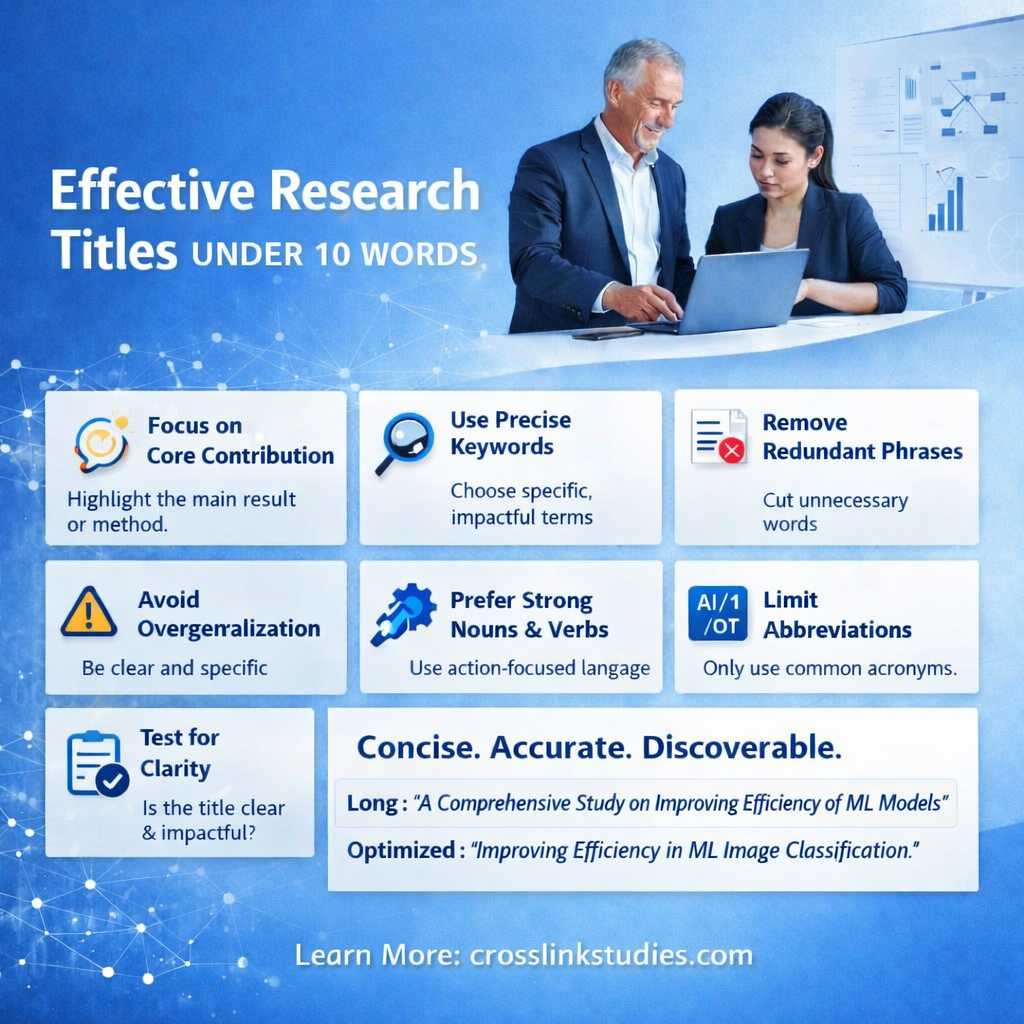
Principles for Writing Titles Under Ten Words
Focus on the Core Contribution
Identify the single most important element of your work a method, a result and a concept. Avoid trying to include everything. A strong title communicates one clear message.
Use Specific, High-Impact Keywords
Choose terms that are recognizable within your field, relevant for indexing and search and technically meaningful. For example, instead of “system,” use “neural network,” “optimization model,” or “block chain framework.”
Eliminate Redundant Words
Remove unnecessary phrases such as: “A study of”, “An analysis of”, “Investigation into”. These add length without adding value. Precision improves when every word contributes meaning.
Avoid Overgeneralization
Short titles should not become vague.
❌ “Improving Performance in Systems”
✔ “Optimizing Neural Network Inference Speed”
Clarity comes from specificity, not length.
Prefer Strong Nouns and Verbs
Use words that convey action and substance:
- “Enhancing,” “Predicting,” “Modeling”
- “Framework,” “Algorithm,” “Dataset”
Strong wording increases both impact and readability.
Limit the Use of Abbreviations
While abbreviations save space, they can reduce clarity for broader audiences, limit discoverability. Use only widely recognized terms (e.g., AI, IoT) when necessary.
Structure for Clarity
Common effective formats include:
- Method + Application
“Deep Learning for Medical Image Segmentation” - Problem + Solution
“Reducing Energy Consumption in Edge Computing”
A clear structure ensures the title remains informative even when brief.
Test for Readability and Meaning
Ask:
- Can a reader understand the contribution in seconds?
- Does the title reflect the main result or method?
- Is anything essential missing?
If the answer is yes, the title achieves precision within brevity.
Examples: Long vs. Optimized Titles
Original:
“A Comprehensive Study on Improving the Efficiency of Machine Learning Models for Image Classification Tasks”
Optimized (Under 10 Words):
“Improving Efficiency in Machine Learning Image Classification”
Original:
“An Investigation into Block chain-Based Secure Data Sharing Systems in Healthcare”
Optimized (Under 10 Words):
“Block chain-Based Secure Healthcare Data Sharing”
Common Mistakes to Avoid
- Overloading the title with multiple concepts
- Using vague or generic language
- Including unnecessary background context
- Relying heavily on abbreviations
- Sacrificing clarity for brevity
These reduce the effectiveness and discoverability of your work.
At Ubiquitous Technology Journal (UTJ), we encourage authors to craft titles that are concise yet technically precise, aligned with the core contribution and optimized for visibility and indexing. A strong title enhances not only readability but also the impact and reach of your research, especially in fast-moving fields like AI and interdisciplinary science. In modern academic publishing, the most effective titles are those that communicate maximum value with minimum words.