

Revising Figures and Tables After Reviewer Feedback
Figures and tables are not simply supporting elements placed around the main text. In a research article, they are part of the evidence through which readers understand methods, results, comparisons, trends, and relationships. A well-designed table can make a complex set of results immediately accessible, while an appropriately constructed figure can reveal a pattern that is difficult to communicate through prose alone.
For this reason, reviewer comments concerning figures and tables should not be treated as minor formatting requests. A reviewer who asks for a clearer figure, a revised table, additional statistical information, or removal of redundant results may be identifying a problem with how the research evidence is being communicated.
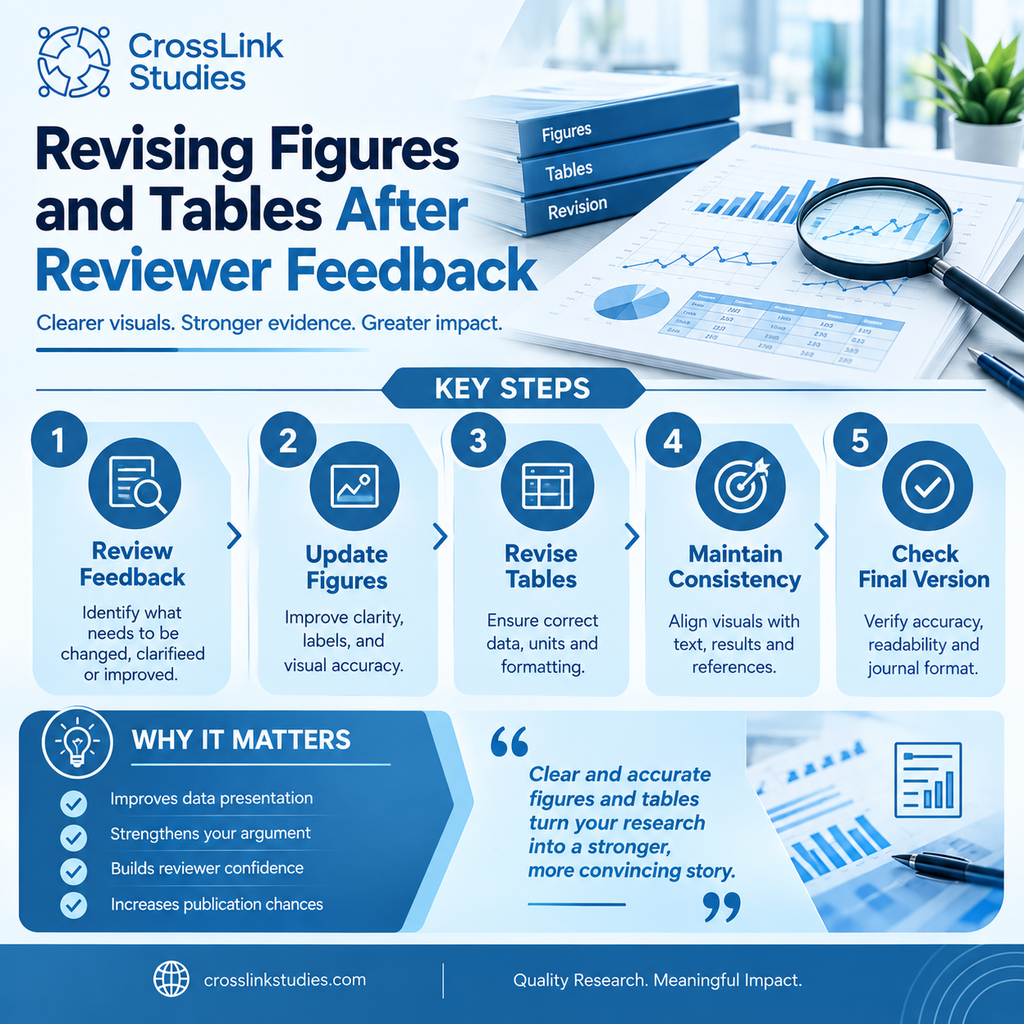
Why Reviewers Pay Attention to Figures and Tables
Reviewers often use figures and tables to assess whether the results are presented logically and whether the evidence supports the manuscript’s claims. A reviewer may identify issues such as:
- A figure is difficult to read or contains excessively small labels.
- A table contains unnecessary columns or repeated information.
- Results described in the text do not match the values in a table.
- A figure does not clearly communicate the pattern discussed in the manuscript.
- Statistical significance indicators are not explained.
- Units, variable names, or abbreviations are inconsistent.
- A visual contains information that is not discussed anywhere in the manuscript.
- The same result is presented unnecessarily in both a table and a figure.
- A figure or table adapted from another source lacks appropriate attribution or permission.
Start By Classifying the Reviewer’s Comment
Before changing a figure or table, determine what type of problem the reviewer has identified.
Technical Problems
These include incorrect values, missing observations, incorrect labels, inconsistent units, statistical errors, or an inappropriate graphical representation. Such issues should be corrected carefully and verified against the underlying analysis.
Presentation Problems
A reviewer may understand the results but find the visual difficult to interpret. The solution could involve improving font size, spacing, labels, legends, table organization, or caption wording.
Analytical Problems
Sometimes a request for a new table or figure reflects a deeper analytical concern.
For example, a reviewer may ask authors to show subgroup results, confidence intervals, robustness estimates, or comparative performance. In such cases, simply changing the formatting is not enough. The underlying analysis may need to be revisited.
Redundancy Problems
A reviewer may determine that a table and figure communicate essentially the same information. Authors should then decide which format communicates the evidence more effectively rather than retaining both simply because they were included in the original manuscript. UTJ specifically advises authors to avoid repeating results unnecessarily across figures and tables and asks that the Results and Discussion section present findings in a simple and straightforward manner.
Do not change a figure without checking the data
One of the most important rules during revision is to return to the original data or analysis before making substantive changes. Suppose a reviewer writes that Figure 4 contains an unexpected trend. The appropriate response is not to redraw the graph until it looks more consistent with the discussion.
Instead:
- Return to the underlying dataset.
- Reproduce the relevant analysis.
- Check the calculations.
- Confirm whether the original figure was generated correctly.
- Determine whether the reviewer has identified an actual error or simply a point requiring explanation.
- Revise the figure only after the underlying evidence has been verified.
Improving Figures After Reviewer Feedback
When a reviewer requests a clearer figure, focus on scientific communication rather than decoration.
Improve Readability
Check:
- Font size
- Axis labels
- Legend size
- Line thickness
- Data-point visibility
- Contrast
- Units
- Abbreviations
- Decimal formatting
Make The Caption Self-Explanatory
A caption should help readers understand what the figure represents without forcing them to search through several paragraphs of the manuscript. Depending on the study, the caption may need to identify:
- What is being measured
- The study population or dataset
- The relevant period
- Experimental conditions
- Panel definitions
- Abbreviations
- Important statistical notation
Revising Tables for Clarity and Precision
Tables often accumulate information during manuscript development. Authors may initially include many variables, models, specifications, or descriptive statistics and then leave the structure unchanged throughout revision. Reviewer feedback provides an opportunity to reconsider whether every element is necessary. A strong revised table should have:
- A descriptive title or caption
- Clear column headings
- Consistent terminology
- Appropriate units
- Logical ordering
- Clearly explained statistical notation
- Consistent decimal places
- Necessary notes or footnotes
Check Consistency Across the entire Manuscript
One of the most overlooked aspects of revision is consistency. After changing a figure or table, search the manuscript for every place where it is discussed. Check that:
- Figure and table numbers remain correct.
- Cross-references point to the correct item.
- Numerical values match the revised analysis.
- Variable names are identical.
- Statistical significance is reported consistently.
- Captions correspond to the actual content.
- The Results section reflects the revised visual.
- The Discussion does not continue interpreting a result that was removed.
Do Not Present the Same Evidence Twice Without a Reason
A common revision problem is retaining both a table and a figure that communicate exactly the same result. Tables are generally useful when readers need precise values, multiple variables, statistical estimates, or detailed comparisons. Figures are often more effective when the objective is to communicate:
- Trends
- Relationships
- Distributions
- Comparisons
- Temporal changes
- Model performance
- Conceptual structures
Responding to A Reviewer Who Requests a New Figure Or Table
When a reviewer requests an additional visual, first determine what question the new element is intended to answer. For example, instead of responding simply:
“A new figure has been added.”
Explain what was added and why.
This is especially important for UTJ revised submissions. The journal requires a Review Accommodation Report containing the original reviewer comment, the author’s response, a detailed description of the revision, and the exact location of the change, including the relevant table or figure where applicable.
What If You Disagree with The Reviewer?
Not every reviewer recommendation needs to be implemented exactly as written. A reviewer may request a figure that does not provide meaningful additional information, or may recommend converting a table into a figure even though the table is more appropriate for the type of evidence being presented. In such cases, do not simply ignore the request. Explain the scientific reasoning.
Recheck Sources and Permissions
Reviewer revisions can sometimes introduce a new issue: authors may add an external figure, reproduce an existing table, or adapt material from another publication.
This requires careful attention to attribution and permissions. UTJ requires figures or tables taken from another article to be fully cited. More broadly, publishers emphasize that authors are responsible for obtaining the necessary permissions when copyrighted material is reproduced.
Whenever possible, authors should create original visualizations from their own data. When adaptation or reproduction is necessary, the source and permission requirements should be checked before resubmission.
Use The Revision Stage to Improve Scientific Communication
The most valuable figure and table revisions are not necessarily the most visually dramatic. A small change such as correcting an axis label, adding confidence intervals, explaining an abbreviation, removing an unnecessary column, or reorganizing a table can substantially improve how readers interpret the evidence. Similarly, a reviewer request for an additional visualization may reveal that an important result is buried within the manuscript. Authors should therefore ask three questions for every visual:
Is it accurate?
Is it necessary?
Is it easy to interpret?
If the answer to all three is yes, the visual is serving its purpose.
Final Pre-Resubmission Checklist
Before submitting a revised manuscript, conduct a dedicated figures-and-tables audit.
Figures
- Are all figures numbered sequentially?
- Is every figure cited in the text?
- Are captions complete and accurate?
- Are labels, units, and legends readable?
- Do the displayed values match the analysis?
- Are statistical symbols and abbreviations explained?
- Are externally sourced figures properly attributed?
Tables
- Are all tables numbered sequentially?
- Are column headings clear?
- Are unnecessary columns removed?
- Are numerical values consistent with the text?
- Are significance indicators explained?
- Are units and abbreviations defined?
- Does the table provide information that is not unnecessarily duplicated elsewhere?
Revised Files
Finally, check all versions of the manuscript. UTJ currently requires a Clean Revised Manuscript, a Trackable Revised Manuscript, and a completed Review Accommodation Report. The clean manuscript should contain the final revised figures and tables without revision markings, while the trackable version should make substantive revisions identifiable. The three files must remain consistent.